
Ankle Ligament Injuries: Causes, Symptoms and Treatment Options
Written and medically reviewed by
Dr Dinesh Sirisena
Consultant in Sports, Exercise & Musculoskeletal Medicine
Triaxis Sports & Joint Clinic
Ankle ligament injuries commonly occur when the ankle rolls or twists beyond its normal range, stretching or tearing one or more ligaments. Pain, swelling, bruising and difficulty walking are common. Most ankle sprains are managed without surgery. Diagnostic ultrasound can assess the injured ligaments, often at the first visit, and a structured rehabilitation programme of strength and balance training is the foundation of recovery and reduces the risk of re-spraining. For partial ligament tears, and for pain or instability that persists, ultrasound-guided platelet-rich plasma (PRP) or prolotherapy can be added to support ligament healing and a return to sport.
What is an ankle ligament injury?
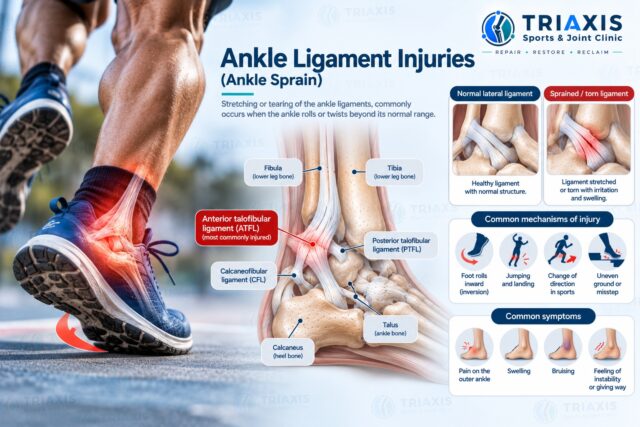
An ankle ligament injury occurs when one or more ligaments that stabilise the ankle are stretched or torn. The most common type is a lateral ankle sprain, affecting ligaments on the outside of the ankle after the foot rolls inward. Injuries can range from mild sprain to a more significant ligament tear.
The ankle joint is formed mainly by the tibia and fibula of the lower leg meeting the talus bone.
Ligaments connect bone to bone and help control excessive movement. The main lateral ankle ligaments include:
- Anterior talofibular ligament (ATFL)
- Calcaneofibular ligament (CFL)
- Posterior talofibular ligament (PTFL)
The ATFL is the ligament most commonly involved in lateral ankle sprains.
Ligaments on the inside of the ankle form the deltoid ligament complex. A different group of ligaments between the tibia and fibula can be injured in a high ankle sprain, also called a syndesmotic injury.
Several tendons, muscles and nerves also pass around the ankle, so not every case of ankle pain is caused by ligament injury.
What does an ankle ligament injury feel like?
An ankle ligament injury commonly causes pain around the injured side of the ankle, together with swelling and tenderness. Bruises may develop over the following hours or days. More significant injuries can make walking difficult or create a feeling that the ankle is unstable or gives way.
Symptoms may include:
- Outer or inner ankle pain
- Swelling
- Bruising
- Tenderness
- Reduced ankle movement
- Pain when bearing weight
- Difficulty walking
- Instability or giving way
The amount of swelling or bruising does not always indicate the exact severity of ligament damage. Fractures, tendon injuries and joint injuries can also cause similar symptoms.
How do ankle ligament injuries happen?
Ankle ligament injuries often happen when the foot rolls unexpectedly during walking, running, landing or changing direction. Lateral ankle sprains commonly occur when the foot turns inward, placing stress on the outer ankle ligaments. Sports involving jumping, cutting and unpredictable changes of direction can increase exposure to this mechanism.
Common situations include:
- Landing awkwardly after a jump
- Stepping on another player’s foot
- Rapidly changing direction
- Running on uneven ground
- Missing a step or kerb
- Losing balance during everyday activity
Relevant sports include football and futsal, basketball, rugby, badminton, tennis, pickleball, padel, running and trail running.
Previous ankle sprains are also relevant because some people experience recurrent sprains or ongoing instability after the initial injury.
Can ankle ligaments heal without surgery?
Yes. Most lateral ankle sprains heal well without surgery. Early management involves protection, appropriate weight-bearing and gradually restoring movement. Rehabilitation then focuses on strength, balance, coordination and ankle control, usually with a physiotherapist. Where pain or a feeling of looseness persists, ultrasound-guided treatments such as PRP or prolotherapy can be added to support ligament healing.
Rehabilitation may include:
- Restoring ankle movement
- Calf and lower-leg strengthening
- Balance exercises
- Single-leg control
- Progressive walking and running
- Jumping and landing exercises
- Change-of-direction training
- Sport-specific rehabilitation
- Ultrasound-guided PRP or prolotherapy where recovery is slower than expected
Bracing or taping may also be helpful, particularly when returning to activities with a higher risk of re-spraining. A review of 14 randomised trials involving 2,182 people found that exercise-based rehabilitation significantly reduced the risk of re-spraining at 12 months compared with usual care [1], and an overview of systematic reviews found strong evidence for bracing and moderate evidence for balance and neuromuscular training in preventing recurrence [2].
How long does an ankle ligament injury take to recover?
Recovery depends on the severity and type of ligament injury, previous ankle problems, activity requirements and rehabilitation progress. A mild sprain and a more significant ligament injury should not be expected to recover at the same rate. Return to sport should therefore be based on function as well as time.
Useful markers can include:
- Minimal swelling
- Comfortable walking
- Restored ankle movement
- Improved strength
- Good single-leg balance
- Running tolerance
- Jumping and landing control
- Change-of-direction ability
Being able to walk normally does not automatically mean the ankle is ready for football, basketball or another high-demand sport.
Why does my ankle keep giving way after a sprain?
Repeated giving way can occur when ankle stability, strength, balance or movement control has not fully recovered after an earlier sprain. Some people develop chronic ankle instability, where recurrent instability continues after the initial injury. Previous ankle sprains are therefore an important part of the clinical assessment.
Symptoms can include:
- Repeated ankle rolling
- Feeling unstable on uneven surfaces
- Reduced confidence during sport
- Recurrent swelling
- Difficulty with cutting or landing
- Repeated sprains
Rehabilitation after the first injury is important because treatment is not only about reducing pain and swelling. Restoring strength, balance and movement control can also form part of reducing future injury risk.
Where the ligaments remain lax or stretched after a sprain, prolotherapy can help. In a randomised placebo-controlled trial of 114 people with chronic ankle instability, dextrose prolotherapy injections into the anterior talofibular ligament improved dynamic balance and reduced the risk of further sprains over one year compared with saline injections.
Can ultrasound diagnose an ankle ligament injury, and when is MRI needed?
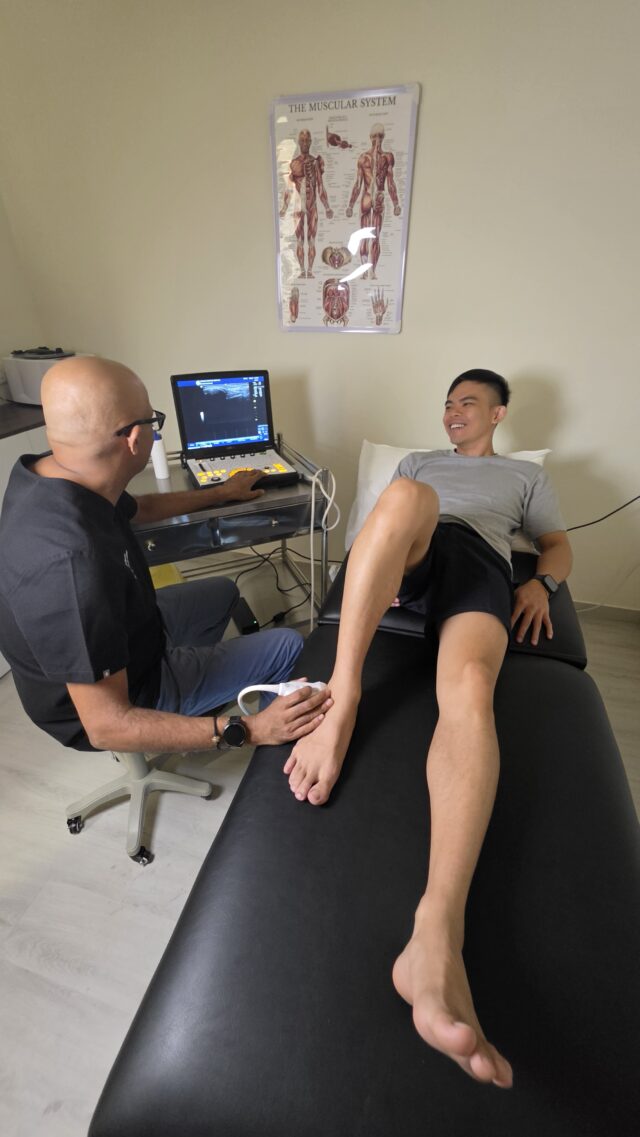
Yes, in experienced hands. High-resolution ultrasound may be useful, alongside clinical assessment, for examining the outer ankle ligaments, and can assess the ligaments while the ankle is gently moved, often at the same visit. X-rays are useful when a fracture is suspected, and MRI is valuable for checking cartilage, bone and deeper structures in more complex injuries.
X-ray: may be considered following trauma when clinical findings suggest a possible fracture or other bone injury.
MRI: can assess ligaments, tendons, cartilage, bone and other deeper structures. It may be useful for persistent symptoms or more complex injuries.
Musculoskeletal ultrasound provides real-time images of the ankle ligaments and nearby tendons. A 2026 meta-analysis of 10 studies found ultrasound detected anterior talofibular ligament (ATFL) injuries with 95% sensitivity and 91% specificity, and a separate meta-analysis found ultrasound was more sensitive than MRI for ATFL tears. Ultrasound can also be repeated to monitor healing and is used to guide injections precisely.
| Test | What it shows | When it may be useful |
| Ultrasound | ATFL, CFL and high ankle ligaments, nearby tendons, swelling; can assess movement | Alongside examination to assess ligament injury, monitor healing and guide injections |
| MRI | Ligaments, cartilage, bone and deeper structures | Complex injuries, suspected cartilage or bone injury, or persistent symptoms |
| X-ray | Bones only | Suspected fracture after significant trauma |
Imaging findings should always be interpreted together with symptoms and examination findings.
What non-surgical treatments can help ankle ligament injuries?
Treatment depends on the ligament involved, the severity of injury, symptoms and activity demands. Most ankle sprains recover well with appropriate loading and progressive rehabilitation. When pain, swelling or a feeling of instability persists, ultrasound-guided treatments can be added to support ligament healing and help you return to sport. Injuries involving fractures or cartilage may need further assessment.
Management includes education, temporary activity modification, appropriate support or bracing, progressive exercise and, where recovery is slower than expected, ultrasound-guided treatments performed under ultrasound guidance.
Platelet-rich plasma (PRP)
PRP is prepared from a small sample of your own blood and concentrated to contain growth factors involved in tissue repair, then injected precisely into the injured part of the ligament under ultrasound guidance. This makes it well suited to partial ligament tears, where the ligament is still intact but damaged and can be supported to heal. A 2025 systematic review found that PRP after an acute ankle sprain provided better short-term pain relief and function and an earlier return to sport than standard care, with no reported adverse events [5]. In a 2026 randomised trial of athletes with acute ankle sprains, those who received PRP returned to unrestricted sport sooner than those receiving standard treatment alone (median 14.5 versus 17.8 weeks) [6]. PRP is also used for chronic ankle instability, where a series of 47 patients showed marked improvements in stability and function scores at three months [7].
Prolotherapy
Prolotherapy uses a dextrose (sugar) solution injected into the stretched or partially torn ligament to stimulate a healing response. It can help partial ligament tears that are slow to recover, and is particularly useful where ligament laxity contributes to ongoing pain or giving way. In a randomised placebo-controlled trial of 114 people with chronic ankle instability, a course of dextrose injections into the ATFL improved balance and reduced re-sprains over 12 months [8].
Ultrasound-guided injections
After a sprain, some people develop irritation inside or around the ankle joint, such as soft-tissue impingement at the front of the ankle. A targeted ultrasound-guided injection can settle this irritation so that rehabilitation can progress comfortably.
Nerve hydrodissection
Small nerves on the outside of the ankle, such as the superficial peroneal nerve, can be stretched during a sprain and cause lingering burning or tingling pain. Ultrasound-guided hydrodissection uses fluid to free an irritated nerve from surrounding scar tissue.
| Treatment | What it involves | When it may be considered |
| Rehabilitation | Progressive strength, balance and movement training | All ankle sprains; the foundation of recovery |
| Bracing or taping | External support for the ankle | Early recovery and returning to higher-risk sport |
| PRP | Your own concentrated platelets injected into the ligament | Partial ligament tears; acute sprains in athletes; persistent pain or instability |
| Prolotherapy | Dextrose injected into the stretched or partially torn ligament | Partial ligament tears, ligament laxity, recurrent sprains or giving way |
| Ultrasound-guided injection | Targeted injection of an irritated joint or soft tissue | Impingement or joint irritation limiting rehabilitation |
| Hydrodissection | Fluid used to free an irritated nerve | Burning or tingling nerve pain after a sprain |
When should I seek medical assessment after an ankle injury?
Consider medical assessment when you cannot comfortably bear weight, have marked swelling or bruising, experience significant tenderness after trauma, or the ankle feels persistently unstable. Assessment may also be useful when symptoms are not improving as expected or repeated sprains interfere with sport or everyday activity.
Seek timely assessment for:
- Inability to bear weight
- Significant deformity
- Severe or increasing pain
- Marked swelling after trauma
- Numbness or unusual weakness
- Persistent instability
- Repeated ankle sprains
- Pain that does not improve as expected
A fracture or more complex ankle injury can sometimes initially resemble a sprain.
How are ankle ligament injuries assessed at Triaxis Sports & Joint Clinic?
Assessment at Triaxis Sports & Joint Clinic focuses on identifying which ankle structures may be injured and how the injury affects movement, stability and function. The clinical assessment may consider the injury mechanism, pain location, swelling, ligament stability, ankle movement, strength, balance and the demands of work or sport.
Where appropriate, assessment includes Sports Medicine and Musculoskeletal Medicine evaluation, functional testing, same-visit diagnostic ultrasound of the ankle ligaments, review of existing imaging, rehabilitation planning coordinated with physiotherapy, and ultrasound-guided treatments where recovery is slower than expected.
Patient education and shared decision-making are used to discuss management options and whether further imaging or assessment is needed.
Frequently Asked Questions About Ankle Ligament Injuries
How do I know if I have torn an ankle ligament?
Pain, swelling, bruising and tenderness after rolling the ankle can suggest a ligament injury, but symptoms alone cannot determine whether the ligament is stretched, partially torn or more extensively injured. Clinical examination assesses tenderness, movement and stability. Imaging may be considered when the diagnosis is uncertain or another injury is suspected.
Can I walk with a torn ankle ligament?
Some people can walk with an ankle ligament injury, particularly milder sprain. More significant injuries may make weight-bearing difficult. Being able to walk does not rule out a ligament tear. If walking is very painful after trauma or you cannot take weight through the ankle, assessment may be appropriate to exclude a fracture or other injury.
What is the difference between a sprain and a torn ligament?
An ankle sprain means that a ligament has been injured. The injury can range from stretching and microscopic damage to a partial or complete tear. Therefore, a ligament tear is a type of sprain rather than a completely separate condition. Partial tears are well suited to non-surgical care, and where recovery is slow, ultrasound-guided PRP or prolotherapy can help support ligament healing.
What is a high ankle sprain?
A high ankle sprain affects the syndesmotic ligaments connecting the tibia and fibula above the ankle joint. It differs from the more common lateral sprain involving the ligaments on the outside of the ankle. The injury mechanism and recovery can differ, so suspected high ankle sprains may require specific clinical assessment.
Should I wear an ankle brace after a sprain?
An ankle brace may be useful for selected patients during early recovery or when returning to activities that involve jumping and changing direction. However, bracing should not automatically replace rehabilitation. Strength, balance, mobility and movement control are also important considerations when returning to activity.
When can I start running after an ankle sprain?
Return to running depends on the injury and recovery rather than one fixed number of days. Before progressing, it can be useful to assess walking comfort, swelling, ankle movement, strength and single-leg control. Running can then be introduced progressively, followed by jumping and change-of-direction work where required for sport.
Why is my ankle still swollen weeks after a sprain?
Some swelling can remain after an ankle sprain even as pain and function improve. However, persistent or increasing swelling, ongoing pain, instability or difficulty progressing activity may warrant reassessment. Associated tendon, cartilage, bone or other joint injuries can sometimes contribute to symptoms that last longer than expected.
What if my ankle is still unstable after rehabilitation?
If giving way continues despite a well-structured programme, the first step is to review balance, strength and movement control, and to check the ligaments with ultrasound. Prolotherapy can help where ligament laxity contributes, and has been shown to reduce re-sprains in chronic ankle instability, while PRP can support ligament healing. Bracing during sport can also help, and further assessment may be needed for more complex injuries.
Can PRP or prolotherapy help an ankle sprain?
Yes, for selected people, including those with partial ligament tears. PRP has been associated with better short-term pain relief and an earlier return to sport after acute sprains, and dextrose prolotherapy has been shown in a randomised trial to improve balance and reduce re-sprains in people with chronic ankle instability. Both are injected precisely into the injured ligament under ultrasound guidance and work best alongside a structured rehabilitation programme.
About the Author
Dr Dinesh Sirisena is a Consultant in Sports, Exercise & Musculoskeletal Medicine. His clinical work includes assessing and managing sports injuries and musculoskeletal conditions involving joints, muscles, tendons, ligaments and related structures.
Medical Disclaimer
This article is for general educational purposes and does not replace individual medical assessment, diagnosis or treatment. Ankle symptoms can have several possible causes. Decisions about imaging, rehabilitation, procedures or further management depend on the individual’s injury, symptoms and clinical findings.