

Ankle Tendon Overload: Causes, Symptoms and Treatment Options
Written and medically reviewed by
Dr Dinesh Sirisena
Consultant in Sports, Exercise & Musculoskeletal Medicine
Triaxis Sports & Joint Clinic
Ankle tendon overload occurs when repeated activity places more demand on a tendon than it can currently tolerate. Pain may develop on the inside, outside, front or back of the ankle depending on the tendon involved. Most ankle tendon problems are managed without surgery. Ultrasound is well suited to identifying which tendon is involved, and progressive strengthening matched to that tendon is the foundation of treatment. Where pain persists, ultrasound-guided treatments such as tendon sheath injection, platelet-rich plasma (PRP), prolotherapy, shockwave or Tenex can be added to support recovery and a return to walking, running or sport.
What is ankle tendon overload?
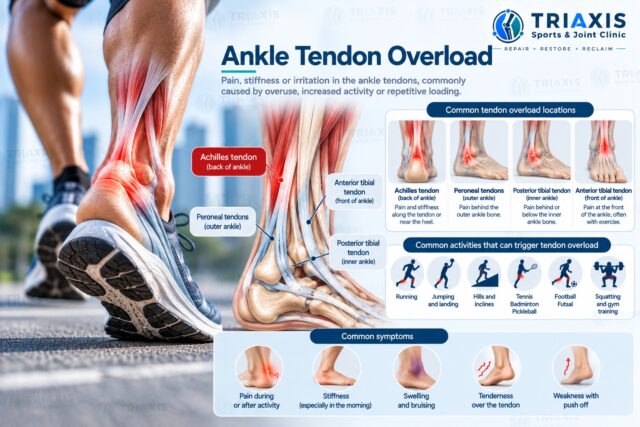
Ankle tendon overload describes tendon pain or reduced function that develops when repeated physical demands exceed the tendon’s current capacity. It is not one specific diagnosis. The Achilles, peroneal, posterior tibial and other ankle tendons can all become symptomatic, so identifying the affected tendon is important when planning rehabilitation.
Tendons connect muscles to bones and transfer force during movement.
Several important tendons cross the ankle:
- Achilles tendon – connects the calf muscles to the heel.
- Peroneal tendons – run behind the outer ankle and help control the foot during walking, running and changes of direction.
- Posterior tibial tendon – passes behind the inner ankle and contributes to foot and arch control.
- Anterior tibial tendon – crosses the front of the ankle and helps lift the foot.
- Flexor and extensor tendons – help move the toes and foot.
Because many structures sit close together, tendon problems are only one possible cause of ankle pain.
Where is ankle tendon overload usually painful?
The location of pain depends on the tendon involved. Achilles tendon problems typically cause pain at the back of the ankle, peroneal tendon symptoms usually occur around the outer ankle, and posterior tibial tendon problems often cause pain behind or below the inner ankle. Pain location provides a clue but does not confirm the diagnosis itself.
Patients may experience:
- Pain during or after activity
- Local tenderness
- Morning or after-rest stiffness
- Mild swelling
- Reduced strength
- Pain when pushing off the foot
- Difficulty running or jumping
Symptoms may start gradually and initially appear only after demanding exercise. As the tendon becomes more sensitive, everyday activities such as prolonged walking or climbing stairs may also become uncomfortable.
Sudden pain following an injury needs different consideration because acute tendon tears can sometimes produce symptoms around the same area.
Why do ankle tendons become overloaded?
Ankle tendon overload often develops after a change in how much, how often or how intensely a tendon is being used. Increasing running distance, adding hills, returning to sport after a break or introducing more jumping can increase tendon demand. However, symptoms usually reflect several interacting factors rather than one single cause.
Potential contributors include:
- Sudden increases in training volume
- Increased running speed or distance
- More hill training
- Repeated jumping and landing
- Returning to exercise after inactivity
- Changes in playing surface
- Previous ankle or tendon injuries
- Reduced strength or physical conditioning
- Occupational activities involving prolonged standing or walking
Relevant sports include running, football and futsal, basketball, rugby, badminton, tennis, pickleball and padel.
Having one of these factors does not mean a tendon problem will necessarily develop.
Can ankle tendon overload improve without surgery?
Yes. Most ankle tendon problems are managed without surgery. Management involves identifying the affected tendon, modifying activities that repeatedly aggravate it and progressively rebuilding strength and loading capacity, usually with a physiotherapist. Complete rest is not required, although temporary reductions in running, jumping or other demanding activities can help. Where tendon pain persists despite good rehabilitation, ultrasound-guided treatments can be added to reduce pain and support recovery.
Rehabilitation may include:
- Progressive ankle strengthening
- Calf strengthening
- Heel raises where appropriate
- Resistance exercises targeting the affected tendon
- Balance and single-leg control
- Gradual walking or running progression
- Jumping and landing exercises when relevant
- Sports-specific movement training
- Ultrasound-guided treatments where tendon pain persists despite rehabilitation
Exercise selection should match the tendon involved. For example, rehabilitation for the posterior tibial tendon may differ from rehabilitation for the peroneal or Achilles tendons. For posterior tibial tendon problems, foot orthoses with arch support combined with an exercise programme have been shown to reduce pain [6].
The aim is not simply to make the pain disappear. Rehabilitation also considers whether the tendon and surrounding muscles can tolerate the person’s work, exercise and sporting demands. Evidence across lower-limb tendinopathies supports exercise as the first-line treatment, with additional treatments considered when progress is slow after around three months.
Can I continue running or playing sports with ankle tendon pain?
Some people can remain active while temporarily modifying their training, while others need a greater reduction in tendon-loading activities. The appropriate level depends on pain, strength, tendon function and how symptoms respond during and after exercise. Continuing unchanged through progressively worsening symptoms is generally different from carefully modifying activity during rehabilitation.
Possible adjustments include reducing:
- Running distance
- Speed sessions
- Hills
- Jumping volume
- Consecutive training days
- Explosive change-of-direction drills
Activity can then be progressively increased as strength and tolerance improve.
Return to unrestricted sport should consider the demands of that sport. A recreational walker and a football player, for example, require different levels of ankle strength and movement capacity.
How long does ankle tendon overload take to improve?
Recovery varies according to which tendon is affected, how long symptoms have been present, the severity of functional loss and the person’s activity demands. Tendons adapt gradually, so persistent tendon problems may require weeks to months of progressive rehabilitation rather than a fixed short recovery period.
Progress can be monitored through improvements such as:
- Less pain during everyday activity
- Better walking tolerance
- Improved ankle strength
- Better single-leg control
- Increased running tolerance
- Improved jumping and landing capacity
- Ability to complete sport-specific training
Recovery should therefore be assessed through function as well as time.

Can ultrasound identify an ankle tendon problem, and when is MRI needed?
Ankle tendon problems are diagnosed through a careful history and examination, and ultrasound is particularly well suited to examining the tendons around the ankle. Ultrasound may be useful, alongside clinical assessment, to identify which tendon is involved, check for tears or tendon slipping and guide treatment, often at the same visit. MRI is valuable for deeper structures or more complex presentations. Scan findings are always interpreted alongside symptoms and examination.
An X-ray mainly assesses bones and certain joint changes rather than tendon structure.
An MRI can provide detailed images of tendons, ligaments, bones, cartilage and deeper ankle structures.
Musculoskeletal ultrasound can examine the Achilles, peroneal, posterior tibial and other ankle tendons in real time, including while the ankle moves. In a study comparing ultrasound and MRI with findings at operation, ultrasound identified peroneal tendinopathy with 100% sensitivity and specificity, and detected peroneal tendon subluxation (slipping) in all cases, compared with 66% for MRI. Dynamic ultrasound is regarded as the imaging method of choice for assessing peroneal tendon slipping. Ultrasound is also used to guide injections precisely.
Importantly, an abnormal-looking tendon on a scan does not automatically mean it is responsible for all of a patient’s symptoms.
| Test | What it shows | When it may be useful |
| Ultrasound | Tendon thickening, tears, sheath fluid, neovascularity and tendon slipping during movement | Alongside examination to identify the affected tendon, monitor progress and guide procedures |
| MRI | Tendons, ligaments, bone, cartilage and deeper structures | Complex presentations or suspected bone or joint problems |
| X-ray | Bones and alignment | Suspected bony problem or foot alignment assessment |
What non-surgical treatments can help ankle tendon problems?
Progressive, tendon-specific rehabilitation is the foundation of treatment. When tendon pain persists despite a good programme, or limits walking, work or sport, several ultrasound-guided treatments can be added to reduce pain, support tendon recovery and help rehabilitation progress. The best option depends on which tendon is involved and the type of tendon problem.
At Triaxis, these treatments are performed under real-time ultrasound guidance so they reach the affected tendon or tendon sheath precisely, and they are combined with a structured exercise programme.
Tendon sheath injection
Some tendons, such as the peroneal and posterior tibial tendons, run within a sheath that can become inflamed (tenosynovitis). A targeted ultrasound-guided injection into the tendon sheath can settle this inflammation so that strengthening can progress. In a study of 96 patients with peroneal tendon problems, ultrasound-guided sheath injection was safe, with over a third reporting pain relief lasting more than 12 weeks.
Platelet-rich plasma (PRP)
PRP is prepared from a small sample of your own blood and concentrated to contain growth factors involved in tendon repair, then injected into the affected tendon under ultrasound guidance. In a randomised trial in Achilles tendinopathy, PRP combined with exercise reduced pain and improved function more than exercise alone.
High-volume injection
For persistent Achilles tendon pain, a high-volume injection places a larger volume of fluid alongside the tendon to disrupt painful new blood vessels and nerves. In the same randomised trial, it produced the fastest improvement in pain and function.
Prolotherapy
Prolotherapy uses a dextrose (sugar) solution injected alongside the affected tendon to stimulate a healing response. In a randomised trial in Achilles tendinopathy, combining prolotherapy with exercise gave faster improvements in pain, stiffness and activity than exercise alone.
Shockwave therapy
Extracorporeal shockwave therapy delivers pressure waves through the skin to the painful tendon, with no needles. In a series of people with posterior tibial tendinopathy who had not improved with standard care, combining radial shockwave with a foot-strengthening programme led to clinically important improvements in daily activities in 90% of patients.
Tenex (ultrasonic tenotomy)
Tenex removes degenerate tendon tissue through a needle-sized incision using ultrasonic energy, under local anaesthetic and ultrasound guidance. It may be considered for long-standing tendinopathy that has not settled with other treatments.
Nerve hydrodissection
Small nerves around the ankle, such as the sural and superficial peroneal nerves, run close to the tendons and can become irritated, adding burning or tingling pain. Ultrasound-guided hydrodissection uses fluid to free an irritated nerve from surrounding tissue.
| Treatment | What it involves | When it may be considered |
| Tendon-specific rehabilitation | Progressive strengthening matched to the affected tendon | All ankle tendon problems; the foundation of recovery |
| Foot orthoses | Arch support inserts | Posterior tibial tendon problems, alongside exercise |
| Tendon sheath injection | Targeted injection into an inflamed tendon sheath | Tenosynovitis limiting rehabilitation |
| PRP | Your own concentrated platelets injected into the tendon | Persistent tendinopathy despite rehabilitation |
| High-volume injection | Larger volume of fluid alongside the tendon | Persistent Achilles tendinopathy with neovascularity |
| Prolotherapy | Dextrose injected alongside the tendon | Persistent tendon pain; combined with exercise |
| Shockwave therapy | Non-invasive pressure waves | Persistent tendon pain; combined with exercise |
| Tenex | Ultrasonic removal of degenerate tendon tissue | Long-standing tendinopathy not settling with other treatments |
| Hydrodissection | Fluid used to free an irritated nerve | Nerve-related pain around the ankle |
When should I seek assessment for ankle tendon pain?
Consider medical assessment when ankle tendon pain persists, repeatedly returns or begins limiting walking, work, exercise or sport. Earlier assessment may be appropriate after a sudden injury, particularly when there is severe pain, significant swelling, marked weakness or an inability to use the foot and ankle normally.
Other reasons include:
- Increasing rather than improving symptoms
- Persistent swelling
- Recurrent ankle problems
- Difficulty bearing weight
- Significant loss of strength
- A sudden pop or tearing sensation
- Numbness or unusual weakness
- Difficulty returning to activity despite rehabilitation
How is ankle tendon overload assessed at Triaxis Sports & Joint Clinic?
Assessment at Triaxis Sports & Joint Clinic focuses on identifying which tendon or other ankle structure may be contributing to symptoms and why it has become painful. Assessment may consider pain location, training changes, previous injuries, ankle movement, tendon function, strength and the demands of work, exercise or sport.
Depending on the presentation, assessment includes Sports Medicine and Musculoskeletal Medicine evaluation, movement and strength testing, same-visit diagnostic ultrasound to identify the affected tendon, rehabilitation planning coordinated with physiotherapy, patient education and shared decision-making.
Ultrasound-guided treatments are considered where tendon pain persists despite good rehabilitation.
Frequently Asked Questions About Ankle Tendon Overload
Is ankle tendon overload the same as tendinopathy?
Not exactly. Tendon overload describes a situation in which tendon demand exceeds its current capacity and symptoms develop. Tendinopathy is a clinical condition characterised by tendon-related pain and reduced function. Persistent overload may contribute to tendinopathy, but the terms should not automatically be treated as identical diagnoses.
Why does my ankle tendon hurt after running?
Running repeatedly loads several tendons around the ankle. Pain may develop after a sudden increase in distance, speed, hills or training frequency, particularly when the tendon is not currently adapted to that workload. The location of pain can help determine whether the Achilles, peroneal, posterior tibial or another tendon may be involved.
Is pain on the outside of my ankle a tendon problem?
It can be. The peroneal tendons pass behind the outer ankle and may cause pain during running, walking or changes of direction. However, lateral ankle ligaments, joints, nerves and other structures can cause pain in a similar location. Persistent lateral ankle pain therefore should not automatically be assumed to be peroneal tendinopathy.
What tendon causes pain on the inside of the ankle?
The posterior tibial tendon is one possible source of pain behind and below the inner ankle. It helps control the foot and supports the arch during movement. Other tendons, ligaments, joints and nerves are also present in this region, so pain location alone cannot confirm posterior tibial tendon involvement.
Should I completely rest an overloaded ankle tendon?
Complete rest is not automatically necessary. Temporary reduction of activities that repeatedly aggravate symptoms may be useful, while appropriate exercise can maintain and progressively rebuild tendon and muscle capacity. The amount of activity that can continue depends on the tendon involved, severity of symptoms and how the ankle responds afterwards.
Can ankle tendon overload cause swelling?
Yes. Some tendon conditions can cause local swelling or thickening around the symptomatic area. However, swelling can also occur with ligament injuries, joint problems and other ankle conditions. Significant swelling following trauma, or swelling that persists or worsens, may warrant clinical assessment.
Can ultrasound identify which ankle tendon is painful?
Yes, it can help. Musculoskeletal ultrasound can examine the tendons around the ankle and assess them dynamically during movement, which is particularly useful for detecting tendon slipping. As some tendons show changes without causing pain, ultrasound findings are interpreted together with the history, pain location and clinical examination to identify the tendon responsible.
What if my ankle tendon pain is not improving?
If tendon pain persists despite a well-structured programme, the first step is to review the diagnosis, the affected tendon and the exercise programme itself. Ultrasound can help, alongside examination, to assess the tendon. Treatments such as tendon sheath injection, PRP, prolotherapy, shockwave or Tenex can then be added to reduce pain and help you return to activity. Significant tendon tears or tendon slipping may need further assessment.
Can injections help ankle tendon pain?
Yes, for persistent tendon pain. Ultrasound-guided tendon sheath injection can settle tenosynovitis, and in Achilles tendinopathy, randomised trials have shown that adding high-volume injection, PRP or prolotherapy to exercise improves pain and function more than exercise alone. Injections work best alongside a structured, tendon-specific exercise programme.
About the Author
Dr Dinesh Sirisena is a Consultant in Sports, Exercise & Musculoskeletal Medicine. His clinical work includes the assessment and management of sports injuries and musculoskeletal conditions involving muscles, tendons, ligaments, joints and related structures.
Medical Disclaimer
This article is for general educational purposes and does not replace individual medical assessment, diagnosis or treatment. Ankle pain can have several possible causes, and “ankle tendon overload” can involve different tendons. Treatment decisions depend on the individual’s symptoms, medical history and clinical assessment.