Not All Achilles Tendon Tears Need an Operation
| In short: A ruptured Achilles tendon used to mean an almost automatic operation. Today, many people recover just as well without surgery, using a modern functional rehabilitation programme in a supportive boot. Surgery still has an important role for some — but it is a choice to be weighed, not a foregone conclusion. Ultrasound is especially useful here: it shows whether the torn ends come together when the foot is pointed, which helps decide whether non-surgical treatment is likely to work well for you. |
Key points
- A torn Achilles tendon does not always need surgery — modern non-surgical care gives many people excellent results.
- Early functional rehabilitation (a boot with heel wedges and controlled weight-bearing) has largely closed the old gap between surgery and non-surgical treatment.
- Surgery lowers the re-rupture risk slightly in some studies, but carries risks non-surgical care avoids — such as wound infection.
- Ultrasound helps decide. It shows whether the torn ends meet when the foot is pointed down — a key factor in choosing non-surgical treatment.
- Getting assessed early gives you the most options and the best results, whichever route you choose.
- PRP can support healing in partial Achilles tears and tendinopathy, delivered precisely under ultrasound guidance — an option many active people ask about.
⚠ Get assessed promptlyA sudden painful “snap” or feeling of being kicked in the back of the ankle needs prompt medical assessment — the sooner an Achilles rupture is diagnosed, the more treatment options you have. Also note that a hot, swollen, painful calf can occasionally signal a blood clot rather than a tendon injury; if that is your main symptom, seek urgent care. |
What is an Achilles tendon rupture?
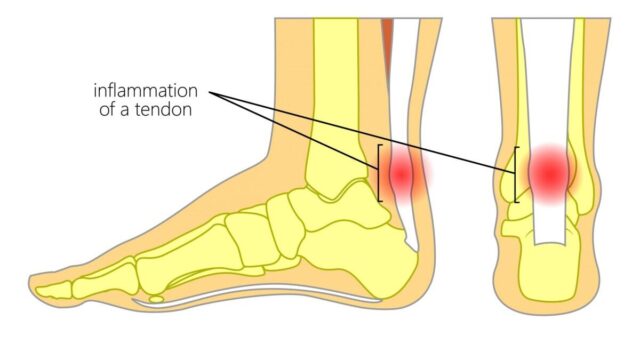
The Achilles is the strong tendon connecting your calf muscles to your heel. A rupture is a tear — partial or complete — that usually happens suddenly during a push-off or jump, often with a sharp pain and an audible snap, as if you had been kicked or hit in the back of the ankle.
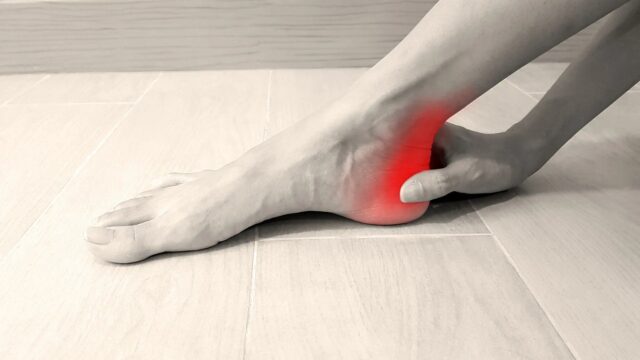
It is one of the most commonly ruptured tendons in the body, and often affects active people in their 30s to 50s during recreational sport. After a complete rupture, pushing off, standing on tiptoe, or walking normally becomes difficult. The good news is that the tendon has a real capacity to heal, which is precisely why non-surgical treatment can work so well when it is done properly.
How do I know if I’ve torn my Achilles?
Typical signs are a sudden sharp pain low in the calf or above the heel, sometimes with a snap, followed by weakness pushing off and difficulty rising onto tiptoe. A clinician can often feel a gap in the tendon, and simple examination tests help confirm it — with ultrasound giving a clear, immediate picture.
In the clinic, a gentle calf-squeeze test (which normally makes the foot point down) and feeling along the tendon for a gap are quick, reliable checks. Ultrasound then confirms the diagnosis and — importantly — shows the size of the gap and whether the torn ends come together when the foot is pointed. That dynamic view is something a static scan cannot easily provide, and it directly informs the treatment decision.
Does a torn Achilles always need surgery?
No. For many people, non-surgical treatment with a modern functional rehabilitation programme achieves results comparable to surgery. The old assumption that every ruptured Achilles must be repaired has been overturned by better rehabilitation and better evidence.
The historical case for surgery rested on a lower re-rupture rate compared with old-fashioned plaster casting. But once early, controlled movement and weight-bearing in a boot replaced rigid casts, that difference narrowed considerably — and surgery’s own risks came into sharper focus. Today the decision is a genuine, shared one, based on your tendon, your health, your goals, and what the ultrasound shows.
Surgery versus non-surgical treatment — how do they compare?
Both routes can lead to excellent recovery. Surgery may slightly reduce the risk of re-rupture in some studies, while non-surgical treatment avoids surgical risks such as wound infection and nerve irritation. Neither is universally “better” — the right choice is individual.
The table below summarises the main trade-offs. The figures vary between studies, and the gap in re-rupture rates is much smaller with modern functional rehabilitation than older data suggest:
| Non-surgical (functional rehab) | Surgery | |
| Re-rupture risk | Slightly higher in some studies; gap narrows with early functional rehab | Slightly lower in some studies |
| Surgical risks | Avoided (no wound, no anaesthetic) | Wound infection, nerve irritation, anaesthetic risk |
| Recovery path | Boot with wedges, progressive weight-bearing, then physio | Repair, then a similar functional rehab programme |
| May particularly suit | Most people; those wishing to avoid surgery or with higher wound-risk | Some high-demand athletes; delayed presentation; re-rupture |
Whichever route is chosen, the rehabilitation programme does much of the real work — getting that right matters more than the label of “operated” or “not operated.”
What does non-surgical treatment involve?
Non-surgical care uses a supportive boot with heel wedges that hold the foot gently pointed, bringing the torn ends together so they can heal, combined with early controlled weight-bearing. Over roughly eight to ten weeks the wedges are reduced and movement is progressed, followed by a structured strengthening programme.
This “functional” approach — moving and loading the tendon in a protected way rather than immobilising it rigidly — is what makes modern non-surgical results so good, because tendons heal better with the right stimulus. Your team monitors progress, adjusts the timeline to how you are healing, and manages practical points such as clot-risk during the less-mobile early phase. Physiotherapy then rebuilds calf strength and confidence for a return to activity.
How does ultrasound help decide the right treatment?
Ultrasound lets us see the tendon moving in real time. By scanning while the foot is gently pointed, we can see whether the torn ends come together — and good apposition of the ends is a strong sign that non-surgical treatment is likely to work well.
This dynamic assessment adds information that changes decisions: a gap that closes nicely with the foot pointed supports confident non-surgical care, while one that does not may tip the balance toward considering surgery. Ultrasound is quick, comfortable and radiation-free, and it can be repeated to track healing over time. Using it to guide the decision — rather than defaulting one way or the other — is central to a tailored, evidence-based plan.
Can a PRP injection help my Achilles tendon rupture heal?
Yes — for many Achilles problems, PRP (platelet-rich plasma) can be a genuinely useful part of treatment. It is most valuable for partial tears and for Achilles tendinopathy, where it uses your own concentrated growth factors to support the tendon’s natural healing. Delivered precisely under ultrasound guidance, it is a popular, minimally invasive option for the right problem.
Partial tears and tendinopathy involve living, struggling tendon rather than a clean complete break — and that is exactly the setting where PRP has the most to offer, because there is tissue for its growth factors to stimulate. Many active people seek PRP to support their recovery and get back to sport, and used alongside a progressive loading and rehabilitation programme it can be a valuable part of the plan. Ultrasound guidance means the PRP is placed exactly where it is needed, which gives it the best chance to work.
For a complete rupture, PRP is not a replacement for the core treatment — the boot-and-rehabilitation programme, or surgery, does the main work — but it can still be considered as part of a wider, individualised plan in selected cases. The key is matching PRP to the specific injury, so you get the benefit where the biology supports it. This is exactly the kind of thing worth talking through in person.
Who might still be better with surgery?
Surgery deserves serious consideration for certain situations: some high-demand or professional athletes, injuries seen late where the ends have drawn apart, a tendon that has re-ruptured, or a gap that does not come together on ultrasound. Personal preference, after a clear discussion of the trade-offs, also matters.
Equally, factors that raise the risk of wound-healing problems — such as smoking, diabetes or poor circulation — can shift the balance toward non-surgical care. There is no single right answer for everyone, which is exactly why an individual assessment beats a blanket rule. The aim is to match the treatment to you, not to a default.
How long is recovery, and when can I return to sport?
Most people are in a boot for around eight to ten weeks, then progress through strengthening and gradually back to activity. A return to running and sport typically takes in the region of six to nine months, and this is broadly similar whether or not you have surgery.
Recovery is a process of steadily rebuilding calf strength, power and confidence, and rushing it is the main avoidable cause of setbacks. Your programme is progressed on how your tendon is responding rather than the calendar alone, and a graded return to sport — much like return-to-play after other injuries — protects against re-rupture. Patience through the middle phase pays off in the long run.
Frequently asked questions
Can a partial Achilles tear heal without surgery?
Yes — most partial tears are managed without surgery, with a period of protection and a progressive rehabilitation programme. An ultrasound assessment helps confirm the extent of the tear and guide the plan.
Will my tendon be weaker if I don’t have surgery?
Not necessarily. With a proper functional rehabilitation programme, non-surgical treatment produces strength and function comparable to surgery for many people. The quality of the rehabilitation matters more than the choice of surgery itself.
How soon do I need to be seen after injury?
As soon as possible. Early assessment gives you the most treatment options, because bringing the torn ends together works best before the tendon starts to draw apart. Prompt ultrasound also gives the clearest picture.
Is non-surgical treatment more likely to re-rupture?
Some studies show a slightly higher re-rupture rate without surgery, but this gap is much smaller with modern early functional rehabilitation, and non-surgical care avoids surgical risks. It is one factor to weigh, not a reason to rule it out.
Can I walk on it during treatment?
Usually yes, in a controlled way. Modern non-surgical care encourages early protected weight-bearing in a boot, which supports better healing than being completely off the leg. Your team will guide how much and when.
Can PRP help a partial Achilles tear?
Yes — partial tears and Achilles tendinopathy are where PRP has the most to offer, because there is living tendon for its growth factors to support. Delivered under ultrasound guidance and combined with a loading programme, it is a popular option for active people wanting to support their recovery.
| Think you’ve torn your Achilles — or want to know if you can avoid surgery?
The best decisions are made early, with a clear picture of the tendon. A prompt assessment with dynamic ultrasound shows whether the torn ends come together — and therefore whether non-surgical treatment is likely to work well for you. Dr Sirisena offers expert ultrasound assessment and honest, non-surgical-first guidance so you can choose the right path with confidence. Triaxis Sports & Joint Clinic, Farrer Park Hospital · WhatsApp +65 8889 3594 · hello@triaxisclinic.com · Repair · Restore · Reclaim |
About the author
Written and medically reviewed by Dr Dinesh Sirisena, Consultant in Sports, Exercise & Musculoskeletal Medicine, and author of Ultrasound-Guided Musculoskeletal Procedures in Sports Medicine (Elsevier, 2021). Dr Sirisena has cared for athletes at the highest level, including Olympic and international competition, and focuses on evidence-based, non-surgical and image-guided treatment of sports and musculoskeletal injuries.