
Runner’s Knee: Causes, Symptoms and Treatment Options
Written and medically reviewed by
Dr Dinesh Sirisena
Consultant in Sports, Exercise & Musculoskeletal Medicine
Triaxis Sports & Joint Clinic
Runner’s knee commonly refers to patellofemoral pain, which causes discomfort around or behind the kneecap. It may become more noticeable during running, stairs, squatting or after prolonged sitting. Despite its name, it can affect runners and non-runners. Most people improve with non-surgical care. Exercise therapy targeting the knee and hip, together with education and sensible adjustments to training load, is the foundation of treatment. Where pain persists, ultrasound-guided treatments such as platelet-rich plasma (PRP), hyaluronic acid or dextrose injections can be added to support recovery and a return to running.
What is runner’s knee?
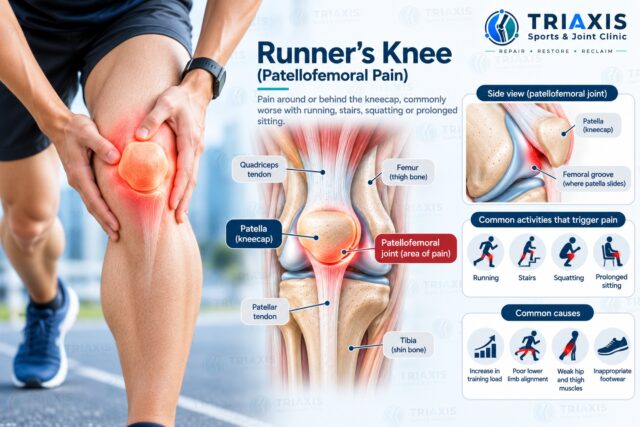
Runner’s knee is a common term for patellofemoral pain, which is pain arising around or behind the kneecap. It often becomes noticeable during activities that load the knee while it is bent, such as running, squatting and climbing stairs. It can affect runners, other athletes and people who are not involved in sport.
The patella, or kneecap, sits at the front of the knee and moves within a groove at the lower end of the femur as the knee bends and straightens.
The quadriceps muscles and quadriceps tendon sit above the kneecap, while the patellar tendon connects it to the tibia below.
These structures work together during walking, running, jumping and squatting. Patellofemoral pain is one of several possible causes of knee pain, so the term “runner’s knee” should not be used for every painful knee.
What does runner’s knee feel like?
Runner’s knee typically causes an ache around, behind or near the kneecap. Pain may become more noticeable while running, climbing or descending stairs, squatting, jumping or sitting with the knee bent for a long time. Some people also notice clicking or grinding, although these sounds do not necessarily indicate damage.
Symptoms can include:
- Pain around or behind the kneecap
- Pain during or after running
- Discomfort on stairs
- Pain during squats or lunges
- Discomfort after prolonged sitting
- Pain while jumping
- Clicking or grinding sensations
- Reduced tolerance for exercise
Pain may develop gradually rather than after one obvious injury.
Other conditions, including patellar tendon problems, meniscus injuries and ligament injuries, can cause different patterns of knee symptoms. Therefore, pain location alone does not confirm the diagnosis.
Why does my knee hurt when I run?
Running repeatedly loads the knee and patellofemoral joint. Symptoms may develop when the amount or type of running exceeds what the knee currently tolerates. A sudden increase in distance, speed, hills or training frequency can contribute, although strength, movement patterns, previous injury and individual factors may also influence symptoms.
Common training-related factors may include:
- Increasing weekly distance quickly
- Adding speed sessions
- More hill running
- Increasing training frequency
- Returning after a period away from running
- Changing several training variables at once
However, runner’s knee is not simply an “overuse injury” caused by running too much. Patellofemoral pain can have several contributing factors.
Assessment may consider hip and knee strength, movement, training history, running demands, footwear and recovery between sessions.
Which sports and activities may aggravate runner’s knee?
Activities involving repeated knee bending, running, jumping or changes of direction may aggravate patellofemoral pain. Running is commonly associated with the condition, but symptoms can also occur during football, basketball, badminton and racquet sports. The activity itself is not necessarily harmful; the amount and intensity of loading may be more important.
Relevant activities can include:
- Running
- Football and futsal
- Basketball
- Badminton
- Tennis
- Pickleball
- Padel
- Hiking
- Stair climbing
- Gym exercises involving repeated knee loading
Squats and lunges may temporarily aggravate symptoms, particularly when performed deeply or under heavier load.
Rather than stopping every activity, modification may involve adjusting running distance, speed, hills, exercise depth or training volume while gradually rebuilding capacity.
Can runner’s knee improve without surgery?
Yes. Runner’s knee is managed without surgery. Exercise therapy and education are the foundation of treatment, while activity modification helps keep exercise at a tolerable level. Running retraining, taping or foot orthoses may help selected people. For pain that persists despite good rehabilitation, ultrasound-guided treatments can be added to ease pain and help rehabilitation progress.
Rehabilitation may include exercises targeting:
- Quadriceps strength
- Hip and gluteal strength
- Calf strength
- Single-leg control
- Balance
- Movement coordination
- Running tolerance
- Ultrasound-guided treatments where pain persists despite rehabilitation
Exercise selection should reflect the person’s symptoms and physical findings rather than follow one programme for everyone. A review of 65 randomised trials found that knee-targeted exercise therapy improves pain and function, and that combined hip-and-knee programmes improve pain and function further.
The aim is to gradually improve the knee’s ability to tolerate everyday and sporting demands rather than permanently avoid movements that cause discomfort. Completing a full course matters: in a study of over 74,000 people with patellofemoral pain, those who attended at least six exercise therapy sessions were significantly less likely to have their knee pain return.
Can I continue running with runner’s knee?
Many people with runner’s knee can continue running with temporary adjustments, while others benefit from reducing their running load for a period. The decision depends on pain during running, symptoms afterwards, current training demands and overall knee function. Complete rest is not usually required.
Possible adjustments may include:
- Temporarily reducing running distance
- Reducing speed
- Limiting hills
- Increasing recovery between runs
- Using lower-impact training temporarily
- Gradually rebuilding running volume
Running retraining may also be considered in selected cases as part of a broader rehabilitation programme.
The goal is to find an appropriate level of activity that can be progressed as symptoms and capacity improve.
How long does runner’s knee take to improve?
Recovery from runner’s knee varies between individuals. Factors such as how long symptoms have been present, training demands, strength, activity modification and consistency with rehabilitation all influence progress. Rather than expecting a fixed recovery date, improvement is monitored through pain, function and increasing tolerance for exercise and running.
Progress may include being able to:
- Climb stairs more comfortably
- Squat with less discomfort
- Tolerate longer periods of activity
- Increase running distance
- Return to faster running
- Resume sport-specific movements
Symptoms can sometimes fluctuate as training changes. A temporary increase in discomfort does not necessarily mean that new structural damage has occurred.
Do I need an X-ray, MRI or ultrasound for runner’s knee?
Runner’s knee is mainly diagnosed through a careful history and examination, and imaging is not needed for every patient. Ultrasound may be useful, alongside clinical assessment, to examine the tendons, soft tissues and nerves around the kneecap and to look for other causes of pain, often at the same visit. X-ray or MRI may be considered when symptoms are unusual, follow significant trauma or do not improve as expected.
An X-ray can assess bones and joint alignment and may be considered when other joint conditions are suspected.
An MRI can show cartilage, menisci, ligaments and other structures but is not automatically needed to diagnose patellofemoral pain.
Musculoskeletal ultrasound may be useful, alongside clinical assessment, for examining the structures around the kneecap, including the patellar and quadriceps tendons, the fat pad, the supporting retinaculum, joint fluid and small nerves. Studies have found ultrasound differences in people with patellofemoral pain, such as thicker supporting retinacula and thinner trochlear cartilage. Ultrasound can also identify conditions that mimic runner’s knee, such as irritation of the infrapatellar branch of the saphenous nerve, and is used to guide injections precisely.
| Test | What it shows | When it may be useful |
| Ultrasound | Tendons, fat pad, retinaculum, joint fluid and nerves around the kneecap | Alongside examination to look for contributing or mimicking causes; guiding injections |
| MRI | Cartilage, menisci, ligaments and bone | Unusual symptoms, trauma, or pain not improving as expected |
| X-ray | Bones, alignment and arthritis | When arthritis or a bony problem is suspected |
Importantly, scan findings should always be considered together with symptoms and clinical examinations.
Can injections help runner’s knee?
Yes, for selected people. Exercise therapy remains the foundation of treatment. When pain persists despite a good rehabilitation programme, or is too painful to allow exercise to progress, ultrasound-guided treatments can be added to ease pain, support the tissues around the kneecap and help rehabilitation move forward.
At Triaxis, these treatments are performed under ultrasound guidance so they reach the intended target precisely, and they are always combined with a structured exercise programme.
Platelet-rich plasma (PRP)
PRP is prepared from a small sample of your own blood and concentrated to contain growth factors involved in tissue repair. It may be considered where runner’s knee is associated with softening or wear of the cartilage behind the kneecap. In a study of 103 patients with patellofemoral cartilage softening (chondromalacia), average pain scores fell from 6.4 to 1.2 out of 10 six months after PRP, with 98% reporting less pain. A 2026 systematic review found a consistent trend towards improvement with PRP and related orthobiologic treatments for patellofemoral cartilage problems.
Hyaluronic acid (HA)
Hyaluronic acid is a lubricating substance naturally found in joint fluid. In a study of 60 athletes with patellofemoral pain, a single HA injection was followed by clinically meaningful improvement in knee function in 75% to 83% of participants at six months. A recent expert consensus also highlighted the usefulness of HA for patellofemoral cartilage problems.
Dextrose injections and prolotherapy
Prolotherapy uses a dextrose (sugar) solution to stimulate a local healing response. It is commonly used to strengthen and tighten lax or stretched ligaments, because looseness in the ligaments and retinaculum that support the kneecap and knee can place extra stress on the joint and contribute to pain. Related dextrose techniques can also be injected around sensitive tissues and small nerves to ease pain. A review of 65 randomised trials found that adding perineural dextrose injections to knee-targeted exercise therapy improved pain and function more than exercise alone.
Nerve hydrodissection
Small sensory nerves around the front and inner knee, such as the infrapatellar branch of the saphenous nerve, can become irritated and produce pain that feels like runner’s knee 3]. Ultrasound-guided [hydrodissection uses fluid to free an irritated nerve from surrounding tissue.
Botulinum toxin
In some people, an imbalance between the outer and inner thigh muscles contributes to how the kneecap moves. An ultrasound-guided botulinum toxin injection into the outer thigh muscle (vastus lateralis), followed by physiotherapy, has been associated with long-lasting improvements in pain and function in people with persistent patellofemoral pain.
Related tendon problems
If assessment shows that a nearby tendon, such as the patellar or quadriceps tendon, is also contributing, treatments such as shockwave therapy or Tenex may be considered for that tendon as part of the overall plan.
| Treatment | What it involves | When it may be considered |
| Exercise therapy | Progressive knee and hip strengthening with a physiotherapist | Everyone with runner’s knee; the foundation of recovery |
| PRP | Your own concentrated platelets injected into the knee | Persistent pain with cartilage softening behind the kneecap |
| Hyaluronic acid | Lubricating injection into the knee | Persistent pain, particularly with cartilage changes |
| Dextrose / prolotherapy | Dextrose injected around lax ligaments, sensitive tissues or nerves | Persistent pain, including where ligament laxity contributes |
| Hydrodissection | Fluid used to free an irritated nerve | Nerve-related pain around the kneecap |
| Botulinum toxin | Injection into the outer thigh muscle | Persistent pain with thigh muscle imbalance |
| Shockwave / Tenex | Treatments targeting a painful tendon | An associated patellar or quadriceps tendon problem |
When should I seek medical assessment for runner’s knee?
Consider medical assessment when knee pain persists, repeatedly returns or prevents you from progressing your normal activities or running. Assessment is also appropriate when symptoms do not fit the typical pattern of runner’s knee or when there is significant swelling, locking, instability, trauma or difficulty bearing weight.
Seek assessment particularly if you experience:
- Persistent or worsening pain
- Significant knee swelling
- Locking or inability to straighten the knee
- Repeated giving way
- Difficulty bearing weight
- Significant pain following trauma
- Symptoms affecting everyday activities
- Difficulty returning to running despite modifying training
These features may indicate that another knee condition needs to be considered.
How is runner’s knee assessed at Triaxis Sports & Joint Clinic?
Assessment of runner’s knee at Triaxis Sports & Joint Clinic focuses on understanding the pain pattern, running and training history, knee function and factors that may be contributing to symptoms. Where helpful, diagnostic ultrasound can be performed at the same visit. The aim is to distinguish patellofemoral pain from other causes of knee pain and build a personalised plan to get you back to running.
Depending on the individual’s presentation, assessment may include:
- Sports Medicine assessment
- Musculoskeletal examination
- Knee and hip movement
- Lower-limb strength
- Single-leg control
- Running and training history
- Previous injuries
- Review of footwear or training changes where relevant
- Diagnostic ultrasound of the structures around the kneecap where appropriate
- Rehabilitation planning, coordinated with physiotherapy
- Ultrasound-guided treatments where pain persists despite rehabilitation
- Patient education
- Shared decision-making
Frequently Asked Questions About Runner’s Knee
Is runner’s knee the same as patellofemoral pain syndrome?
Runner’s knee commonly refers to patellofemoral pain, although the term is sometimes used loosely for other running-related knee problems. Patellofemoral pain typically causes discomfort around or behind the kneecap and is aggravated by activities that load the knee while bent. Clinical assessment can help distinguish it from tendon, meniscus, ligament or other joint conditions.
Can I run through runner’s knee?
Continuing to run may be possible for some people if symptoms remain manageable and do not progressively worsen. Others may need to temporarily reduce distance, speed, hills or running frequency. The aim is not necessarily complete rest, but to find an appropriate training load while addressing strength and other contributing factors through rehabilitation.
What exercises are useful for runner’s knee?
Exercise programmes commonly include knee-targeted and hip-targeted strengthening. Examples may involve quadriceps, hip and gluteal exercises, with progression towards single-leg control and activities that reflect the person’s running or sporting demands. There is no single exercise that is appropriate for everyone, so exercise selection and loading should be adjusted according to symptoms and physical findings.
Are squats bad for runner’s knee?
Squats are not automatically harmful. Because squatting increases load through the patellofemoral joint, deeper or heavier squats may temporarily aggravate symptoms. Instead of avoiding squats completely, rehabilitation may adjust the depth, resistance or number of repetitions before gradually progressing the exercise as tolerance improves.
Does runner’s knee mean my cartilage is damaged?
Not necessarily. Patellofemoral pain is a clinical pain condition and does not automatically mean there is significant cartilage damage. Pain intensity also does not always correspond directly with structural changes seen on imaging. This is one reason an MRI is not routinely required for every person with typical runner’s knee symptoms.
Will changing my running shoes fix runner’s knee?
Changing footwear alone is unlikely to address every case of runner’s knee. Footwear may be relevant for some runners, but training load, strength, movement, previous injuries and running demands may also contribute. Foot orthoses may be considered for selected people, but management is usually individualised rather than based on one particular shoe or device.
Can runner’s knee come back after it improves?
Yes. Patellofemoral pain can recur, particularly when running or sporting demands increase faster than current capacity. Gradually progressing training, maintaining appropriate strength and responding to early changes in symptoms may help manage future training. Recurrence does not necessarily mean that the knee has developed new structural damage.
What if my runner’s knee is not improving?
If pain persists despite a well-structured exercise programme, the first step is to review the diagnosis and the programme itself, including training load, exercise selection and running technique. Ultrasound may help, alongside examination, to identify contributing structures. Ultrasound-guided treatments such as PRP, hyaluronic acid or dextrose injections can then be added to ease pain and help rehabilitation progress.
Can injections help runner’s knee?
Yes, for people whose pain persists despite good rehabilitation. Adding perineural dextrose injections to exercise therapy has been shown to improve pain and function more than exercise alone [1], and studies of PRP and hyaluronic acid report meaningful improvements in pain and knee function [5, 6]. Injections work best as part of a structured exercise programme rather than on their own.
About the Author
Dr Dinesh Sirisena is a Consultant in Sports, Exercise & Musculoskeletal Medicine. His clinical work includes assessing and managing sports injuries and musculoskeletal conditions affecting joints, muscles, tendons, ligaments and related structures.
Medical Disclaimer
This article is for general educational purposes and does not replace individual medical assessment, diagnosis or treatment. Knee pain can have several possible causes. Decisions about exercise, imaging, rehabilitation or other management options should be based on individual symptoms, medical history and clinical assessment.