Ultrasound-Guided Hydrodissection: Uses, Evidence and What to Expect
Written and medically reviewed by
Dr Dinesh Sirisena
Consultant in Sports, Exercise & Musculoskeletal Medicine
Triaxis Sports & Joint Clinic
Hydrodissection is a minimally invasive, ultrasound-guided procedure that uses fluid to gently separate tissues and free nerves, fascia and tendons from the structures pressing on or sticking to them.
It is used across a broad range of musculoskeletal problems — including nerve entrapments such as carpal tunnel syndrome, fascial and myofascial pain, and persistent tendon conditions such as Achilles and patellar tendinopathy. The technique is performed under real-time ultrasound so the clinician can see the needle and the injected fluid throughout, and it works well alongside rehabilitation and progressive loading.
What is hydrodissection?
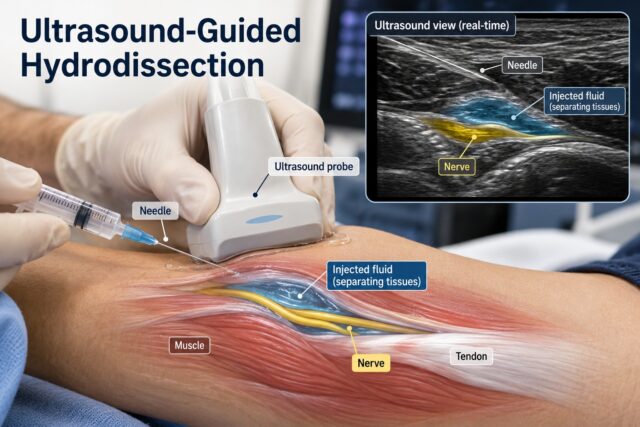
Hydrodissection is an ultrasound-guided injection technique in which fluid is used to create space around a nerve, fascial layer or tendon, gently separating it from the surrounding tissue. This can relieve compression, reduce adhesions and improve the way the structure glides and moves.
Because it is performed under high-resolution ultrasound, the clinician can identify the exact tissue plane and watch the fluid spread in real time. The technique is also described in the literature as perineural injection therapy when applied to nerves, and as high-volume injection or high-volume image-guided injection (HVIGI) when a larger fluid volume is used around a tendon.
Hydrodissection describes the technique, not a single medicine. Depending on the problem, the injected solution may include:
- Normal saline
- Local anaesthetic
- 5% dextrose (D5W), often used for nerve-related pain
- Platelet-rich plasma (PRP) in selected cases
- Corticosteroid, where clinically appropriate
The choice of solution is tailored to the diagnosis, the structure being treated and the individual patient.
What conditions can hydrodissection treat?
Hydrodissection is used across three broad areas: freeing entrapped nerves, releasing adhered fascial and myofascial planes, and addressing the tissue changes around persistent tendon problems. The strongest evidence is for nerve entrapment, while its use around fascia and tendons continues to grow.
Nerve entrapment (nerve hydrodissection)
This is the best-established application. Fluid is used to release a compressed nerve from the tissue trapping it, restoring space and improving nerve gliding. Commonly treated entrapments include:
- Carpal tunnel syndrome (median nerve at the wrist)
- Cubital tunnel syndrome (ulnar nerve at the elbow)
- Deep gluteal / sciatic nerve entrapment
- Meralgia paraesthetica (lateral femoral cutaneous nerve)
- Baxter’s nerve and tarsal tunnel entrapment in the heel and foot
Fascial and myofascial release
Fluid can be used to separate adhered fascial layers and interfascial planes that contribute to pain and restricted movement, for example around the plantar fascia or the gluteal and piriformis region. This is an active and growing area of practice.
Tendon and paratendon problems (high-volume injection)
Around persistent tendon conditions such as mid-portion Achilles and patellar tendinopathy, a higher volume of fluid is placed between the tendon and the tissue in front of it — sometimes called high-volume “stripping.” The aim is to influence the small blood vessels and accompanying nerve fibres that are associated with tendon pain, as part of a wider loading and rehabilitation plan.
How does hydrodissection work?
Hydrodissection works mainly by mechanically separating structures that have become compressed or stuck together. Freeing a nerve from surrounding tissue can relieve pressure, improve its blood supply and restore normal gliding, while separating tissue planes around a tendon can influence the vessels and nerve fibres linked to pain.
For nerves, the goal is to release the nerve from compressive or scarred tissue so that its own small blood vessels and nerve fibres (the vasa nervorum and nervi nervorum) can function normally again. Some solutions, such as 5% dextrose, may also have a settling effect on irritated nerves beyond the mechanical release itself.
For tendons, chronic tendon pain is often accompanied by increased small blood vessels and nerve fibres around the tendon, which can be seen on Doppler ultrasound. Placing fluid between the tendon and the tissue in front of it is intended to separate these planes and influence those pain-associated structures. This is why the technique is combined with progressive tendon loading, which builds the tendon’s capacity over time.
What does the evidence show?
The evidence is strongest for nerve hydrodissection, where randomised trials and systematic reviews support its use in conditions such as carpal tunnel syndrome. Evidence for fascial applications is emerging, while for tendon conditions hydrodissection is best considered as one component of a rehabilitation-based programme.
For nerve entrapment, randomised controlled trials have shown that ultrasound-guided hydrodissection can improve symptoms and function in carpal tunnel syndrome, with benefits maintained over months. Systematic reviews and a network meta-analysis have reported that 5% dextrose is among the most effective injectates, with results comparable to corticosteroid at longer follow-up and an excellent safety profile. Contemporary reviews now position hydrodissection as a valuable step for patients who have not settled with splinting or therapy but who wish to avoid, or are not yet ready for, surgery.
For fascial and myofascial pain, published case series and ongoing trials describe encouraging results, and interest in interfascial hydrodissection is growing as ultrasound techniques improve.
For tendon conditions, results are more variable. A 2020 randomised controlled trial found that high-volume injection without corticosteroid did not add benefit over a small placebo injection when both groups followed a structured exercise programme, while a 2024 systematic review reported possible short-term improvement, particularly in protocols that included corticosteroid. Taken together, this supports using high-volume injection selectively and always alongside a progressive loading programme, rather than as a stand-alone treatment.
Is hydrodissection the same as prolotherapy, PRP or a steroid injection?
No. Hydrodissection describes an injection technique — using fluid under ultrasound to separate tissues — while prolotherapy, PRP and corticosteroid refer to the substances injected. Some hydrodissection procedures use one of these solutions, but the terms are not interchangeable.
In practice, the diagnosis and the structure being treated guide both the technique and the choice of solution. For example, a nerve entrapment and a chronic tendon problem may both be treated with hydrodissection, but with different injectates, volumes and target planes.
Why is ultrasound guidance used?
Ultrasound guidance lets the clinician see the nerve, fascia or tendon and the surrounding anatomy in real time, guide the needle precisely into the intended tissue plane, and watch the fluid spread exactly where it is needed. This precision is central to how hydrodissection works.
Sports and musculoskeletal ultrasound can also assess the target structure before treatment — for example the size and shape of a nerve, the thickness and structure of a tendon, or blood flow using Doppler imaging — and can be used dynamically while the joint or limb moves.
Who may be considered for hydrodissection?
Hydrodissection may be considered for people with a confirmed nerve entrapment, fascial pain or persistent tendon problem who are looking for a minimally invasive option, often after an appropriate period of conservative care. A clinical assessment, and usually ultrasound, help confirm the diagnosis and identify the right target.
Assessment typically considers:
- The specific diagnosis and where the problem is arising
- Duration and pattern of symptoms
- Response to previous treatment and rehabilitation
- Functional and sporting demands
- Relevant medical conditions and current medications
- Ultrasound findings
What happens during a hydrodissection procedure?
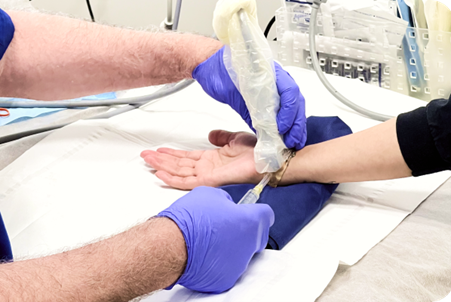
During hydrodissection, the area is examined with ultrasound, the skin is cleaned, and a needle is guided precisely toward the target nerve, fascia or tendon. Fluid is then introduced to separate the tissue planes while the clinician watches in real time. It is usually a day procedure.
A typical procedure involves:
- Clinical review and confirmation of the diagnosis
- Ultrasound examination of the target structure
- Discussion of the expected benefits, the solution used and any risks
- Skin preparation
- Ultrasound-guided needle placement
- Introduction of the tailored solution to separate the tissue planes
- Post-procedure advice and rehabilitation planning
Is hydrodissection painful?
Most people tolerate hydrodissection well. It involves a needle and the introduction of fluid, so some pressure or temporary soreness is normal, and local anaesthetic is often included to keep the procedure comfortable. The amount of discomfort varies from person to person.
Any discomfort is usually related to the needle, the pressure of the fluid or an already sensitive area, and tends to settle over the following days. You will be given individual advice on what to expect and how to look after the area afterwards.
What are the possible risks?
Hydrodissection has a strong safety profile, and studies of nerve hydrodissection have reported very few complications. As with any needle-based procedure, considerations can include temporary soreness, bruising, a small risk of bleeding or infection, and irritation of nearby structures. Additional considerations apply when medicines such as corticosteroid are included.
To keep the procedure as safe as possible, it is helpful to discuss beforehand:
- Current and blood-thinning medication
- Allergies
- Diabetes
- Previous injections or procedures in the area
- Other relevant medical conditions
How long does recovery take, and will I still need rehabilitation?
Recovery varies with the condition treated and your individual response, and many people return to everyday activities quickly. Rehabilitation remains an important partner to hydrodissection — especially for tendon problems — because progressive loading builds lasting strength and capacity that an injection alone does not provide.
For nerve entrapments, symptom relief may develop over the weeks following the procedure. For tendon conditions, hydrodissection is most effective when combined with a graded loading programme, and return to running or sport is guided by function and comfort rather than a fixed timetable. Your clinician and rehabilitation team will tailor the plan to you.
How is hydrodissection considered at Triaxis Sports & Joint Clinic?
At Triaxis Sports & Joint Clinic, hydrodissection is considered following a Sports Medicine and musculoskeletal assessment. The clinic reviews the diagnosis, previous treatment, functional needs, ultrasound findings and the current evidence before discussing whether an ultrasound-guided procedure is a suitable option.
Where a procedure is appropriate, patients can discuss the solution being used, the expected benefits, any limitations and risks, and the alternatives, so that the decision is a shared one. Depending on the individual’s condition and clinical assessment, hydrodissection may be considered as part of a broader management plan that includes rehabilitation.
Frequently Asked Questions About Hydrodissection
Does hydrodissection help carpal tunnel syndrome?
Yes — this is one of its best-supported uses. Randomised trials and systematic reviews have shown that ultrasound-guided hydrodissection can improve symptoms and function in carpal tunnel syndrome, and it is increasingly offered to people who have not settled with splinting or therapy but wish to avoid or delay surgery. Your suitability is confirmed with a clinical assessment and ultrasound.
What is high-volume injection for tendons?
High-volume injection is the tendon-focused form of hydrodissection. A larger volume of fluid is placed between a painful tendon, such as the Achilles, and the tissue in front of it, to separate the planes and influence the small vessels and nerve fibres associated with tendon pain. It is used selectively and works best alongside a progressive loading programme.
Is hydrodissection a type of surgery?
No. Hydrodissection is a minimally invasive, ultrasound-guided injection performed as a day procedure. For conditions such as nerve entrapment, it is often considered as a step before surgery is needed.
What fluid is injected during hydrodissection?
It depends on the problem. Solutions may include saline, local anaesthetic, 5% dextrose, PRP or, where appropriate, corticosteroid. The choice is tailored to the diagnosis and the structure being treated, and you will be told what is being used.
Do I still need rehabilitation after hydrodissection?
For tendon conditions, yes — progressive loading builds lasting strength and capacity that an injection alone does not provide, so the two work best together. For nerve entrapments, activity and nerve-gliding advice often support recovery. Your plan is tailored to your condition.
How soon will I notice a difference?
This varies with the condition and the individual. Some people notice change within days, while for others relief develops over the following weeks. Return to sport is guided by function and comfort rather than a set number of days.
About the Author
Dr Dinesh Sirisena is a Consultant in Sports, Exercise & Musculoskeletal Medicine. His clinical work includes the assessment and management of sports injuries and musculoskeletal conditions involving muscles, tendons, ligaments, nerves, joints and related structures, including ultrasound-guided procedures.
Medical Disclaimer
This page provides general educational information and does not replace individual medical advice. Hydrodissection is not required or suitable for every person, and the right option depends on the diagnosis and clinical assessment. Decisions about imaging, rehabilitation or image-guided procedures should follow an individual consultation.