Ultrasound-Guided Procedures: Uses, Benefits and What to Expect
Written and medically reviewed by
Dr Dinesh Sirisena
Consultant in Sports, Exercise & Musculoskeletal Medicine
Triaxis Sports & Joint Clinic
Ultrasound-guided procedures use real-time ultrasound imaging to help a clinician visualise selected muscles, tendons, joints, nerves and other soft tissues while performing a procedure. Depending on the diagnosis, this may include selected injections, aspirations or other musculoskeletal interventions. These procedures are not needed for every condition and should be considered only after clinical assessment as part of a broader management plan. Ultrasound itself does not use ionising radiation.
What is an ultrasound-guided procedure?
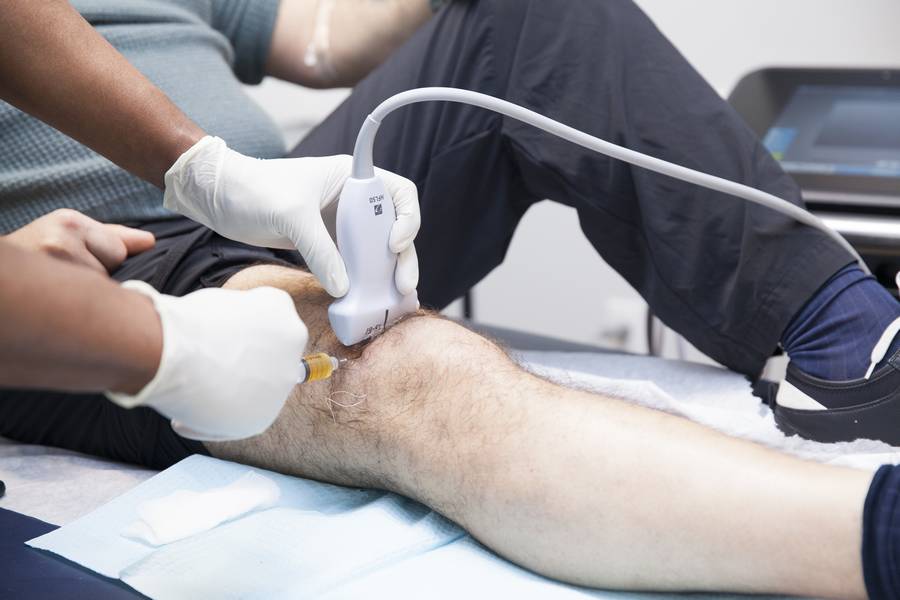
An ultrasound-guided procedure uses real-time medical ultrasound to help a clinician see the intended anatomical area while performing an intervention. A needle or other instrument can be visualised in relation to nearby structures such as joints, tendons, muscles, nerves or fluid collections, depending on the procedure being performed.
Ultrasound creates images using high-frequency sound waves. During a procedure, a clinician places an ultrasound probe on the skin and views the anatomy on a screen.
The imaging can help identify:
- Joints
- Tendons
- Muscles
- Ligaments
- Peripheral nerves
- Bursae
- Fluid collections
- Other superficial soft tissues
The American College of Radiology describes ultrasound as an appropriate imaging modality for guidance during musculoskeletal interventional procedures.
However, it is important to discuss with your clinician what treatment is appropriate and how best to manage it afterwards. This depends on your symptoms, physical examination, diagnosis and overall management plan.
Why is ultrasound used to guide some musculoskeletal procedures?
Ultrasound allows a clinician to visualise selected anatomy and the position of a needle in real time. This can be helpful when a procedure needs to reach a particular joint, bursa, tendon-related structure, nerve or fluid collection while recognising surrounding tissues.
Unlike imaging performed before a procedure, ultrasound can provide live images while the intervention takes place.
For example, the clinician may be able to see:
- The intended anatomical target
- The needle pathway
- Adjacent blood vessels
- Nearby nerves
- Tendons and muscles
- Fluid within a joint or bursa
Research literature describes ultrasound guidance as being used for intra-articular, periarticular and perineural musculoskeletal interventions, among other applications.
The clinical benefit of using ultrasound depends on the procedure and anatomical area, so it is used where it genuinely adds value.
What types of ultrasound-guided procedures may be used in musculoskeletal medicine?
Ultrasound guidance can be used for several types of musculoskeletal procedures, including selected joint injections, soft-tissue injections, aspirations and other interventions. The exact procedure depends on the diagnosis and clinical circumstances, and not every patient with musculoskeletal pain requires an intervention.
Examples described in musculoskeletal practice include:
- Selected joint injections
- Bursa injections
- Aspiration of selected fluid collections
- Procedures around certain tendons
- Selected nerve-related procedures
- Drainage of certain cysts or collections
- Other image-guided musculoskeletal interventions
Published reviews also describe ultrasound guidance for joint, perineural and tendon-related procedures, as well as aspiration or drainage of selected fluid collections.
Depending on the individual’s condition and clinical assessment, certain procedures may be considered as part of a broader management plan.
What parts of the body can ultrasound-guided procedures be used for?
Ultrasound-guided procedures may be considered around many accessible musculoskeletal areas, including the spine, shoulder, elbow, wrist, hand, hip region, knee, ankle and foot. Whether ultrasound guidance is appropriate depends on the structure involved, its depth and the type of intervention being considered.
Common regions may include:
Spine
For facet joints, ligament, peri-neural and epidurals.
Shoulder
Selected joints, bursae and tendon-related structures.
Elbow
Selected tendon, joint or nerve-related structures.
Wrist and hand
Selected tendon sheaths, joints, nerves and cysts.
Hip region
Certain joints, tendons and surrounding soft tissues.
Knee
Selected joints, bursae and tendon-related structures.
Ankle and foot
Selected joints, tendons, nerves and other soft tissues.
Ultrasound is particularly useful for many superficial structures, while other imaging methods may be more appropriate for deeper anatomy.
What anatomy can ultrasound show during a procedure?
Musculoskeletal ultrasound can show selected muscles, tendons, ligaments, nerves, joints and other soft tissues. This allows the clinician to identify relevant anatomy before and during certain procedures. However, ultrasound cannot clearly visualise every structure, particularly when tissue lies deep within the body or behind bone.
A joint is where bones meet and allow movement. Ligaments help stabilise joints, while tendons connect muscles to bones.
Peripheral nerves carry movement and sensation signals between the spinal cord and limbs.
Because these structures often lie close together, understanding the local anatomy is important when planning a procedure.
Ultrasound also allows some structures to be assessed during movement, providing dynamic information that may complement the physical examination.
Should ultrasound-guidance be considered for musculoskeletal procedures?
Not all musculoskeletal pain requires an injection or other procedure, but if a procedure is being considered, it should be done under guidance to improve accuracy and minimise potential side effects. This is also important as part of a wider management plan that may include education, activity modification, exercise therapy and rehabilitation. A procedure can be considered when the diagnosis, symptoms, previous management and clinical findings suggest that it has an appropriate role.
Before discussing an intervention, clinical assessment may consider:
- How the symptoms started
- Where the pain occurs
- Duration of symptoms
- Previous injuries
- Medical conditions
- Current medication
- Strength and movement
- Work or sporting demands
- Previous rehabilitation
- Other treatments already attempted
A procedure should therefore be linked to a clear clinical reason rather than performed solely because a scan shows an abnormality.
Is an ultrasound-guided injection better than a normal injection?
Ultrasound guidance provides real-time visualisation of selected anatomical structures during an injection, and aims to improve the accuracy of delivery and reduce potential adverse effects. The importance of guidance varies according to the anatomical target, condition, procedure and individual circumstances.
Studies have found improved placement accuracy for many ultrasound-guided musculoskeletal procedures compared with landmark-based approaches.
However, while accuracy of needle placement and clinical outcome are not the same thing, the added confidence provided by guidance ensures that specific structures can be targeted.
Whether a patient experiences improvement can depend on several factors, including:
- The diagnosis
- The underlying condition
- The medication or procedure used
- Rehabilitation
- Activity demands
- Duration of symptoms
- Other medical factors
For this reason, guidance is best seen as one factor that supports a good outcome, alongside the right diagnosis and rehabilitation.
Does an ultrasound-guided procedure hurt?
Some discomfort may occur because an ultrasound-guided procedure can involve a needle passing through the skin and into or around a musculoskeletal structure. The amount of discomfort varies depending on the procedure, anatomical area and individual. The ultrasound scanning itself is generally non-invasive.
The ultrasound portion involves placing gel on the skin and moving a probe over the treatment area.
If a needle is required, the clinician may explain:
- How the procedure will be performed
- What sensations may be expected
- Whether local anaesthetic is appropriate
- Possible risks
- What to expect afterwards
Patients should ask questions before proceeding if they are uncertain about any part of the procedure.
What happens during an ultrasound-guided procedure?
The clinician usually begins by positioning the patient and examining the relevant anatomy with ultrasound. The skin is prepared, and where appropriate, a needle is introduced while the clinician observes its position on the ultrasound screen. The exact steps depend on the type of procedure being performed.
A typical process may include:
- Review of the clinical indication.
- Explanation of potential benefits, limitations and risks.
- Positioning of the patient.
- Ultrasound assessment of the intended area.
- Cleaning and preparation of the skin.
- Needle placement where required.
- Real-time ultrasound observation during the procedure.
- Post-procedure instructions.
Ultrasound-guided procedures should be performed using appropriate clinical and procedural standards. The ACR practice parameter notes that usual interventional procedure standards apply to ultrasound-guided musculoskeletal interventions.
Are ultrasound-guided procedures safe?
Ultrasound imaging itself does not use ionising radiation. However, an ultrasound-guided intervention may carry risks related to the needle, medication and anatomical area being treated. The potential risks therefore depend on the specific procedure rather than on ultrasound alone.
Possible risks of selected interventions may include:
- Temporary soreness
- Bleeding or bruising
- Infection
- Reaction to medication
- Injury to surrounding structures
- Temporary worsening of symptoms
Different injections may have additional medication-specific considerations.
Before a procedure, the clinician should consider relevant medical information such as medications, allergies and underlying conditions.
Do I need an X-ray or MRI before an ultrasound-guided procedure?
Not necessarily, but imaging may help clinicians confirm the diagnosis or answer a specific clinical question. Ultrasound may itself provide sufficient information for some superficial musculoskeletal structures, while other conditions require X-ray or MRI before deciding whether a procedure is appropriate.
Different imaging methods provide different information.
X-ray may be useful for bones, fractures and certain joint changes.
MRI provides detailed images of joints, soft tissues and bones and may be useful for deeper or more complex structures.
Musculoskeletal ultrasound is a versatile, patient-friendly tool that can evaluate selected muscles, tendons, ligaments, nerves and joints in real time, without radiation. Because it produces live images, it can also assess these structures as they move — for example, watching a tendon glide or a joint flex — which can reveal problems a static scan may miss. It is widely available and well tolerated, and can often be carried out in the same consultation, allowing assessment and, where appropriate, treatment to be combined in a single visit.
Imaging should therefore be selected according to what the clinician needs to understand.
Can ultrasound-guided procedures help sports injuries?
Ultrasound-guided procedures may be considered for selected sports-related musculoskeletal conditions in athletes. The decision depends on the diagnosis, severity of symptoms, rehabilitation progress and sporting demands. Where used, a procedure usually forms one part of a wider return-to-activity plan.
Sports that commonly involve musculoskeletal loading include:
- Running
- Tennis
- Golf
- Badminton
- Football
- Rugby
- Swimming
- Cricket
- Weightlifting
However, the sport does not determine whether a procedure is needed.
For example, two runners with Achilles pain may require different management depending on their diagnosis, training history and examination findings.
Do I still need rehabilitation after an ultrasound-guided procedure?
Often, yes. An ultrasound-guided procedure is usually part of a wider treatment program that needs to address strength, mobility, movement control or the physical demands that contributed to a musculoskeletal problem. When rehabilitation is appropriate, exercise and progressive loading may remain important parts of recovery before and after a procedure.
Depending on the condition, rehabilitation may include:
- Education
- Activity modification
- Mobility exercises
- Strengthening
- Progressive loading
- Balance training
- Movement retraining
- Sport-specific exercises
- Return-to-sport planning
A procedure should therefore not necessarily be viewed as a replacement for rehabilitation.
What should I do after an ultrasound-guided procedure?
Aftercare depends on the procedure performed, the medication used and the anatomical area involved. Some patients may be advised to offload the treated area or temporarily modify activity before gradually returning to exercise or rehabilitation. The clinician should provide individual instructions based on the procedure and condition.
Aftercare questions may include:
- When can I return to work?
- When can I exercise?
- Should I avoid particular movements?
- When should rehabilitation restart?
- Which symptoms are expected?
- What symptoms require medical review?
There is no single aftercare plan that applies to every ultrasound-guided procedure.
When should I seek medical attention after a procedure?
Patients should follow the specific instructions provided after their procedure. Medical assessment may be required if unexpected or concerning symptoms develop, particularly increasing redness, marked swelling, fever, severe pain, progressive weakness or other symptoms that are significantly different from what was discussed beforehand.
Seek advice promptly if there is:
- Increasing redness or warmth
- Significant swelling
- Fever
- Feeling substantially unwell
- Severe or rapidly worsening pain
- New weakness or numbness
- Unexpected loss of function
The exact warning signs may vary depending on the procedure.
How are ultrasound-guided procedures considered at Triaxis Sports & Joint Clinic?
At Triaxis Sports & Joint Clinic, ultrasound-guided procedures may be considered for selected sports and musculoskeletal conditions following clinical assessment. The process may combine Sports Medicine evaluation, musculoskeletal examination, sports ultrasound, patient education, rehabilitation planning and shared decision-making.
Assessment may consider:
- Symptoms and medical history
- Physical examination
- Movement and strength
- Sporting or occupational demands
- Relevant imaging
- Previous rehabilitation
- Available non-procedural options
- Potential benefits and limitations of an intervention
Where a procedure is considered appropriate, its purpose, alternatives and role within the wider management plan can be discussed with the patient.
This wording is also consistent with the Singapore healthcare advertising framework. HCSA licensees must comply with applicable regulations and advertising requirements, and MOH has emphasised that healthcare advertising should be accurate, truthful and should not induce unnecessary consumption of healthcare services.
Frequently Asked Questions About Ultrasound-Guided Procedures
What is the main purpose of ultrasound guidance?
Ultrasound guidance allows the clinician to see selected anatomical structures and the position of a needle in real time during certain procedures. This may help identify the intended target and surrounding tissues.
Are ultrasound-guided injections always more accurate?
Research suggests ultrasound guidance can improve needle-placement accuracy for many musculoskeletal procedures compared with using anatomical landmarks alone. Remember, outcomes depend on the condition, intervention, rehabilitation and individual circumstances.
Can ultrasound guidance be used for joint injections?
Yes. Ultrasound may be used to guide selected joint injections by allowing the clinician to identify the joint and observe needle positioning. It may also be used around certain bursae, tendons, nerves and soft-tissue structures. Whether it is appropriate depends on the clinical diagnosis and type of procedure.
Can ultrasound be used to remove fluid from a joint or cyst?
Ultrasound guidance can be used during selected aspirations or drainage procedures involving fluid collections, joints or cystic structures.
How long does an ultrasound-guided procedure take?
The duration varies according to the anatomical area and type of procedure. Time is also needed to review the indication, position the patient, examine the anatomy and discuss aftercare. Patients should not assume that all ultrasound-guided interventions follow the same process or timeline.
Can I exercise after an ultrasound-guided procedure?
That depends on the procedure and condition. Temporary modification of exercise may sometimes be advised, followed by a gradual return to activity or rehabilitation. Patients should follow the specific recommendations provided because aftercare can differ according to the anatomical structure, medication and purpose of the intervention.
Does ultrasound guidance mean the injection will work?
Ultrasound guidance helps visualise anatomy and needle placement, but the outcome depends on the type and purpose of the procedure, the underlying diagnosis, individual condition and wider management plan.
Can an ultrasound-guided procedure replace physiotherapy or rehabilitation?
Many musculoskeletal conditions require progressive strengthening, mobility work, activity modification or other rehabilitation and procedures are meant to work with these rather than in place of them. Therefore, when appropriate, an ultrasound-guided procedure forms one component of a broader management plan.
About the Author, Dr Dinesh Sirisena is a Consultant in Sports, Exercise & Musculoskeletal Medicine. His clinical work includes assessment and management of sports injuries and musculoskeletal conditions involving muscles, tendons, ligaments, joints and related structures.
Medical Disclaimer
This page provides general educational information and does not replace an individual medical consultation. Ultrasound-guided procedures are not suitable or required for every musculoskeletal condition. The decision to undertake an investigation or procedure should depend on the individual’s symptoms, medical history, diagnosis and clinical assessment.