
Achilles Tendon Pain: Causes, Symptoms and Treatment Options
Written and medically reviewed by
Dr Dinesh Sirisena
Consultant in Sports, Exercise & Musculoskeletal Medicine
Triaxis Sports & Joint Clinic
Achilles tendon pain commonly related to Achilles tendinopathy, which can cause pain, stiffness and reduced tolerance for walking, running or jumping. Symptoms may occur in the middle of the tendon or near its attachment to the heel. Achilles tendinopathy managed without surgery. Progressive tendon-loading exercise the foundation of treatment, and ultrasound well suited to examining the tendon. Where pain persists, ultrasound-guided treatments such as high-volume injection, prolotherapy, platelet-rich plasma (PRP) or Tenex can be added to support recovery and a return to running and sport. PRP particularly useful for partial or degenerative tears within the tendon.
What causes Achilles tendon pain?
Achilles tendon pain can have several causes, but Achilles tendinopathy common in active adults. It may develop when repeated loading exceeds the tendon’s current capacity, particularly after changes in running, jumping or training. Pain at the back of the ankle can also come from bursae, nearby joints, other tendons or an acute Achilles tear.
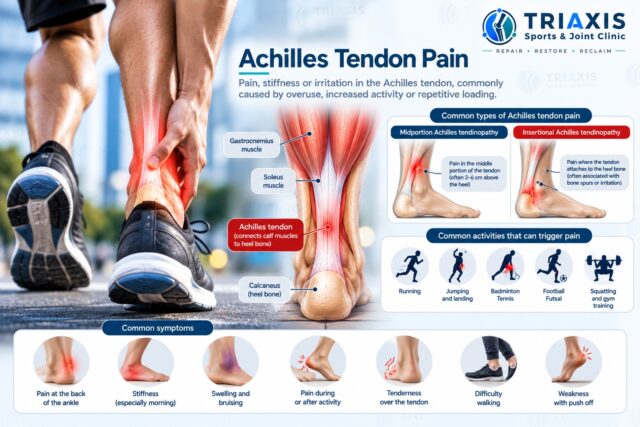
The Achilles the large tendon at the back of the ankle. It connects the gastrocnemius and soleus calf muscles to the calcaneus, or heel bone.
When these muscles contract, the Achilles tendon transfers force to the foot. This helps you:
- Walk
- Run
- Jump
- Climb stairs
- Rise onto your toes
- Push off the ground
Achilles problems are one possible cause of ankle pain. The location, onset and behaviour of symptoms can help distinguish tendinopathy from other conditions.
Where’s Achilles tendon pain usually felt?
Achilles tendinopathy commonly causes pain either in the middle portion of the tendon or close to where the tendon attaches to the heel bone. People may notice stiffness after rest, tenderness when touching the tendon, or discomfort during activities such as walking uphill, running, jumping and pushing off the foot.
Two common patterns are:
- Midportion Achilles tendinopathy: symptoms typically occur several centimetres above the heel.
- Insertional Achilles tendinopathy: symptoms occur near the lower end of the tendon where it attaches to the heel bone.
Some people notice morning stiffness that improves after moving. Others experience pain at the start of exercise, during higher loads or after activity.
Sudden severe pain after an explosive movement is different from gradually developing tendinopathy and may require assessment for an acute tear.
Why do runners and athletes develop Achilles tendinopathy?
Achilles tendinopathy often associated with repeated tendon loading and changes in physical activity. A sudden increase in running distance, speed, hills, jumping or training frequency may increase tendon demand. However, the condition is usually influenced by several factors rather than one single cause.
Relevant activities include:
- Running and trail running
- Football and futsal
- Basketball
- Badminton
- Tennis
- Pickleball
- Padel
- Rugby
- Jumping and plyometric training
Age, previous tendon problems, calf strength, training history and some medical or medication-related factors may also be relevant.
Having one or more risk factors does not mean a person will necessarily develop Achilles tendinopathy.
Can Achilles tendon pain improve without surgery?
Yes. Achilles tendinopathy managed without surgery. Exercise-based rehabilitation the foundation of treatment and gradually improves the tendon’s ability to tolerate load, usually with a physiotherapist. Activity may need to be adjusted, but complete rest not required and can reduce physical capacity. Where tendon pain persists despite good rehabilitation, ultrasound-guided treatments can be added to reduce pain and support tendon recovery.
Rehabilitation may include:
- Calf-strengthening exercises
- Progressive heel rises
- Exercises with the knee straight and bent
- Gradually increasing resistance
- Balance and lower-limb strengthening
- Progressive walking and running
- Jumping and landing exercises where appropriate
- Sport-specific loading
- Ultrasound-guided treatments where tendon pain persists despite rehabilitation
Exercise may involve different approaches rather than one universal programme. A large living review of lower-limb tendinopathy treatments supports exercise as the first-line treatment, with additional treatments considered when progress is slow after around three months.
The appropriate starting point depends on symptoms, strength, current activity and whether the problem involves the midportion or insertion of the tendon.
Can I continue running with Achilles tendon pain?
Some people with Achilles tendinopathy can continue running with temporary changes to their training, while others may need to reduce running for a period. The decision depends on symptom severity, tendon irritability and how the tendon responds during and after exercise. Running does not always need to stop completely.
Adjustments might include reducing:
- Weekly distance
- Running speed
- Hill training
- Sprinting
- Consecutive running days
- Jumping or plyometric sessions
Progress should consider both symptoms and function rather than pain alone. The aim usually to gradually restore the tendon’s ability to tolerate the demands of the person’s chosen activity.
How long does Achilles tendinopathy take to improve?
Recovery from Achilles tendinopathy varies considerably. Tendons adapt gradually, and persistent symptoms may require several months of progressive rehabilitation. Recovery depends on factors such as symptom duration, tendon location, activity demands, strength and consistency with rehabilitation. A fixed recovery timeline cannot accurately predict progress for every person.
Useful measures of improvement include:
- Less morning stiffness
- Improved walking tolerance
- Increased calf strength
- Better heel-raise capacity
- Increased running tolerance
- Ability to jump and land where relevant
- Gradual return to sport-specific activity
A temporary increase in symptoms does not always mean the tendon has sustained further structural damage, but significant or persistent worsening should be reviewed.
Can ultrasound diagnose Achilles tendinopathy, and when is MRI needed?
Achilles tendinopathy diagnosed through a careful history and examination, and ultrasound is particularly well suited to examining the Achilles tendon. Ultrasound may be useful, alongside clinical assessment, to confirm tendon changes, distinguish midportion from insertional problems, check for tears and guide treatment, often at the same visit. MRI may be considered in selected or more complex presentations. Scan findings are always interpreted alongside symptoms and function.
An X-ray does not show the Achilles tendon in detail but may identify heel bone changes or other bone-related conditions.
Musculoskeletal ultrasound can assess tendon thickness, structure, small tears, the surrounding paratenon and bursae, and neovascularity (new blood vessel growth often seen in painful tendons), and can examine the tendon dynamically. Ultrasound can be repeated to monitor how the tendon responds to treatment; in a randomised trial, tendon thickness and blood vessel activity on ultrasound reduced after high-volume injection and PRP. It’s also used to guide injections precisely and useful when a tear suspected.
An MRI provides detailed imaging of the tendon and surrounding structures and may be considered in selected or more complex presentations.
Importantly, structural tendon changes on imaging do not automatically explain how much pain a person experiences.
| Test | What it shows | When it may be useful |
| Ultrasound | Tendon thickness and structure, neovascularity, tears, paratenon and bursae | Alongside examination to confirm tendon changes, monitor progress and guide procedures |
| MRI | The tendon and surrounding structures in detail | Selected or complex presentations |
| X-ray | Heel bone changes, such as spurs or calcification | Insertional pain or suspected bony problem |
What non-surgical treatments can help Achilles tendinopathy?
Progressive tendon-loading exercise the foundation of treatment. When tendon pain persists despite a good programme, or limits the ability to walk, run or train, several ultrasound-guided treatments can be added to reduce pain, support tendon recovery and help you return to activity. At Triaxis, these performed under real-time ultrasound guidance so treatment reaches the affected area precisely.
High-volume injection
A high-volume injection places a larger volume of fluid alongside the tendon under ultrasound guidance, aiming to disrupt the painful new blood vessels and nerves that grow into a chronic tendon. In a randomised double-blinded trial of 60 men with chronic midportion Achilles tendinopathy, adding a high-volume injection to exercise improved pain and function more than exercise alone, with the fastest improvement seen at 6 and 12 weeks.
Prolotherapy
Prolotherapy uses a dextrose (sugar) solution injected alongside the affected part of the tendon to stimulate a healing response. In a randomised trial, combining prolotherapy with exercise gave faster improvements in pain, stiffness and activity than exercise alone, with 86% of patients achieving a clinically meaningful improvement at 12 months. In a separate series of 132 patients, 74% had symptom resolution within 12 months of prolotherapy.
Platelet-rich plasma (PRP)
PRP prepared from a small sample of your own blood and concentrated to contain growth factors involved in tendon repair, then injected precisely into the damaged area under ultrasound guidance. It’s particularly useful for partial tears and degenerative tears within the tendon, where the tendon still intact but weakened and can be supported to heal. In a randomised trial, PRP combined with exercise reduced pain and improved function more than exercise alone at six months [2]. In a reported case of a competitive basketball player with a partial Achilles tear, a course of three PRP injections with progressive rehabilitation allowed a return to full competitive games within 75 days, with tendon repair confirmed on ultrasound and MRI [9]. Research results for PRP in general Achilles tendinopathy vary between studies, so it’s considered on an individual basis.
Shockwave therapy
Extracorporeal shockwave therapy delivers pressure waves through the skin to the painful tendon, with no needles or downtime. In a randomised trial of runners, combining exercise with radial shockwave produced the largest reduction in symptoms at three months, and a 2026 trial found that adding shockwave to resistance training was associated with more pronounced tendon remodelling on ultrasound. Results vary between studies, so shockwave usually combined with exercise rather than used alone.
Tenex (ultrasonic tenotomy)
Tenex removes degenerate tendon tissue through a needle-sized incision using ultrasonic energy, under local anaesthetic and ultrasound guidance. In 34 patients with insertional Achilles tendinopathy, the proportion with moderate or severe pain fell from 68% to 15%, with high patient satisfaction and a low complication rate.
| Treatment | What it involves | When it may be considered |
| Tendon-loading rehabilitation | Progressive calf and heel-raise strengthening | Everyone with Achilles tendinopathy; the foundation of recovery |
| High-volume injection | Larger volume of fluid alongside the tendon | Persistent midportion pain, particularly with neovascularity |
| Prolotherapy | Dextrose injected alongside the tendon | Persistent pain; combined with exercise |
| PRP | Your own concentrated platelets injected into the damaged area of tendon | Partial or degenerative tears; persistent pain despite rehabilitation |
| Shockwave therapy | Non-invasive pressure waves | Persistent pain; combined with exercise |
| Tenex | Ultrasonic removal of degenerate tendon tissue | Long-standing pain, including insertional tendinopathy |
Expert reviews describe high-volume injection and shockwave as valuable next steps when exercise alone has not been enough [8]. All of these treatments work best alongside a continued tendon-loading programme.
When should Achilles tendon pain be medically assessed?
Consider assessment when Achilles pain persists, repeatedly returns or limits walking, exercise or sport despite appropriate activity changes. More urgent assessment appropriate after sudden severe pain, a pop at the back of the ankle, marked weakness or difficulty pushing off the foot because these symptoms can occur with an Achilles tendon rupture.
Other reasons to seek assessment include:
- Persistent swelling
- Increasing pain
- Significant loss of calf strength
- Difficulty walking
- Symptoms following a sudden injury
- Inability to perform a heel rise
- Symptoms that do not fit a typical tendinopathy pattern
How’s Achilles tendon pain assessed at Triaxis Sports & Joint Clinic?
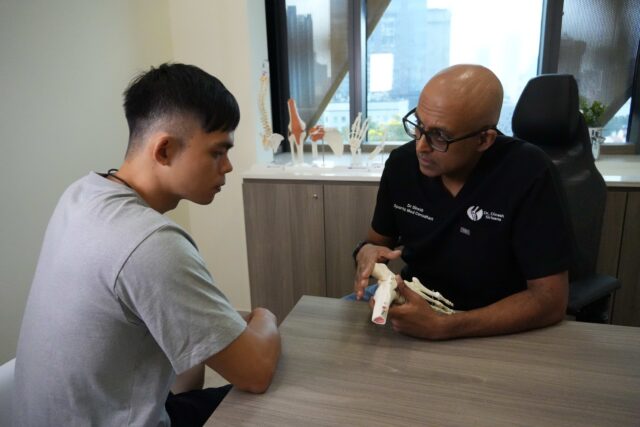
Assessment at Triaxis Sports & Joint Clinic focuses on determining which structure may be causing pain and how symptoms affect movement and activity. For suspected Achilles tendinopathy, assessment may consider pain location, symptom behaviour, calf strength, tendon loading, walking or running demands, training history and other possible causes of pain around the back of the ankle.
Where appropriate, assessment includes Sports Medicine and Musculoskeletal Medicine evaluation, strength and movement testing, same-visit diagnostic ultrasound of the tendon, review of existing imaging, rehabilitation planning coordinated with physiotherapy, patient education and shared decision-making.
Ultrasound-guided treatments considered where tendon pain persists despite good rehabilitation.
Frequently Asked Questions About Achilles Tendon Pain
Is Achilles tendon pain the same as Achilles tendinopathy?
Not always. Achilles tendinopathy is a common cause of pain involving the Achilles tendon, particularly when symptoms develop gradually with repeated loading. However, pain in the same area can also arise from bursitis, a partial or degenerative tendon tear, surrounding tissues or other ankle and heel conditions. Ultrasound can help identify a partial tear, which may respond well to ultrasound-guided PRP alongside rehabilitation.
What is the difference between Achilles tendinopathy and an Achilles rupture?
Achilles tendinopathy usually develops gradually and causes load-related pain and stiffness. An Achilles rupture is an acute tear and may occur suddenly during running, jumping or rapid acceleration. People may describe a pop or sensation of being struck at the back of the leg, followed by weakness when pushing off. A suspected rupture warrants timely medical assessment.
Is walking good for Achilles tendinopathy?
Walking can often continue if symptoms remain manageable, although the amount may need to be adjusted during a painful period. Long walks, hills and faster walking increase Achilles tendon demand. The appropriate activity level depends on symptom severity and how the tendon responds during and after walking.
Should I stretch a painful Achilles tendon?
Stretching is not automatically appropriate for every type of Achilles pain. In insertional tendinopathy, bringing the ankle deeply upwards can increase compression where the tendon meets the heel and may aggravate symptoms in some people. Exercise selection should therefore reflect the location and behavior of the person’s symptoms rather than relying on stretching alone.
Are heel raises useful for Achilles tendon pain?
Progressive heel-raise exercises commonly used to strengthen the calf-Achilles tendon unit. Rehabilitation may begin at a level the person can tolerate and gradually increase resistance, repetition and speed. Both straight-knee and bent-knee exercises may be used because different calf muscles contribute to Achilles tendon loading.
Can an ultrasound show Achilles tendinopathy?
Yes. Musculoskeletal ultrasound can show tendon thickness, structure, neovascularity and surrounding tissues, can assess the tendon dynamically and helps evaluate suspected tears. It can also be repeated to track how the tendon responds to treatment. As some people have tendon changes without significant symptoms, ultrasound is interpreted together with your history and examination.
Do I need to stop sports completely?
Not necessarily. Some people can continue modified training while reducing activities that repeatedly aggravate symptoms. Others may temporarily need a greater reduction in running, jumping or high-intensity sport. Rehabilitation then progressively rebuilds strength and tendon-loading tolerance before higher-demand activities reintroduced.
What if my Achilles pain is not improving?
If tendon pain persists despite a well-structured programme, the first step is to review the diagnosis, training load and the exercise programme itself, including whether the problem is midportion or insertional. Ultrasound can help, alongside examination, to assess the tendon. Treatments such as high-volume injection, prolotherapy, PRP, shockwave or Tenex can then be added to reduce pain and help you return to activity.
Can injections help Achilles tendinopathy?
Yes, for persistent tendon pain. In a randomised trial, adding a high-volume injection or PRP to exercise reduced pain and improved function more than exercise alone, and combining prolotherapy with exercise gave faster improvements than exercise alone. PRP is particularly useful where ultrasound shows a partial or degenerative tear within the tendon. Injections work best alongside a structured tendon-loading programme.
About the Author
Dr Dinesh Sirisena a Consultant in Sports, Exercise & Musculoskeletal Medicine. His clinical work includes the assessment and management of sports injuries and musculoskeletal conditions involving muscles, tendons, ligaments, joints and related structures.
Medical Disclaimer
This article is for general educational purposes and does not replace individual medical assessment, diagnosis or treatment. Pain around the Achilles tendon can have several possible causes. Decisions about activity, imaging, rehabilitation, procedures or further management depend on the individual’s symptoms, history and clinical findings.