
Shoulder Labral Injury: Symptoms, Causes and Treatment Options
Written and medically reviewed by Dr Dinesh Sirisena
Consultant in Sports, Exercise & Musculoskeletal Medicine · Triaxis Sports & Joint Clinic, Farrer Park Hospital, Singapore
In short: A labral injury is damage to the ring of cartilage that deepens the shoulder socket and helps keep the joint stable. It can follow a dislocation, a fall, repetitive overhead sport or gradual wear. Symptoms include pain, clicking, catching or a feeling of instability. Many labral injuries improve without surgery through structured rehabilitation, supported where needed by ultrasound-guided injections — and surgery is reserved for specific situations.
Key points at a glance
- The labrum is a cartilage ring that deepens the shoulder socket and improves stability.
- Injuries follow dislocations, falls, repetitive overhead sport or gradual wear.
- Pain, clicking, catching and a sense of instability are the common symptoms.
- Labral changes are common on MRI even in pain-free shoulders — imaging must be matched to examination.
- Many labral injuries improve without surgery through rehabilitation.
- Ultrasound-guided injections can settle pain and help confirm the pain source.
- Surgery is reserved for recurrent instability and selected tear patterns — not every labral tear needs an operation.
What is a labral injury?
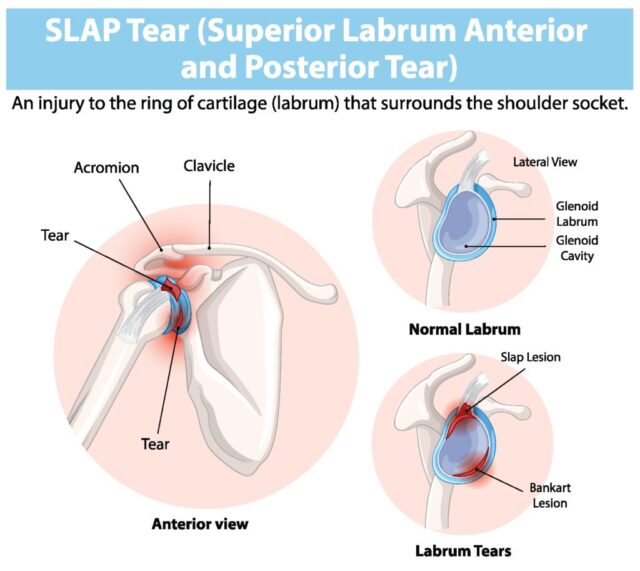
A labral injury is damage to the labrum — the ring of fibrocartilage around the rim of the shoulder socket. The labrum deepens the socket and anchors key ligaments, so injury can affect both comfort and stability.
The shoulder is a ball-and-socket joint with a deliberately shallow socket — that is what gives it the largest range of motion of any joint in the body. The trade-off is that stability depends on the labrum, the capsule and ligaments, and the surrounding muscles working together.
Labral tears are described by their location — SLAP tears at the top (where the biceps tendon attaches) and Bankart tears at the front (typically after dislocation) are the best known patterns.
What does a labral injury feel like?
The common picture is deep shoulder pain with clicking, catching or clunking, and sometimes a sense that the shoulder is loose or about to give way.
Common symptoms include:
- A deep ache within the shoulder, hard to pinpoint
- Clicking, catching or clunking with movement
- Pain with overhead or throwing movements
- A feeling of instability or apprehension in certain positions
- Pain lying on the affected side
- Loss of throwing power or overhead endurance in athletes
What causes a labral injury?
Labral injuries follow either a single traumatic event — a dislocation, a fall onto the arm, a heavy tackle — or accumulate gradually through repetitive overhead loading.
Common causes include shoulder dislocation or subluxation, falls onto an outstretched arm, traction injuries (a sudden pull on the arm), repetitive throwing or overhead sport, heavy overhead lifting, and age-related wear — labral fraying becomes increasingly common and increasingly normal from midlife onwards.
Who is more likely to develop a labral injury?
Contact-sport athletes, throwers, overhead athletes and anyone who has dislocated their shoulder are at highest risk.
Young athletes who dislocate a shoulder have a high chance of labral (Bankart) injury, which is why that group is assessed carefully. In older adults, degenerative labral fraying is often an incidental finding rather than the true pain source.
How is a labral injury diagnosed?
Diagnosis combines the story — how the injury happened — with specific examination tests for labral pain and instability. Imaging confirms the pattern where it will change management.
Assessment distinguishes a genuinely symptomatic labral tear from the many other causes of similar pain — rotator cuff problems, biceps tendinopathy and impingement — which frequently coexist. Getting this right matters, because treating an incidental labral finding while missing the real pain source is a common path to failed treatment.
Do I need an MRI or MR arthrogram?
If a labral tear will change management — for example after a dislocation in a young athlete — MRI, sometimes with joint contrast (MR arthrogram), is the best test for the labrum.
Two caveats matter. First, labral changes are common on MRI in completely pain-free shoulders, especially with age — so scan findings are always matched against the examination. Second, ultrasound cannot see the labrum directly, but it assesses the rotator cuff and biceps tendon (frequent co-contributors) in real time, and allows a precisely placed diagnostic injection that can confirm whether the joint is truly the pain source.
How is a labral injury treated?
Many labral injuries improve without surgery. Structured rehabilitation that rebuilds the shoulder’s muscular stability is the foundation, with image-guided procedures supporting progress where pain is a barrier.
A complete treatment programme may include:
- A progressive rehabilitation programme targeting the rotator cuff and shoulder blade stabilisers — the shoulder’s dynamic stability system
- Activity and technique modification during the rehabilitation window
- Ultrasound-guided intra-articular injection to settle pain so rehabilitation can progress — and, diagnostically, to confirm the joint as the pain source
- Treatment of coexisting problems such as biceps tendinopathy, including ultrasound-guided tendon sheath injection or PRP where appropriate
- A guided return-to-sport progression for athletes
The evidence in throwing athletes is instructive: rehabilitation returns most to sport, and surgical repair of some tear patterns (particularly SLAP tears in adults over 30–40) has disappointing return-to-performance rates. Surgery is not the default — it is one option, for specific situations.
How long does a labral injury take to improve?
With structured rehabilitation, most people improve substantially over eight to sixteen weeks. Athletes returning to throwing or contact sport typically need three to six months.
Progress is tracked functionally — pain, strength, confidence in provocative positions — rather than by expecting the tear to “heal over” on a repeat scan. Many well-functioning shoulders have imperfect labrums.
Do I need surgery for a labral tear?
Not necessarily. Surgery is genuinely indicated for recurrent instability — a shoulder that keeps dislocating, especially in young contact athletes — and for selected tear patterns that fail proper rehabilitation.
For degenerative fraying and many SLAP tears, evidence favours rehabilitation first: trials of SLAP repair in middle-aged adults show no advantage over non-surgical care, and biceps-focused treatment often addresses the actual pain.
If you have been told you need labral surgery, a structured second opinion — confirming the tear is truly the pain source, checking what rehabilitation has actually been completed, and considering a diagnostic ultrasound-guided injection — is a reasonable and increasingly common step.
When should I seek medical assessment?
Seek assessment after any shoulder dislocation, if the shoulder repeatedly feels unstable, or if deep shoulder pain with clicking has persisted beyond a few weeks.
Recurrent instability in a young athlete deserves early specialist assessment, because each dislocation can add damage.
Assessment at Triaxis Sports & Joint Clinic
Triaxis Sports & Joint Clinic at Farrer Park Hospital provides assessment for shoulder injuries, instability and sports injuries.
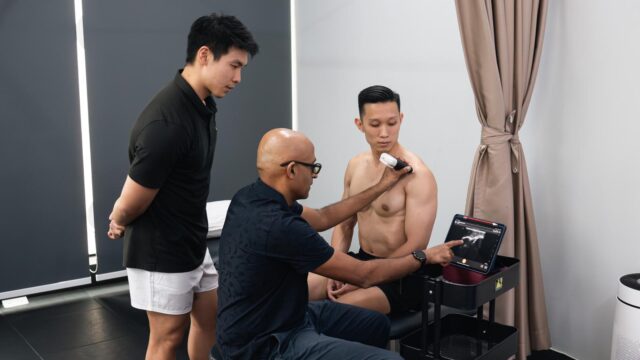
Assessment includes a musculoskeletal examination, diagnostic ultrasound of the surrounding tendons where appropriate, and precise ultrasound-guided injections where they will settle pain or clarify the diagnosis. Rehabilitation planning, imaging decisions and — where genuinely indicated — surgical referral are discussed openly, so you understand every option before deciding on a plan.
Frequently asked questions
Can a labral tear heal on its own?
The labrum has a limited blood supply, so tears rarely “seal over” — but that is not the same as needing surgery. Shoulders function well when the surrounding muscles provide stability, which is exactly what rehabilitation rebuilds. Many people with labral tears return to full activity without an operation.
My MRI shows a labral tear — does that explain my pain?
Not automatically. Labral changes are common on MRI in pain-free shoulders, particularly with age. The examination, and sometimes a precisely placed diagnostic injection, determine whether the tear is truly the pain source before any decision about surgery.
What is the difference between a SLAP tear and a Bankart tear?
A SLAP tear affects the top of the labrum where the biceps tendon anchors, and is common in throwers. A Bankart tear affects the front of the labrum and typically follows a dislocation, contributing to ongoing instability. The distinction matters because the treatments differ.
Can I return to sport with a labral tear?
Very often, yes. Most overhead and contact athletes return to sport with structured rehabilitation. Recurrent instability is the main situation where surgery earns its place before return to contact sport.
Can an injection help a labral injury?
An ultrasound-guided intra-articular injection can settle pain so rehabilitation can progress, and doubles as a diagnostic test — meaningful relief helps confirm the joint as the pain source. It is used as part of a complete treatment programme, not as a standalone fix.
Shoulder clicking, instability — or told you need labral surgery?
Many labral injuries improve without an operation. Dr Sirisena offers assessment with diagnostic ultrasound during the consultation, structured rehabilitation planning and precise ultrasound-guided injections — as a first port of call or a second opinion before surgery.
Triaxis Sports & Joint Clinic, Farrer Park Hospital · WhatsApp +65 8889 3594 · hello@triaxisclinic.com · Repair · Restore · Reclaim
About the author
Written and medically reviewed by Dr Dinesh Sirisena, Consultant in Sports, Exercise & Musculoskeletal Medicine, and author of Ultrasound-Guided Musculoskeletal Procedures in Sports Medicine (Elsevier, 2021). Dr Sirisena focuses on the non-surgical and image-guided treatment of musculoskeletal and sports injuries.