Hydrodilatation: Uses, Evidence, Risks and What to Expect
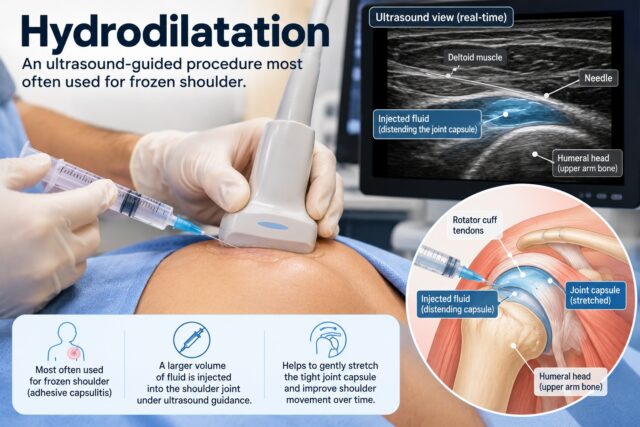
Hydrodilatation is an ultrasound-guided procedure most often used for frozen shoulder. A controlled volume of fluid introduced into the shoulder joint to gently expand the tightened joint capsule, usually together with local anaesthetic and, where appropriate, corticosteroid. It’s a well-tolerated day procedure with a strong safety record. It can help ease pain and improve movement — particularly external rotation, one of the movements most affected in frozen shoulder — and works best as part of a structured plan that includes rehabilitation.
What is hydrodilatation?
Hydrodilatation an ultrasound-guided shoulder procedure used most often for adhesive capsulitis, commonly called frozen shoulder. A controlled volume of fluid introduced into the glenohumeral (shoulder) joint to gently expand the tightened joint capsule. The fluid usually includes saline and local anaesthetic, with corticosteroid added where appropriate.
In frozen shoulder, the capsule surrounding the joint becomes tight, which brings on pain and progressively restricts movement. Hydrodilatation works with this problem directly: by introducing fluid under gentle pressure, it distends the capsule, creates more space within the joint, and helps restore movement.
Hydrodilatation also known as:
- Hydrodistension
- Joint distension
- Capsular distension
- Shoulder hydrodilatation
Although frozen shoulder the most common reason for the procedure, the same principle — using fluid to distend a tightened joint capsule under ultrasound guidance — can also be applied to help stiffness in other joints where the capsule has become restricted.
How does hydrodilatation work?
Hydrodilatation gently stretches and expands the tightened shoulder capsule by introducing fluid into the joint. This helps to create more room within the joint, ease movement and reduce pain. It’s a controlled, gradual process rather than a forceful one.
The shoulder joint is surrounded by a flexible sleeve of connective tissue called the joint capsule. In frozen shoulder, this capsule becomes tight and inflamed, and movement becomes restricted and uncomfortable.
During hydrodilatation, fluid is introduced into the glenohumeral joint under ultrasound guidance. The volume and gentle pressure distend the capsule, increase the available space within the joint, and help the shoulder move more freely. Where corticosteroid included, it can also help settle the inflammation that contributes to pain and stiffness.
This is best understood as gently distending and easing the capsule — creating room and improving mobility — rather than “breaking” or “tearing” anything. That description is both more accurate and a better reflection of what patients actually experience.
What’s frozen shoulder and why does the shoulder become stiff?
Frozen shoulder, or adhesive capsulitis, a condition in which shoulder pain and stiffness develop gradually because the capsule surrounding the joint becomes tight. Movement becomes restricted both when the patient moves the arm themselves and when a clinician moves the shoulder during examination.
The shoulder a ball-and-socket joint. The structures involved include:
Humeral head — the ball at the top of the upper arm bone.
Glenoid — the shallow socket on the shoulder blade.
Joint capsule — a flexible layer surrounding the joint.
Rotator cuff tendons — tendons that help control and stabilise shoulder movement.
Ligaments — connective tissues that help support the joint.
Muscles — including the rotator cuff, deltoid and shoulder blade muscles.
Nerves — supplying sensation and muscle control around the shoulder and arm.
In frozen shoulder, the main issue tightening of the joint capsule rather than simple muscle weakness — which exactly why a treatment aimed at the capsule itself, such as hydrodilatation, can be helpful.
Who may develop frozen shoulder?
Frozen shoulder commonly affects adults in middle age and can occur without any obvious injury. Certain medical conditions, particularly diabetes, are associated with a higher likelihood of developing it. A period of shoulder immobilisation after injury or surgery can also contribute.
Factors associated with frozen shoulder include:
- Age, particularly middle age
- Diabetes
- Thyroid disorders
- Previous shoulder injury
- Shoulder surgery
- Prolonged restriction of shoulder movement
Many people develop frozen shoulder without any clear trigger. Sports such as swimming, tennis, badminton, golf and weightlifting can make shoulder stiffness more noticeable, although the sport itself not usually the cause.
When may hydrodilatation be considered?
Hydrodilatation may be considered for patients with frozen shoulder when pain and stiffness continue to affect daily activity. It is one of several effective options and can be a helpful step for patients who want to ease symptoms and regain movement.
Management of frozen shoulder may include:
- Education and reassurance
- Appropriate pain management
- Activity modification
- Mobility and range-of-motion exercises
- Physiotherapy or rehabilitation
- Corticosteroid injection
- Hydrodilatation
- Less commonly, surgical procedures
The right choice depends on factors such as the stage and duration of symptoms, the severity of stiffness, pain levels, previous treatment, medical conditions, functional needs and patient preferences. Hydrodilatation fits naturally into this plan and often combined with rehabilitation to support recovery.
Does hydrodilatation help frozen shoulder?
Hydrodilatation can improve shoulder movement and comfort, and it’s particularly associated with improved external rotation — one of the movements most restricted in frozen shoulder. It’swell tolerated, has a strong safety record, and delivers its best results when combined with a structured rehabilitation programme.
Frozen shoulder generally has a favourable long-term outlook, and the aim of hydrodilatation to help patients get there more comfortably and with better movement along the way.
The evidence supports several encouraging points. A 2023 systematic review found that hydrodilatation could improve shoulder disability and passive external rotation compared with corticosteroid injection alone. A larger 2026 systematic review, covering 103 studies and 44 randomised controlled trials, confirmed better external rotation at 12 weeks compared with corticosteroid injection alone, with broadly comparable results on other measures such as pain and overall shoulder function. When hydrodilatation was combined with physical therapy or exercise, that same review found small additional improvements in pain and disability compared with therapy alone.
Taken together, this positions hydrodilatation as a useful, well-tolerated option within a broader management plan — most effective when paired with rehabilitation, rather than as a stand-alone cure.
How does hydrodilatation compare with a steroid injection?
Hydrodilatation and a steroid injection are not simply competing alternatives. Hydrodilatation can include corticosteroid while adding the mechanical benefit of gently distending the capsule — in effect combining both effects in a single procedure.
Because corticosteroid often part of the hydrodilatation solution, the useful clinical question rarely “hydrodilatation or steroid?” Instead, the approach tailored to the individual, and hydrodilatation offers a way to deliver capsular distension and, where appropriate, the anti-inflammatory effect of corticosteroid together.
The evidence reflects this. Recent research shows an advantage for external rotation after hydrodilatation compared with corticosteroid injection alone, with comparable results on other measures. For many patients, combining gentle capsular distension with rehabilitation offers a practical and effective route to easing symptoms and restoring movement.
Is hydrodilatation the same as a steroid injection?
No. A steroid injection describes the medication being injected, while hydrodilatation describes a technique in which a larger, controlled volume of fluid introduced into the shoulder joint to expand the capsule. Corticosteroid can form part of the hydrodilatation solution, so the two overlap.
A typical hydrodilatation solution may contain:
- Saline
- Local anaesthetic
- Corticosteroid, where appropriate
The key point for patients understanding both what being injected and why a larger volume used — the volume what allows the capsule to be gently distended, which the mechanical part of the treatment.
Is hydrodilatation performed with ultrasound?
Yes. At Triaxis, hydrodilatation performed using ultrasound guidance, so the joint and the needle can be seen clearly in real time throughout the procedure.
Ultrasound guidance offers several practical advantages:
- Real-time visualisation of the needle as it enters the joint, supporting accurate placement.
- No ionising radiation, unlike X-ray-based imaging.
- The ability to assess the surrounding tendons and soft tissues at the same appointment.
- A comfortable, in-clinic setting without the need for a radiology suite.
Under ultrasound, the clinician can identify the humeral head, the shoulder joint, the nearby tendons and the surrounding soft tissues, and watch the fluid distend the capsule as it is introduced. This precision one of the reasons ultrasound-guided hydrodilatation a reassuring and well-controlled procedure.
Do I need an MRI or ultrasound before hydrodilatation?
Frozen shoulder usually diagnosed through symptoms and physical examination, so not everyone needs an MRI beforehand. Imaging is used when it will answer a specific clinical question — for example, if the diagnosis uncertain or another shoulder condition needs to be assessed.
Different imaging tests have different roles:
X-ray — may help identify arthritis, fractures or other bone-related conditions.
Musculoskeletal ultrasound — assesses the rotator cuff tendons, the biceps tendon and other structures, and is also used to guide the procedure itself.
MRI — considered when deeper structures or an alternative diagnosis need investigation.
Imaging chosen to answer a clinical question rather than ordered routinely for everyone with shoulder stiffness.
What happens during hydrodilatation?
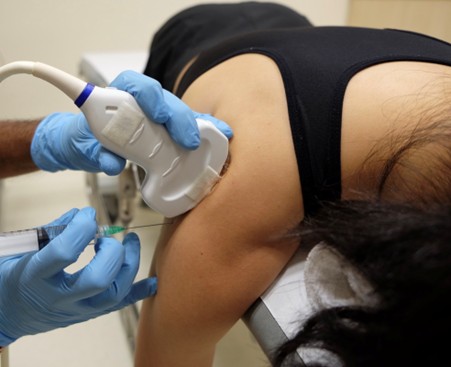
During hydrodilatation, the shoulder is positioned and the joint is identified using ultrasound. After the skin is cleaned, a fine needle is guided into the joint and fluid is introduced gradually while the clinician watches in real time. Patients are then given clear advice about movement and rehabilitation.
A typical appointment involves:
- Clinical review of symptoms and diagnosis.
- Explanation of what to expect, the benefits and the risks.
- Positioning of the shoulder.
- Ultrasound guidance to locate the joint.
- Cleaning of the skin.
- Placement of a fine needle into the shoulder joint.
- Gradual introduction of the fluid to distend the capsule.
- Post-procedure advice.
- Rehabilitation planning.
The whole procedure is carried out gently and gradually, with the volume tailored to the individual shoulder and the patient’s comfort throughout.
Is hydrodilatation painful?
Hydrodilatation generally well tolerated. Local anaesthetic is usually included in the injection to keep the procedure comfortable, and most patients describe a feeling of pressure as the fluid introduced rather than sharp pain. Some temporary soreness afterwards normal and settles quickly.
Patients may notice:
- Mild needle discomfort
- A sensation of pressure inside the shoulder as the fluid is introduced
- Temporary soreness for a short period afterwards
Knowing what to expect helps most patients feel at ease, and the team will explain what is normal and what, if anything, should prompt a follow-up.
What are the possible risks of hydrodilatation?
Hydrodilatation has a strong safety record, and serious complications are uncommon. As with any injection, there are some risks to be aware of, and these are discussed with you beforehand so you can make an informed decision.
Reassuringly, a 2026 systematic review reported only two infections among 8,754 patients in the studies that recorded this outcome — around 0.02%, a very low rate.
Points to be aware of include:
- A temporary flare of pain or soreness
- Bruising or minor bleeding at the injection site
- A small risk of infection
- Reaction to medication
- A temporary rise in blood glucose if corticosteroid used, particularly relevant for patients with diabetes
- Skin or soft-tissue effects associated with corticosteroid
Sharing information about your medications, allergies, diabetes and other medical conditions before treatment helps keep the procedure safe and appropriate for you.
How long does hydrodilatation take to work?
Recovery varies from person to person. Some patients notice an improvement in pain or movement within the first few weeks, while others improve more gradually. Because frozen shoulder tends to improve over time, progress is best judged by how your movement and function are returning.
Clinical trials commonly assess outcomes over weeks to months, with particular attention to the 12-week mark, where hydrodilatation has shown a clear advantage for external rotation. Pairing the procedure with rehabilitation helps you make the most of the movement it creates and supports steady, lasting progress.
Do I still need rehabilitation after hydrodilatation?
Yes, rehabilitation an important partner to the procedure. Hydrodilatation creates more room and movement in the joint, and rehabilitation helps you use and build on that movement to return to daily and sporting activities.
Rehabilitation may include:
- Gentle shoulder mobility work
- Range-of-motion exercises
- Gradual strengthening
- Shoulder blade exercises
- Activity modification
- Progressive return to work or sport
Evidence supports this combined approach: a 2026 review found that adding hydrodilatation to physical therapy or exercise produced small improvements in pain and disability compared with therapy alone. Hydrodilatation and rehabilitation work best together, as two parts of one recovery plan.
Can I exercise after hydrodilatation?
Yes, gentle movement usually encouraged soon after the procedure, with the timing and intensity guided by your symptoms and your rehabilitation plan. The aim to build useful movement steadily rather than to force the shoulder.
Exercises often focus on:
- Forward elevation
- External rotation
- Internal rotation
- Shoulder blade control
- Gradual strengthening
For athletes, returning to swimming, tennis, golf, badminton or weight training guided by shoulder function rather than a fixed timetable, so you can return with confidence.
Can frozen shoulder recover without hydrodilatation?
Yes. Frozen shoulder often improves over time, and management can involve education, appropriate pain relief, activity modification, exercise and rehabilitation. Hydrodilatation one helpful option that can ease symptoms and restore movement sooner — it’s a choice, not a requirement.
Treatment tailored to your pain, stiffness, functional limitations, symptom duration, medical conditions, response to rehabilitation and personal preferences. Surgery is reserved for the small number of patients whose significant symptoms persist despite appropriate non-surgical management.
When should I seek medical assessment for a stiff shoulder?
Consider a medical assessment when shoulder pain and stiffness begin to restrict dressing, reaching, sleeping, work or exercise — particularly when movement has been limited for several weeks. Prompt assessment is also sensible after significant trauma or if you notice sudden weakness, marked swelling, fever or other unusual symptoms.
It’s worth seeking assessment when there is:
- Progressive loss of shoulder movement
- Persistent night pain
- Difficulty dressing or reaching overhead
- Difficulty reaching behind the back
- Significant weakness
- Recent trauma
- Fever or marked swelling
- Numbness or other neurological symptoms
- Symptoms that are not improving as expected
A clinical assessment can distinguish frozen shoulder from rotator cuff problems, arthritis and other causes of shoulder pain, so the right plan can be put in place early.
How is hydrodilatation considered at Triaxis Sports & Joint Clinic?
At Triaxis Sports & Joint Clinic, hydrodilatation is considered for patients with frozen shoulder following a thorough clinical assessment. Care includes Sports Medicine evaluation, musculoskeletal examination, sports ultrasound where appropriate, a clear discussion of the options, rehabilitation planning and shared decision-making.
Assessment may consider:
- The duration and pattern of symptoms
- Shoulder range of motion
- Functional limitations
- Previous rehabilitation
- Medical conditions such as diabetes
- Relevant imaging
- The full range of management options
Where hydrodilatation is discussed, you will have the chance to understand what the procedure involves, what medication may be used, what the evidence shows, the potential risks, what to expect afterwards and the rehabilitation that supports recovery. The aim always a plan that fits you.
Frequently Asked Questions About Hydrodilatation
Does hydrodilatation help frozen shoulder?
Yes. Hydrodilatation gently expands the tightened shoulder capsule and can improve movement and comfort, with a particular benefit for external rotation. Frozen shoulder also tends to improve over time, and hydrodilatation — combined with rehabilitation — can help you get there more comfortably.
How does hydrodilatation compare with physiotherapy?
They complement one another rather than compete. A 2026 systematic review found that adding hydrodilatation to physical therapy or exercise produced small improvements in pain and disability compared with therapy alone. Rehabilitation remains an important part of the plan, and hydrodilatation supports it.
How does hydrodilatation compare with a cortisone injection?
Hydrodilatation can include corticosteroid while also gently distending the capsule, so it often combines both effects. Recent evidence shows a benefit for external rotation compared with corticosteroid injection alone, with comparable results on other measures. The best choice is tailored to your individual situation.
Does hydrodilatation break the shoulder capsule?
No. Hydrodilatation works by gently distending and stretching the capsule with fluid to create more space and ease movement. It is a controlled, gradual process rather than a forceful “breaking” of tissue.
How many hydrodilatation injections will I need?
This is tailored to the individual. Many patients benefit from a single procedure alongside rehabilitation. Whether a further procedure is helpful depends on your symptoms, movement, previous response and overall plan, and discussed with you.
Can hydrodilatation help me avoid shoulder surgery?
Most patients with frozen shoulder improve without surgery, and hydrodilatation is one of the non-surgical options that can help. Surgery only considered in selected patients whose symptoms and functional limitations persist despite appropriate non-surgical management.
How long should I rest after hydrodilatation?
Aftercare is tailored to you and the medications used. Short-term soreness may occur, and gentle movement and rehabilitation are usually encouraged as part of recovery. You will be given clear, individual instructions to follow, and heavier exercise is guided by your shoulder’s symptoms and function.
Is hydrodilatation safe for people with diabetes?
Hydrodilatation can be considered for people with diabetes, with individual assessment. Because corticosteroid often part of the solution and can temporarily affect blood glucose, your clinician will discuss this with you and advise on monitoring if steroid medication is used.
About the Author
Dr Dinesh Sirisena is a Consultant in Sports, Exercise & Musculoskeletal Medicine. His clinical work includes the assessment and management of sports injuries and musculoskeletal conditions affecting joints, muscles, tendons, ligaments and related structures.
Medical Disclaimer
This page provides general educational information and does not replace individual medical advice. Hydrodilatation not necessary or suitable for every person with frozen shoulder. Decisions about imaging, injections, rehabilitation or other management options should depend on the individual’s symptoms, medical history, clinical findings and treatment goals.