
High-Volume Saline Injection: Uses, Evidence and What to Expect
Written and medically reviewed by
Dr Dinesh Sirisena
Consultant in Sports, Exercise & Musculoskeletal Medicine
Triaxis Sports & Joint Clinic
High-volume saline injection is an ultrasound-guided procedure that has mainly been studied for chronic mid-portion Achilles tendinopathy. A relatively large volume of fluid is injected around the tendon, commonly between the Achilles tendon and the tissue in front of it. Research results are mixed, particularly when corticosteroid is not included. Exercise-based rehabilitation remains an important part of Achilles tendinopathy management.
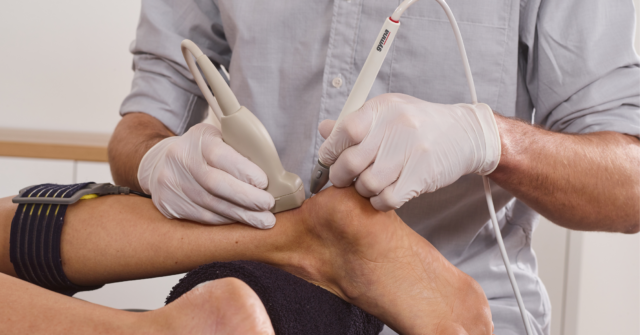
What is a high-volume saline injection?
A high-volume saline injection is an image-guided musculoskeletal procedure that has mainly been investigated for chronic mid-portion Achilles tendinopathy. A larger volume of fluid than in a conventional injection is introduced around the tendon under ultrasound guidance. Protocols differ between studies and may use saline with local anaesthetic, with or without corticosteroid.
The procedure is also known as:
- High-volume injection
- High-volume image-guided injection
- HVIGI
- High-volume distension injection
Importantly, it is not simply a large steroid injection. Published research has used different mixtures.
For example, a large placebo-controlled trial studied a 50 mL injection containing saline and local anaesthetic without corticosteroid.
Other studies included corticosteroid as part of the injection, making direct comparisons between research studies difficult.
What condition is high-volume saline mainly used for?
High-volume injection has primarily been studied for chronic mid-portion Achilles tendinopathy, where pain and tendon changes occur several centimetres above the heel bone. It should not be assumed to be an established treatment for every tendon injury or other musculoskeletal condition.
The Achilles tendon connects the calf muscles to the heel bone and plays an important role in:
- Walking
- Running
- Jumping
- Pushing off the ground
- Climbing stairs
Mid-portion Achilles tendinopathy commonly causes pain, stiffness and reduced tolerance to repeated loading.
It is particularly associated with running and other activities involving repeated jumping or acceleration.
A 2024 systematic review of high-volume injections identified 10 studies involving 460 participants with Achilles tendinopathy.
How is high-volume saline injection thought to work?
High-volume injection has been proposed to mechanically influence tissues and small blood vessels around the painful Achilles tendon by introducing fluid between the tendon and nearby tissue. However, the exact mechanism remains uncertain, and current evidence does not establish that the procedure heals, regenerates or structurally repairs the tendon.
Some people with chronic Achilles tendinopathy develop increased small blood vessels around the tendon, known as neovascularisation.
These vessels can be seen using Doppler ultrasound.
One proposed theory is that injecting a relatively large volume of fluid between the front of the Achilles tendon and Kager’s fat pad mechanically separates the tissues and affects these small vessels and accompanying nerve fibres.
However, this remains a proposed mechanism.
Changes seen on ultrasound do not automatically mean that a patient’s pain will improve, and reduction in neovascularisation should not be presented as proof of tendon healing.
Where is the fluid injected?
For mid-portion Achilles tendinopathy, high-volume injection is generally performed under ultrasound guidance around the front surface of the Achilles tendon, between the tendon and nearby Kager’s fat pad. The injection is intended to remain outside the tendon rather than being deliberately injected into the tendon fibres.
The basic anatomy includes:
Achilles tendon
Connects the calf muscles to the heel bone.
Gastrocnemius and soleus muscles
The major calf muscles that contribute to pushing the foot downwards.
Kager’s fat pad
A region of fatty tissue located in front of the Achilles tendon.
Blood vessels and nerves
Small blood vessels and nerve-related structures may occur around the tendon.
Ultrasound helps the clinician identify these structures during the procedure.
Why is ultrasound guidance used?
Ultrasound guidance allows the clinician to view the Achilles tendon and surrounding anatomy in real time while performing the injection. It can help identify the intended tissue plane and observe the needle and fluid during the procedure. However, ultrasound guidance does not guarantee that the procedure will improve symptoms.
Sports ultrasound can also assess:
- Tendon thickness
- Tendon structure
- Partial or complete tears
- Surrounding soft tissues
- Blood flow using Doppler imaging
Ultrasound and MRI are both recognised imaging methods for examining Achilles tendon disorders, with ultrasound having the additional ability to assess the tendon dynamically during ankle movement.
The value of ultrasound guidance is therefore anatomical rather than a guarantee of treatment effectiveness.
Does high-volume saline injection work for Achilles tendinopathy?
Current evidence is mixed. Some studies report improvements after high-volume injection, particularly when corticosteroid was included, while a well-designed randomised trial found no additional benefit from high-volume saline and local anaesthetic without corticosteroid when compared with a small placebo injection alongside exercise rehabilitation.
This distinction is important.
In the 2020 randomised controlled trial, 80 adults with chronic mid-portion Achilles tendinopathy completed a 24-week exercise programme. One group received a 50 mL high-volume injection, while the comparison group received a 2 mL placebo injection.
Both groups improved, but there was no significant difference between them in pain and function, patient satisfaction or return to desired sport. The researchers concluded that high-volume injection without corticosteroid could not be recommended for this patient group based on their findings.
A 2024 systematic review reached a more favourable but cautious conclusion. Across 10 studies, the authors reported possible improvements, particularly in the short term and in protocols containing corticosteroid. However, they also noted differences between studies and the need for more robust randomised controlled trials.
Therefore, this procedure should not be described as proven to work for everyone.
Does adding corticosteroid make a difference?
Some studies suggest that high-volume injections containing corticosteroid may produce greater early improvements in pain and function than protocols without corticosteroid. However, the evidence is not strong enough to conclude that corticosteroid-containing high-volume injections are universally better, and corticosteroid use around tendons requires appropriate clinical consideration.
The 2024 systematic review found that high-volume injections containing corticosteroid appeared to provide greater early improvement than those without corticosteroid, although differences were not significant at later follow-up points.
At the same time, expert reviews note that robust large-scale randomised trials of high-volume injection for Achilles tendinopathy remain lacking.
The choice of whether corticosteroid forms part of any procedure should therefore depend on the clinical situation rather than on a general assumption that it improves every outcome.
Is high-volume saline injection the same as a steroid injection?
No. High-volume saline injection describes the injection technique and volume, while a steroid injection refers to the medication used. Some high-volume injection protocols contain corticosteroid, whereas others use saline and local anaesthetic without corticosteroid. Patients should understand exactly what solution is being proposed before undergoing the procedure.
This difference also explains why studies can produce different results.
For example:
High-volume saline without corticosteroid
A major randomised trial found no additional benefit over placebo alongside exercise.
High-volume injection containing corticosteroid
Some studies included in a 2024 systematic review reported greater early improvements.
These protocols should therefore not be grouped together as though they are identical treatments.
Is high-volume injection the same as prolotherapy or PRP?
No. High-volume injection, prolotherapy and platelet-rich plasma are different procedures. High-volume injection uses a larger volume of fluid around selected tissues, prolotherapy commonly involves a dextrose-containing solution, while PRP uses a preparation derived from the patient’s blood. Their proposed mechanisms and evidence are different.
None should automatically be considered superior to another.
An expert review of Achilles imaging and interventions noted that large-scale randomised controlled trial evidence supporting high-volume injection, prolotherapy, tendon fenestration or PRP for Achilles tendinopathy remains limited.
For this reason, the diagnosis and quality of evidence for the individual intervention should guide discussion rather than terms such as “regenerative” or “advanced”.
Who may be considered for a high-volume injection?
High-volume injection may be discussed in selected patients with persistent mid-portion Achilles tendinopathy, particularly after an appropriate period of conservative management. However, there is no single profile that means a patient should automatically receive the procedure, and evidence regarding its additional benefit remains uncertain.
Clinical assessment may consider:
- Duration of Achilles symptoms
- Exact location of pain
- Tendon loading tolerance
- Previous rehabilitation
- Running or sporting demands
- Strength and calf function
- Medical conditions
- Previous injections
- Ultrasound findings where relevant
People involved in running, football, badminton, tennis, rugby and other jumping or running sports may develop Achilles tendinopathy, but participation in these sports alone is not a reason for injection treatment.
Do I need an ultrasound or MRI before considering high-volume injection?
A clinical assessment usually comes first. Musculoskeletal ultrasound may be useful for assessing the Achilles tendon and is also used to guide high-volume injection. MRI can provide additional information in selected cases, while X-rays may help when bone-related or insertional conditions are suspected. Not everyone with Achilles pain needs multiple scans.
Ultrasound can assess tendon structure and blood flow and can be used dynamically.
MRI can provide detailed imaging of the tendon and surrounding deeper tissues.
X-ray may help assess bone-related changes around the heel.
The imaging choice should depend on the clinical question.
A scan showing tendon changes does not automatically mean that an injection is necessary.
What happens during a high-volume saline injection?
During a high-volume injection, the patient is positioned so the Achilles tendon can be examined with ultrasound. The skin is cleaned, the relevant anatomy is identified and a needle is guided toward the intended tissue plane. Fluid is then introduced while the clinician observes the procedure in real time.
The exact protocol can vary.
A procedure may involve:
- Clinical review and confirmation of the indication.
- Ultrasound examination of the Achilles tendon.
- Discussion of possible benefits, limitations and risks.
- Skin preparation.
- Ultrasound-guided needle placement.
- Administration of the intended solution.
- Post-procedure advice.
- Rehabilitation planning.
Patients should be told which medications are included because published high-volume injection protocols are not all the same.
Is high-volume saline injection painful?
A high-volume injection involves a needle and the introduction of fluid around a sensitive musculoskeletal area, so discomfort, pressure or temporary soreness can occur. Local anaesthetic is included in some protocols. The amount of discomfort varies between people, and patients should be advised what to expect before and after the procedure.
The ultrasound scan itself is non-invasive.
Any discomfort is more commonly related to:
- Needle insertion
- Pressure from the injected volume
- An already painful tendon
- Temporary post-procedure soreness
Patients should receive individual advice about expected symptoms and warning signs following the procedure.
What are the possible risks?
Possible risks depend on the injection technique, medications included and individual medical circumstances. As with other needle-based procedures, considerations can include temporary pain, bruising, bleeding, infection and irritation of nearby structures. Additional risks may apply when medications such as corticosteroids or local anaesthetics are included.
A 2024 systematic review reported no adverse events in the included high-volume injection studies, but the authors also highlighted the need for larger, higher-quality trials with longer follow-up.
Therefore, absence of reported complications in these studies should not be interpreted as meaning the procedure is risk-free.
Patients should discuss:
- Current medication
- Blood-thinning medication
- Allergies
- Diabetes
- Previous tendon injury
- Previous injections
- Other medical conditions
before a procedure.
Do I still need rehabilitation after a high-volume injection?
Yes, rehabilitation generally remains important in Achilles tendinopathy because an injection does not automatically restore calf strength, tendon loading capacity or sporting function. Progressive exercise and load management are established components of Achilles rehabilitation and were used alongside injection treatment in major clinical trials.
Rehabilitation may involve:
- Education
- Modification of aggravating activities
- Progressive calf strengthening
- Tendon-loading exercises
- Gradual return to running
- Plyometric exercises when appropriate
- Sport-specific rehabilitation
The 2020 randomised trial instructed all participants to follow an exercise programme for 24 weeks. Both the high-volume injection and placebo groups improved over time.
This underlines why improvements following a procedure cannot necessarily be attributed to the injection alone.
How long does recovery take after a high-volume injection?
There is no fixed recovery time after high-volume injection. Progress depends on the underlying Achilles condition, duration of symptoms, physical demands, rehabilitation and individual response. The injection should not be presented as providing a rapid return to running or sport, and return-to-activity decisions should be based on function rather than a set number of days.
Recovery from Achilles tendinopathy itself can take time.
Rather than focusing only on pain, rehabilitation may assess:
- Calf strength
- Single-leg function
- Walking tolerance
- Running tolerance
- Hopping or jumping ability
- Response to increasing tendon load
The clinician and rehabilitation team can then guide progression according to the individual’s condition.
When should I seek assessment for Achilles pain?
Consider musculoskeletal assessment when Achilles pain persists, repeatedly returns or interferes with walking, exercise or sport. Assessment is also appropriate after a sudden injury, particularly if there is marked weakness, difficulty pushing off, significant swelling or concern about an Achilles tendon tear.
Seek prompt assessment following:
- A sudden “pop” or snapping sensation
- Difficulty walking normally
- Loss of push-off strength
- Significant bruising or swelling
- Sudden weakness
- A traumatic injury
Persistent pain without a sudden injury can also benefit from assessment when rehabilitation progress is limited or the diagnosis is uncertain.
How is high-volume saline injection considered at Triaxis Sports & Joint Clinic?
At Triaxis Sports & Joint Clinic, high-volume injection may be discussed in selected cases following Sports Medicine and musculoskeletal assessment. The clinic considers the diagnosis, previous rehabilitation, functional limitations, imaging where appropriate, current evidence and other management options before discussing whether an image-guided procedure has a role.
Assessment may include:
- Sports Medicine evaluation
- Clinical examination
- Assessment of calf strength and tendon loading
- Sports ultrasound where appropriate
- Review of previous treatment
- Patient education
- Rehabilitation planning
- Shared decision-making
Where a procedure is being considered, patients can discuss the solution being used, current evidence, potential limitations, risks and alternatives.
Depending on the individual’s condition and clinical assessment, certain procedures may be considered as part of a broader management plan.
This cautious wording is particularly appropriate because Singapore’s Healthcare Services advertising regulations require healthcare advertising information to be factually accurate, substantiable and not exaggerated, misleading or designed to create unjustified expectations.
Frequently Asked Questions About High-Volume Saline Injection
Does high-volume saline injection cure Achilles tendinopathy?
No. High-volume injection should not be described as curing Achilles tendinopathy or regenerating the tendon. A placebo-controlled randomised trial found that high-volume saline and local anaesthetic without corticosteroid did not provide additional improvement in pain or function compared with a small placebo injection alongside exercise rehabilitation. Other studies have produced different findings, so the evidence remains mixed.
Is high-volume saline injection effective without steroids?
The strongest placebo-controlled trial specifically evaluating high-volume injection without corticosteroid found no significant additional clinical benefit over placebo when both groups followed a 24-week exercise programme. This does not prove that every high-volume protocol is ineffective, but it means the procedure without corticosteroid should not be promoted as an established effective treatment.
Why is such a large volume of saline used?
The proposed aim is to introduce enough fluid between the front of the Achilles tendon and nearby tissue to mechanically separate the tissue planes and influence neovascular structures around the tendon. However, this proposed mechanism does not establish that the technique improves clinical outcomes, and research results remain inconsistent.
Is high-volume injection safer than steroid injection?
There is not enough evidence to make a general claim that high-volume saline injection is safer than a steroid injection. Risks depend on the ingredients, injection site, technique and individual patient. Some high-volume protocols include corticosteroid, while others do not. Potential risks and alternatives should therefore be considered for the specific procedure rather than comparing the names alone.
Can I run after a high-volume injection?
Return to running should depend on symptoms, calf strength, tendon loading tolerance and the rehabilitation plan rather than a fixed timetable. An injection does not mean the tendon is immediately ready for unrestricted exercise. Gradual loading and return-to-running progression may still be needed, particularly when symptoms have been present for a prolonged period.
Does high-volume injection replace Achilles rehabilitation?
No. Exercise and progressive tendon loading remain important parts of management for many people with Achilles tendinopathy. In a major high-volume injection trial, both treatment and placebo groups followed the same 24-week exercise programme, and both improved over time. Any procedure should therefore be considered within a broader rehabilitation strategy where appropriate.
Is high-volume injection the same as hydrodilatation?
Both involve introducing a larger volume of fluid, but they are not necessarily the same procedure. “High-volume injection” in Sports Medicine most commonly refers to procedures studied around the Achilles tendon. Hydrodilatation is also used to describe distension procedures in other anatomical areas, such as the shoulder capsule. The terms should not be used interchangeably without explaining the anatomical target and clinical purpose.
Who should consider a high-volume saline injection?
There is no single group for whom high-volume injection is automatically recommended. It may be discussed in selected patients with persistent mid-portion Achilles tendinopathy after clinical assessment and rehabilitation, but current evidence is mixed. Factors such as diagnosis, sporting demands, previous treatment, ultrasound findings and alternative management options should be considered before deciding whether the procedure has a role.
About the Author
Dr Dinesh Sirisena is a Consultant in Sports, Exercise & Musculoskeletal Medicine. His clinical work includes assessment and management of sports injuries and musculoskeletal conditions involving muscles, tendons, ligaments, joints and related structures.
Medical Disclaimer
This page provides general educational information and does not replace individual medical advice. High-volume injection is not required or suitable for every person with Achilles pain. Evidence regarding its effectiveness varies according to the injection protocol. Decisions about imaging, rehabilitation or image-guided procedures should follow individual clinical assessment.