
Piriformis Syndrome: Causes, Symptoms and Treatment Options
Written and medically reviewed by
Dr Dinesh Sirisena
Consultant in Sports, Exercise & Musculoskeletal Medicine
Triaxis Sports & Joint Clinic
Piriformis syndrome is a possible cause of buttock pain that may travel down the back of the leg. It is thought to involve irritation of the sciatic nerve around the piriformis muscle, although diagnosis can be challenging because symptoms overlap with sciatica from the lower back and other conditions. Management usually begins without surgery and may include activity modification, exercise and rehabilitation. When symptoms persist, ultrasound-guided minimally invasive treatments, including targeted injections, sciatic nerve hydrodissection, shockwave therapy and platelet-rich plasma (PRP), can help relieve pain and support a confident return to activity.
What is piriformis syndrome?
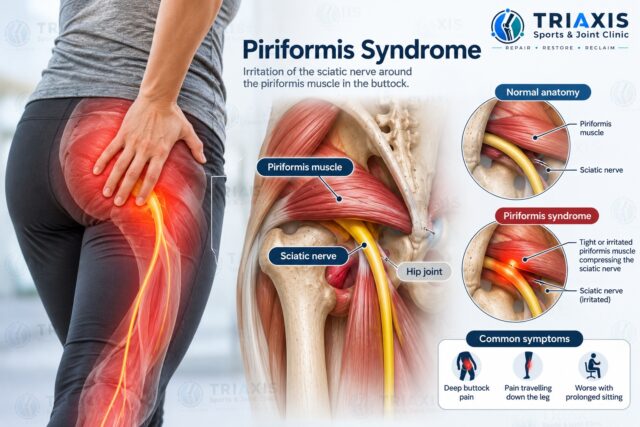
Piriformis syndrome describes buttock and sometimes leg symptoms thought to involve the piriformis muscle and nearby sciatic nerve. The piriformis is located deep in the buttock, and the sciatic nerve usually passes close to it. Irritation or compression around this area may produce symptoms similar to sciatica.
However, piriformis syndrome is not always straightforward to diagnose.
There is no single universally accepted test that proves someone has the condition, and several other problems can cause similar buttock and leg symptoms.
This is why a clinical assessment should consider the lower back, hip and surrounding muscles and nerves rather than assuming that buttock pain is coming from the piriformis.
For a broader overview of conditions affecting this region, see Triaxis’s guide to hip pain.
What does piriformis syndrome feel like?
Piriformis syndrome commonly causes a deep ache or tenderness in the buttock. Some people also experience pain that travels down the back of the thigh or leg. Symptoms may become more noticeable during prolonged sitting, walking, running or movements that load the muscles around the hip.
Patients may describe:
- Deep buttock pain
- Tenderness around the buttock
- Pain after sitting for a long time
- Pain travelling into the back of the thigh
- Tingling or altered sensation in some cases
- Discomfort during running or exercise
- Pain during certain hip movements
Because these symptoms overlap with other causes of sciatica and hip pain, symptoms alone cannot confirm piriformis syndrome.
Where is piriformis syndrome pain usually felt?
Pain is usually felt deep within one side of the buttock. It may remain around the buttock or travel down the back of the thigh and sometimes further into the leg. This pattern can resemble sciatica caused by irritation of a nerve in the lower back.
The location of pain is therefore only one part of the assessment.
For example, pain around the buttock may also be associated with:
- Lower-back conditions
- Sciatic nerve irritation
- Hip joint conditions
- Gluteal tendon problems
- Sacroiliac joint problems
- Other causes of deep gluteal pain
Identifying where the symptoms begin, what makes them worse and whether there are neurological symptoms can help narrow down the possible causes.
What does the piriformis muscle actually do?
The piriformis is a small muscle located deep within the buttock. It connects the lower part of the spine to the upper thigh bone and helps control movement and stability of the hip. The sciatic nerve runs close to the muscle, which explains why problems in this area may sometimes produce leg symptoms.
The piriformis works with several other muscles around the hip.
These include the gluteal muscles and other small muscles that help rotate and stabilise the hip.
The sciatic nerve is a large nerve travelling from the lower back through the buttock and down the leg. Its close relationship with the piriformis is important when assessing possible piriformis-related symptoms.
What causes piriformis syndrome?
There is not always one clear cause of piriformis syndrome. Symptoms may develop following changes in activity, repetitive loading, prolonged sitting or an injury around the buttock. Anatomical differences between the piriformis muscle and sciatic nerve may also exist, although their importance varies between individuals.
Possible contributing factors include:
- Sudden increases in running or exercise
- Repetitive hip movements
- Prolonged sitting
- Direct injury to the buttock
- Changes in training load
- Muscle irritation
- Previous hip or pelvic injury
Importantly, symptoms should not automatically be blamed on a “tight piriformis.” Other causes of buttock and leg pain may need to be considered first. Current reviews emphasise that the diagnosis remains challenging and that there is no widely accepted confirmatory test. PubMed
Which sports may aggravate piriformis-related symptoms?
Activities involving repeated hip movement, running or prolonged loading of the buttock muscles may aggravate symptoms in some people. However, no particular sport automatically causes piriformis syndrome, and similar symptoms in athletes may come from several different structures.
Relevant activities may include:
- Running
- Football and futsal
- Cycling
- Tennis
- Badminton
- Pickleball
- Padel
- Golf
- Weightlifting
Athletes with buttock or leg symptoms should be assessed according to their individual movement patterns and training demands rather than assuming the sport itself is responsible.
The Triaxis Sports Injury Management services provide further information about the clinic’s approach to sports-related musculoskeletal conditions. Triaxis Sports & Joint Clinic
How is piriformis syndrome diagnosed?
Piriformis syndrome is mainly assessed through the patient’s history and physical examination. There is no single test that reliably confirms the diagnosis. Assessment therefore looks at the pattern of symptoms, movements that reproduce pain and other possible causes involving the lower back, hip or sciatic nerve.
A clinical assessment may consider:
- Where the pain starts
- Whether pain travels down the leg
- Sitting tolerance
- Hip movement
- Muscle strength
- Tenderness around the buttock
- Neurological symptoms
- Lower-back symptoms
- Exercise and sporting activities
This is particularly important because piriformis syndrome can resemble lumbar sciatica and other forms of deep gluteal pain.
Do I need an X-ray, MRI or ultrasound?
Not everyone with suspected piriformis syndrome needs imaging. Imaging may be considered when the diagnosis is unclear, symptoms persist, or another condition needs to be investigated. The choice of X-ray, MRI or ultrasound depends on what the clinical assessment suggests.
X-rays may help assess certain bone, joint or hip-related conditions but do not show the piriformis or sciatic nerve in detail.
MRI may be considered when clinicians need to assess deeper structures or investigate other possible causes of buttock and sciatic-type pain.
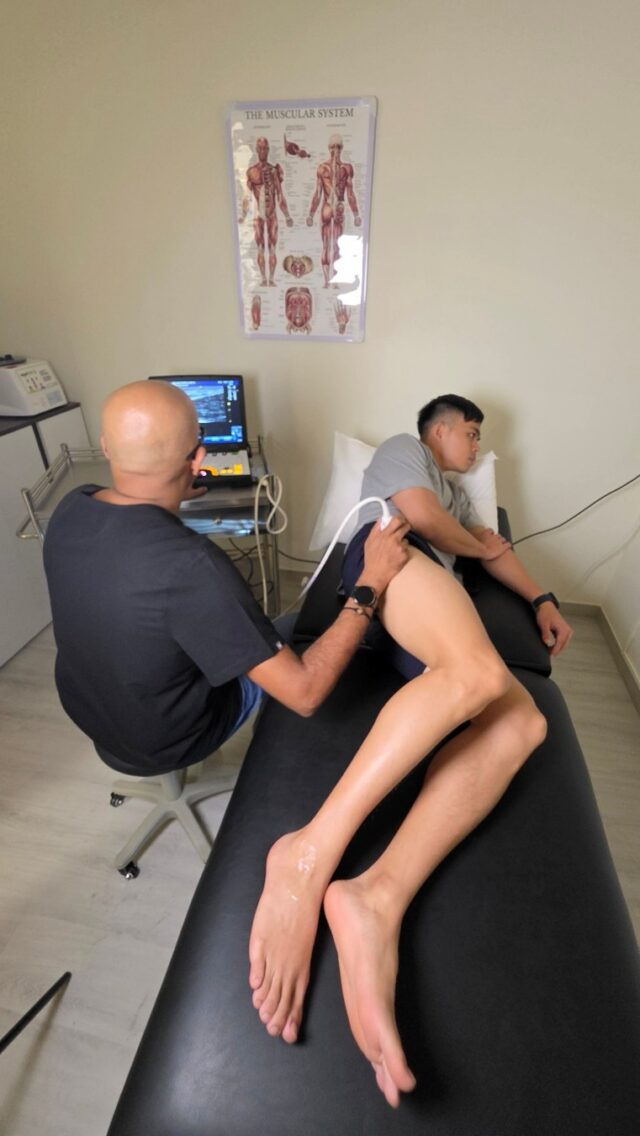
Musculoskeletal ultrasound can provide real-time imaging of muscles and selected soft tissues and may also be used to guide certain procedures.
However, ultrasound findings alone do not establish piriformis syndrome. Triaxis’s Musculoskeletal Ultrasound guide explains when ultrasound may form part of a musculoskeletal assessment.
What treatment options are available for piriformis syndrome?
Management usually begins conservatively and depends on the likely cause of symptoms. Treatment may include education, temporarily modifying aggravating activities, exercise therapy and rehabilitation. The aim is to improve movement and function while gradually increasing tolerance to everyday activities and sport.
Management may include:
- Education about the condition
- Activity and training modification
- Rehabilitation
- Exercise therapy
- Hip and gluteal strengthening
- Mobility work where appropriate
- Gradual return to activity
- Management of contributing lower-back or hip factors
- Ultrasound-guided minimally invasive procedures when symptoms persist
Surgery is not usually the first approach.
Importantly, rehabilitation should be based on the individual assessment rather than simply prescribing piriformis stretching to everyone.
What exercises may help piriformis syndrome?
Exercises may focus on hip strength, movement control, mobility and gradually increasing tolerance to activities that cause symptoms. Stretching may be appropriate for some people, but it is not necessarily the right approach for everyone. Exercise selection should reflect the person’s symptoms and the findings from clinical assessment.
A rehabilitation programme may include:
- Gluteal strengthening
- Hip strengthening
- Core and trunk exercises
- Movement control exercises
- Hip mobility exercises
- Gradual walking or running progression
- Sport-specific rehabilitation
Significant pain, numbness or weakness during exercise may require reassessment rather than simply pushing through the symptoms.
What minimally invasive procedures can help piriformis syndrome?
When buttock and leg pain persists despite rehabilitation, ultrasound-guided minimally invasive procedures can settle pain, calm an irritated sciatic nerve and open a window to progress rehabilitation. Options at Triaxis include ultrasound-guided piriformis injections, sciatic nerve hydrodissection, shockwave therapy and PRP, with Tenex ultrasonic tenotomy available when a coexisting tendon problem is found. None of these involve open surgery, and each is matched to the findings of your assessment.
Because each procedure targets a different source of pain, an accurate diagnosis comes first. Ultrasound shows the piriformis, the sciatic nerve and nearby blood vessels in real time, allowing precise needle placement while protecting surrounding structures. Find out more about ultrasound-guided procedures at Triaxis.
Ultrasound-guided piriformis injection
A small volume of local anaesthetic, often combined with a corticosteroid, is placed precisely into the piriformis muscle under ultrasound guidance. Beyond relieving pain, the response to the injection helps confirm whether the piriformis is a meaningful source of symptoms, which guides the rest of the treatment plan. A systematic review and meta-analysis found that local anaesthetic combined with corticosteroid produced the largest improvement in pain among the injection options studied [1]. Learn more about ultrasound-guided steroid injections.
For people with persistent piriformis tightness, botulinum toxin may also be considered. It relaxes the overactive muscle gradually over several weeks, easing pressure around the sciatic nerve, and in a randomised controlled trial it improved pain when combined with physiotherapy [2].
Sciatic nerve hydrodissection
Hydrodissection uses a precise, ultrasound-guided injection of fluid to gently free the sciatic nerve from surrounding muscle and connective tissue that may be compressing or irritating it. It is particularly well suited to people whose symptoms suggest nerve involvement in the deep gluteal space, such as pain, tingling or altered sensation travelling down the leg. In a case series of 53 patients with deep gluteal syndrome, 62% reported at least a 50% reduction in pain at final follow-up, with no nerve or blood vessel injuries [3]. Learn more about nerve hydrodissection.
Shockwave therapy (ESWT)
Extracorporeal shockwave therapy delivers acoustic pulses through the skin to the deep buttock muscles, with no needles and no downtime, so most people return to work straight away. Two randomised controlled trials have found shockwave therapy to be similarly effective to ultrasound-guided corticosteroid injection for piriformis syndrome, making it an appealing needle-free option [4, 5].
Platelet-rich plasma (PRP)
PRP is a concentrated preparation of your own platelets, which carry growth factors involved in tissue repair. In a randomised controlled trial of 60 patients, ultrasound-guided PRP injection into the piriformis produced faster improvements in pain and function than a saline injection, with both groups similar at one month [6]. PRP is also a well-established option for tendon conditions around the hip and buttock, such as gluteal or proximal hamstring tendinopathy, which can accompany or mimic piriformis syndrome.
Tenex ultrasonic tenotomy
Deep buttock pain does not always come from the piriformis. Recent research highlights that tendon and muscle-attachment problems in the deep gluteal region can be important pain generators in their own right [7]. When assessment identifies a chronic, degenerative tendon problem, Tenex removes damaged tendon tissue through a tiny skin opening under local anaesthetic and ultrasound guidance, helping the tendon heal. Tenex treats the coexisting tendon rather than the piriformis muscle itself. Learn more about Tenex therapy.
Comparing minimally invasive options for piriformis syndrome
| Procedure | What it targets | Key benefit |
| Ultrasound-guided piriformis injection | Piriformis muscle | Pain relief and helps confirm the diagnosis |
| Botulinum toxin | Persistent piriformis tightness | Gradual muscle relaxation alongside physiotherapy |
| Sciatic nerve hydrodissection | Irritated or compressed sciatic nerve | Frees the nerve to ease leg symptoms |
| Shockwave therapy (ESWT) | Deep buttock muscles | Needle-free with no downtime |
| Platelet-rich plasma (PRP) | Piriformis and nearby tendons | Uses your own healing factors |
| Tenex ultrasonic tenotomy | Coexisting degenerative tendon | Removes damaged tendon tissue |
Procedures work best as part of a complete plan. Most people continue a tailored rehabilitation programme alongside any procedure, which helps maintain the improvement and lowers the chance of symptoms returning.
When should I seek assessment for buttock or leg pain?
Consider medical assessment if buttock pain persists, repeatedly returns, travels down the leg or begins to affect sitting, walking, exercise or daily activities. Assessment is also important when symptoms include significant weakness, persistent numbness or other neurological changes.
Seek more urgent medical attention for symptoms such as:
- New or worsening leg weakness
- Significant numbness
- Loss of bladder or bowel control
- Numbness around the groin or saddle area
- Severe symptoms following significant trauma
These symptoms should not simply be assumed to be piriformis syndrome.
How is piriformis syndrome assessed at Triaxis Sports & Joint Clinic?
Assessment at Triaxis Sports & Joint Clinic focuses on identifying the likely source of buttock or leg symptoms rather than assuming that the piriformis muscle is responsible. Clinical assessment may include the lower back, hip, muscles, nerves, movement and relevant sporting or occupational demands.
Depending on the findings, assessment and management may involve:
- Sports Medicine
- Musculoskeletal Medicine
- Clinical examination
- Movement and strength assessment
- Musculoskeletal ultrasound where appropriate
- Ultrasound-guided procedures where appropriate, including injections, hydrodissection, shockwave therapy, PRP and Tenex
- Rehabilitation planning
- Patient education
- Shared decision-making
Further information about the clinic’s broader approach is available through Triaxis Sports & Joint Clinic services.
Frequently Asked Questions on Piriformis Syndrome
Is piriformis syndrome the same as sciatica?
Not exactly. Sciatica describes pain or neurological symptoms along the sciatic nerve, often caused by irritation of a nerve root in the lower back. Piriformis syndrome describes symptoms thought to involve the sciatic nerve around the piriformis muscle in the buttock. Because symptoms can be similar, clinical assessment may be needed to distinguish between possible causes.
How do I know if my sciatic pain is coming from the piriformis?
It can be difficult to determine from symptoms alone. Piriformis-related symptoms often include deep buttock pain that may worsen with sitting and sometimes travel down the leg. However, lower-back and other conditions can produce a similar pattern. There is no single widely accepted test that confirms piriformis syndrome, so diagnosis relies on the overall clinical picture.
Can piriformis syndrome go away?
Symptoms may improve with conservative management, particularly when aggravating activities and contributing factors are identified. Management may involve changes to activity, exercise and rehabilitation. Recovery varies depending on the cause, duration of symptoms and whether another lower-back, hip or nerve condition is contributing.
Is walking good for piriformis syndrome?
Walking may be comfortable and useful for some people, while longer walks may aggravate symptoms in others. There is no single activity recommendation that suits everyone. Rather than stopping movement completely, activity can often be adjusted according to symptoms and gradually progressed as tolerance improves.
Should I stretch my piriformis?
Piriformis stretching is commonly suggested, but stretching is not automatically appropriate for every person with buttock or sciatic-type pain. Treatment should consider why the symptoms are occurring. Some people may benefit more from strengthening, movement modification or addressing another source of symptoms rather than repeatedly stretching the piriformis.
Can running cause piriformis syndrome?
Running involves repeated loading of the hip and buttock muscles, and changes in training volume or intensity may contribute to symptoms in some runners. However, buttock pain in a runner does not automatically mean piriformis syndrome. Other possible causes include tendon conditions, lower-back problems and other forms of deep gluteal pain.
Can ultrasound diagnose piriformis syndrome?
Musculoskeletal ultrasound can visualise the piriformis muscle and surrounding soft tissues, but an ultrasound finding alone cannot reliably confirm piriformis syndrome. Ultrasound may provide additional information in selected patients and can also help guide certain procedures. Clinical history and examination remain important when determining the likely source of symptoms.
Does piriformis syndrome require surgery?
Surgery is generally not the first management option. Conservative treatment may include activity modification, exercise and rehabilitation. Procedures may be considered in selected cases. Surgical assessment is usually reserved for unusual or persistent cases where symptoms remain significant and the diagnosis and underlying cause have been carefully evaluated.
What non-surgical procedures can help piriformis syndrome?
Several ultrasound-guided options can help when rehabilitation alone has not settled symptoms. These include piriformis injections with local anaesthetic and corticosteroid or botulinum toxin, sciatic nerve hydrodissection to free an irritated nerve, needle-free shockwave therapy and PRP. Studies show that injections, hydrodissection and shockwave therapy can each meaningfully reduce pain in suitable patients. The right choice depends on whether the muscle, the nerve or a nearby tendon is the main source of pain.
About the Author
Dr Dinesh Sirisena is a Consultant in Sports, Exercise & Musculoskeletal Medicine. His clinical work includes assessment and management of sports injuries and musculoskeletal conditions involving muscles, tendons, ligaments, joints and related structures.
Medical Disclaimer
This article provides general educational information and does not replace individual medical advice, diagnosis or treatment. Buttock and leg symptoms can have several possible causes. Decisions about imaging, rehabilitation, medication or procedures should be based on the individual’s medical history, symptoms and clinical assessment.