Tennis Elbow: Causes, Symptoms and Treatment Options
Tennis Elbow, Written and medically reviewed by Dr Dinesh Sirisena · Consultant in Sports, Exercise & Musculoskeletal Medicine · Triaxis Sports & Joint Clinic
In short: Tennis elbow (lateral elbow tendinopathy) is a common, treatable tendon problem on the outer elbow, usually caused by repeated gripping and loading rather than a single injury. The reassuring news is that it rarely needs surgery. The treatments that work best target the tendon directly — a progressive strengthening programme, sensible load management, and time — with options such as shockwave therapy or image-guided injections for stubborn cases.
Key points at a glance
- Tennis elbow affects the tendons on the outer elbow and is usually caused by repetitive gripping or loading — not just playing tennis.
- It is a tendon-loading problem, so the most effective treatment is a progressive strengthening programme, not rest alone.
- A cortisone injection can ease pain briefly, but it is not the best long-term solution for most people.
- For stubborn cases, shockwave therapy, image-guided PRP or percutaneous ultrasonic tenotomy (Tenex) may help.
- Surgery is very rarely needed.
What is tennis elbow?
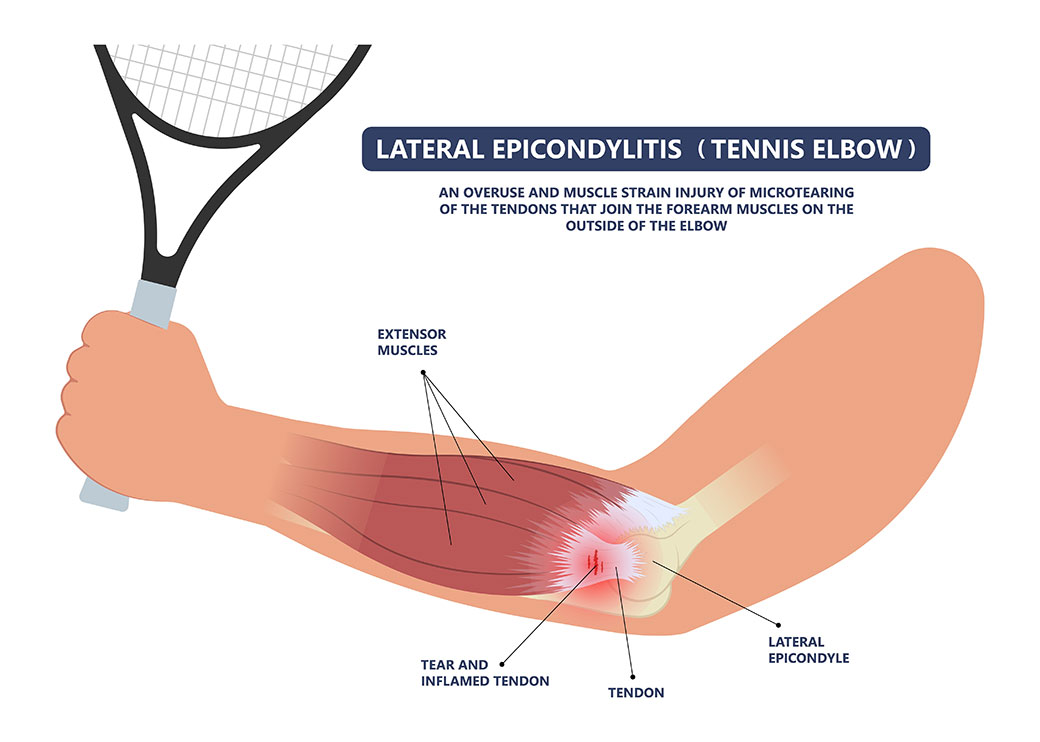
Tennis elbow is a tendon condition affecting the tendons that attach to the outer side of the elbow (the lateral epicondyle). It develops when these forearm tendons are loaded repeatedly over time, which is why it is now called lateral elbow tendinopathy.
The wrist-extensor tendons that control gripping and lifting attach here. Despite the name, most people with tennis elbow have never played tennis — it more often comes from work, gym training or everyday repetitive gripping.
Importantly, it is usually a problem of tendon overload and change rather than simple inflammation, which is why anti-inflammatory approaches alone often disappoint.
Why does tennis elbow happen, and what causes it?
Tennis elbow develops when the forearm tendons are loaded faster than they can adapt. It usually builds up gradually rather than from a single injury.
- Repetitive gripping
- Racquet sports, especially after a change in technique or training volume
- Gym training — heavy gripping, pull-ups, rows and deadlifts
- Manual work with hand tools
- Long periods using a computer mouse or keyboard, in some people
- A sudden increase in activity or load
In most people the common thread is a change in how much load the tendon is being asked to handle.
What does tennis elbow feel like?
Tennis elbow typically causes pain on the outside of the elbow, especially when gripping, lifting, twisting or carrying. Many people also notice a weaker grip.
- Pain and tenderness over the outer elbow
- Pain when lifting or carrying
- Discomfort opening jars or shaking hands
- A weakened grip
- Forearm aching after repetitive use
Unlike a trapped nerve, tennis elbow does not usually cause numbness or pins-and-needles. If you do notice tingling spreading into the hand, it is worth being assessed, as that can point to nerve involvement rather than tennis elbow.
Why hasn’t my tennis elbow healed?
Tendons respond to the right kind of load, not to rest alone. Many cases stall because the tendon is either doing too much or too little — and a structured loading programme is usually the missing piece.
Complete rest can feel better briefly, but it often allows the tendon to lose capacity, so symptoms return when you resume activity. A graded programme that gradually rebuilds the tendon’s tolerance is what tends to produce lasting improvement.
What are the best treatments for tennis elbow?
Tennis elbow is best treated as a complete programme built around the tendon: a progressive strengthening and loading programme, sensible activity modification, and time. Additional options can help stubborn cases.
- Education about tendon loading
- Activity modification — not complete rest
- A progressive strengthening and loading programme
- Grip and forearm conditioning
- Shockwave therapy for persistent cases
- Image-guided injections such as PRP where appropriate
- Percutaneous ultrasonic tenotomy (Tenex) for chronic, degenerative tendon changes that have not settled with a loading programme
- Sports ultrasound assessment to confirm the diagnosis and guide treatment
Should I get a cortisone injection for tennis elbow?
A cortisone injection can ease pain in the short term, but current evidence suggests it does not improve — and may slow — long-term recovery for most people. It is a tool for specific situations rather than a default.
For that reason, a loading-based programme is usually the priority, with injections considered selectively as part of a broader plan.
Is it tennis elbow or golfer’s elbow?
They are the same type of tendon problem in different places: tennis elbow affects the outer elbow, while golfer’s elbow affects the inner elbow.
| Tennis elbow | Golfer’s elbow | |
| Where | Outer side of the elbow | Inner side of the elbow |
| Tendons | Wrist-extensor tendons | Wrist-flexor tendons |
| Worse with | Gripping, lifting palm-down | Gripping, wrist flexion, throwing |
Do I need a scan for tennis elbow?
Not everyone needs a scan. Tennis elbow is usually diagnosed from your symptoms and examination; imaging is used selectively, often to confirm the diagnosis or check for another cause.
Where helpful, sports ultrasound can assess the tendon directly and can also guide treatment accurately. MRI is reserved for selected situations.
How long does tennis elbow take to recover?
Tennis elbow often improves over a few months with the right loading programme, although the timeline varies with how long symptoms have been present and the demands you place on the tendon.
Reviewing your sporting technique, gym routine or workplace setup helps reduce the repeated overload that drives symptoms.
Do I need surgery for tennis elbow?
Surgery is very rarely needed for tennis elbow. The large majority of people improve with a complete non-surgical programme, and surgery is considered only in the small number of cases that remain limiting despite thorough treatment.
When should I seek assessment for tennis elbow?
It is worth seeking assessment if elbow pain persists for several weeks, keeps coming back, weakens your grip, or interferes with work, sport or daily activities.
- Symptoms lasting several weeks
- A weakening grip
- Difficulty with daily tasks
- Limited sport or pain interfering with work
- Frequent recurrences
- No improvement with self-management
- Elbow pain that began after an injury
Frequently asked questions
Can tennis elbow heal on its own?
It can improve over time, but a structured loading programme usually gives faster, more durable results than rest alone.
Should I rest or exercise my tennis elbow’s?
Mostly exercise. Complete rest tends to weaken the tendon; a guided loading programme is the cornerstone of recovery.
Does a tennis elbow’s brace work?
A strap can ease symptoms for some people during activity, but it is a support rather than a cure — the loading programme does the real work.
Is tennis elbow the same as golfer’s elbow?
They are the same type of tendon problem, but elbow pain affects the outer elbow and golfer’s elbow the inner elbow.
Assessment at Triaxis Sports & Joint Clinic
Triaxis Sports & Joint Clinic provides assessment for a wide range of musculoskeletal and sports conditions affecting the shoulder, elbow, spine, hip, knee, ankle and other joints. Assessment focuses on understanding your symptoms, functional limitations, activity needs, medical history and goals.
Depending on the clinical findings, assessment may include movement analysis, a musculoskeletal examination, sports ultrasound where appropriate, and a discussion of suitable treatment options. Patient education and shared decision-making are central to the consultation, so you can understand your condition and the care options available to you.
Struggling with elbow pain that won’t settle?
Elbow pain usually responds well to the right loading programme. Dr Sirisena offers assessment, sports ultrasound and minimally invasive, non-surgical treatment for stubborn tendon pain.
Triaxis Sports & Joint Clinic, Farrer Park Hospital · WhatsApp +65 8889 3594 · hello@triaxisclinic.sg · Repair · Restore · Reclaim
About the author
Written and medically reviewed by Dr Dinesh Sirisena, Consultant in Sports, Exercise & Musculoskeletal Medicine, and author of Ultrasound-Guided Musculoskeletal Procedures in Sports Medicine (Elsevier, 2021). Dr Sirisena focuses on the non-surgical and image-guided treatment of musculoskeletal and sports injuries.