
Frozen Shoulder: Causes, Symptoms and Treatment Options
Written and medically reviewed by Dr Dinesh Sirisena · Consultant in Sports, Exercise & Musculoskeletal Medicine · Triaxis Sports & Joint Clinic
In short: Frozen shoulder (also called adhesive capsulitis) is a common and treatable condition in which the capsule around the shoulder joint tightens, causing pain and a gradual loss of movement. The reassuring news is that it almost always improves without surgery. A complete treatment programme — pain relief, a guided shoulder-mobility programme, and minimally invasive image-guided options — including a corticosteroid injection, hydrodilatation, hyaluronic acid (HA) and, where a rotator cuff problem coexists, PRP — can ease pain and help restore movement, often shortening the natural recovery. Surgery is rarely needed.
Key points at a glance
- Frozen shoulder causes shoulder pain and a gradual loss of movement, most often between the ages of 40 and 60.
- It almost always improves without surgery, although recovery can take several months.
- It is more common in people with diabetes or thyroid conditions.
- Minimally invasive, image-guided injections — including corticosteroid, hydrodilatation, hyaluronic acid (HA) and PRP where appropriate — can relieve pain and help movement return sooner.
- A musculoskeletal assessment, including sports ultrasound where helpful, can confirm the diagnosis and guide a complete treatment programme.
What is a frozen shoulder?
Frozen shoulder is a condition in which the capsule surrounding the shoulder joint becomes thickened and tight, leading to pain and progressively restricted movement. Symptoms usually develop gradually over several months.
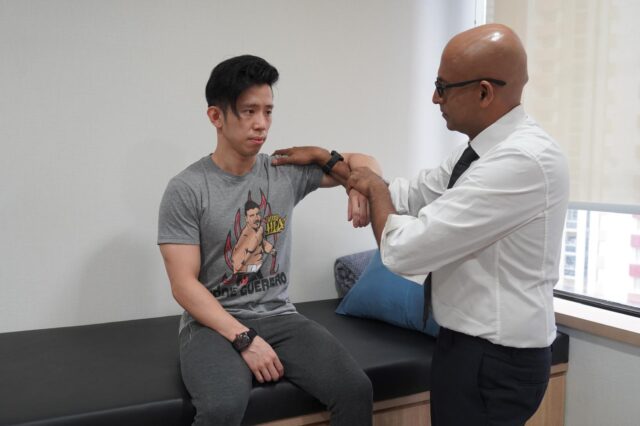
The shoulder is one of the most mobile joints in the body, supported by a thin capsule of connective tissue that normally allows smooth movement in every direction. In frozen shoulder, this capsule becomes inflamed and contracts, so movement becomes both painful and limited.
Unlike a muscle strain or a tendon injury, frozen shoulder affects the joint capsule itself. This is why people typically feel both pain and stiffness, with stiffness becoming more noticeable as the condition progresses.
What does a frozen shoulder feel like?
Frozen shoulder usually causes a deep, aching shoulder pain together with increasing stiffness. Many people first notice it when reaching for something, or when lying on the affected shoulder at night.
Symptoms vary between individuals, but commonly include:
- Shoulder pain and stiffness
- Difficulty reaching overhead or behind the back
- Trouble dressing, washing or combing hair
- Disturbed sleep, especially when lying on the shoulder
- A reduced ability to lift or carry
Everyday activities often become progressively more difficult over time. Unlike a trapped nerve, frozen shoulder does not usually cause numbness or pins-and-needles in the hand.
Where is frozen shoulder pain usually felt?
Frozen shoulder pain is felt mainly around the front and outer part of the shoulder, and it can spread into the upper arm — particularly during movement.
Many people describe a deep ache over the outer shoulder, with sharper pain on reaching or lifting, and a sense that the joint itself feels stiff during rotation or overhead movement.
What causes a frozen shoulder, and why does it happen?
Frozen shoulder develops when the shoulder capsule becomes inflamed and gradually tightens. It often follows a period of reduced shoulder movement, and several health conditions can make it more likely — though in many people it appears without any clear cause.
Factors that may contribute include:
- Reduced shoulder movement after an injury or surgery
- Prolonged use of an arm sling
- Earlier shoulder pain that limited movement
- Diabetes
- Thyroid disorders
- Increasing age
- Previous shoulder conditions or fractures around the shoulder
Importantly, many people develop frozen shoulder without any major injury beforehand.
Who is most likely to get a frozen shoulder?
Frozen shoulder most commonly affects adults aged 40 to 60. It is more likely in people with diabetes or thyroid conditions, or after a period of shoulder immobility.
- Adults aged 40–60
- People with diabetes or thyroid disorders
- Those recovering from shoulder surgery or who have worn a sling for several weeks
- People with a previous shoulder injury
Frozen shoulder can still affect people outside these groups.
How long does a frozen shoulder last?
Frozen shoulder usually passes through three stages and tends to improve over time. Recovery varies, but with a complete treatment programme many people regain comfort and movement considerably sooner than if the condition is simply left alone.
| Stage | What tends to happen |
| Freezing | Pain gradually increases and the shoulder becomes more limited in movement. |
| Frozen | Stiffness becomes the main problem, while the pain often begins to settle. |
| Thawing | Movement gradually returns, though the pace varies from person to person. |
The whole process can take many months. Treatment is aimed at controlling pain and helping movement return sooner, rather than waiting for the shoulder to recover on its own.
Does a frozen shoulder go away on its own?
Frozen shoulder often does improve on its own — but this can be slow, and there is no need to simply wait it out. Active treatment can relieve pain and help restore movement more quickly.
Because recovery differs for each person, regular review helps monitor progress and adjust treatment so you are not left uncomfortable for longer than necessary.
How is a frozen shoulder diagnosed?
Frozen shoulder is usually diagnosed from your symptoms and a physical examination of your shoulder movement, strength and function. Scans are not always required.
A musculoskeletal assessment may include a review of your medical history, an examination of shoulder movement and function, an assessment of where the pain is felt, strength testing, and a review of any previous imaging.
Do I need a scan for a frozen shoulder?
Not everyone needs a scan. Imaging is used selectively — usually to check for another shoulder problem rather than to confirm frozen shoulder itself.
Where imaging is helpful, sports ultrasound can assess the tendons, bursae and surrounding soft tissues — and can also be used to guide injections accurately. An MRI may be considered when more detail about deeper joint structures is needed, and an X-ray can help rule out other causes.
What are the best treatments for a frozen shoulder?
Frozen shoulder is best treated as a complete programme rather than a single fix. The foundations are pain relief, a guided shoulder-mobility programme, and — where helpful — minimally invasive image-guided injections such as a corticosteroid injection or hydrodilatation.
Depending on the stage and your individual circumstances, a complete treatment programme may include:
- Education and reassurance about the condition
- Activity modification to keep the shoulder comfortable and active
- A graded shoulder-mobility and stretching programme
- Pain-relieving medication where appropriate
- An image-guided corticosteroid injection, which can be particularly helpful in the painful early stage
- Hydrodilatation to ease pain and help restore movement
- A hyaluronic acid (HA) injection — a steroid-free option that may suit some patients, including those with diabetes
- PRP (platelet-rich plasma) where a coexisting rotator cuff problem is contributing to pain
- Sports ultrasound assessment where appropriate
Can an injection help — and what is hydrodilatation?
Yes — image-guided injections can be very helpful, particularly while the shoulder is painful. Hydrodilatation is a minimally invasive procedure, performed under ultrasound guidance, in which the tightened capsule is gently expanded with fluid to ease pain and help restore movement.
A corticosteroid injection can calm the inflammation that drives pain in the early stage, which often makes it easier to move the shoulder and progress with rehabilitation. Hydrodilatation works by gently stretching the capsule from the inside. Both are typically performed as day procedures, and ultrasound guidance helps place the treatment accurately. Depending on your circumstances, other injection options — including hyaluronic acid (HA) and PRP — may also form part of your programme, as explained below.
Is a hyaluronic acid (HA) injection an option for frozen shoulder?
Yes — hyaluronic acid (HA) can be injected into the shoulder joint as a steroid-free option. It may help reduce pain and support returning movement, and it can be particularly worth considering for people who prefer to avoid corticosteroid or who may need more than one injection.
HA is a gel-like substance found naturally in healthy joint fluid. When placed into the joint under ultrasound guidance, it can lubricate the joint and calm irritation within the capsule. Because HA does not affect blood sugar, it can be an appealing option for people with diabetes — a group in whom frozen shoulder is more common. It can be used on its own or alongside the other elements of a complete treatment programme.
What if I also have a rotator cuff problem — can PRP help?
Frozen shoulder often coexists with rotator cuff tendon problems. Where a cuff tendinopathy or partial tear is contributing to your pain, PRP (platelet-rich plasma) can be used — under ultrasound guidance — to support tendon healing as part of a complete treatment programme.
PRP is prepared from a small sample of your own blood, concentrating the platelets that carry your body’s natural growth factors. It is then injected precisely into the affected tendon using ultrasound guidance. A sports ultrasound assessment helps identify whether the capsule, the rotator cuff tendons, or both are driving your symptoms — so treatment can be targeted at the right structure rather than guessed at.
What exercises help, and should I rest or keep moving?
Gentle, regular movement is part of recovery, kept within a comfortable range. Complete rest tends to let the shoulder stiffen further, so a guided programme of mobility and stretching is usually encouraged.
The aim is steady, consistent movement rather than forcing the arm through severe pain. A clinician or physiotherapist can tailor a programme to your stage and comfort, and adjust it as you improve.
How can I sleep better with a frozen shoulder?
Night pain is one of the most common frustrations with frozen shoulder. Simple changes — such as sleeping on the unaffected side and supporting the arm with a pillow — can help, alongside treatment to bring the underlying pain down.
Because disturbed sleep is so often driven by the pain itself, effective treatment — including an image-guided injection where appropriate — frequently improves sleep as the shoulder becomes more comfortable.
What makes a frozen shoulder worse?
Frozen shoulder can be aggravated by forcing the arm through painful movements, by long periods of complete immobility, and by leaving significant pain untreated.
The balance is the key: neither forcing the shoulder nor resting it completely. Seeking assessment early helps you find the right level of activity and treatment for your stage.
Do I need surgery for a frozen shoulder?
Surgery is rarely needed for frozen shoulder. The large majority of people improve with a complete non-surgical programme, and surgery is considered only in the small number of cases that remain very restricting despite thorough treatment.
Where it is needed, options such as manipulation under anaesthesia or arthroscopic capsular release exist — but these are uncommon and are usually considered only after non-surgical treatment has been given a fair trial.
When should I seek assessment for a frozen shoulder?
It is worth seeking assessment if shoulder pain or stiffness is interfering with your daily activities, work, exercise or sleep — or if symptoms have lasted several weeks.
Consider an assessment if you notice:
- Progressive shoulder stiffness or difficulty lifting the arm
- Persistent shoulder pain or a reduced range of movement
- Difficulty dressing, or pain that affects your sleep
- Symptoms lasting several weeks
- Shoulder pain that began after an injury
Early assessment helps identify the cause of your symptoms and determine whether any further investigations or treatments would help.
Frequently asked questions
Will a frozen shoulder go away on its own?
Often yes, but it can be slow. Active treatment can relieve pain and help movement return more quickly, so there is no need to simply wait it out.
Is frozen shoulder linked to diabetes?
Yes. Frozen shoulder is more common in people with diabetes, and it is also associated with thyroid conditions.
Does hydrodilatation hurt?
It is a minimally invasive day procedure performed under local anaesthetic and ultrasound guidance, and most people tolerate it well.
Can frozen shoulder affect both shoulders?
It can affect the other shoulder, sometimes at a different time.
How long until I can sleep and move normally again?
This varies with the individual and the stage of the condition. Treatment is aimed at bringing that point forward by reducing pain and restoring movement.
Can I have an injection if I have diabetes?
Yes — there are options. A corticosteroid injection can cause a short-term rise in blood sugar, which is discussed and monitored. Hyaluronic acid (HA) is a steroid-free alternative that does not affect blood sugar, which can make it an attractive choice for people with diabetes.
Is PRP used for frozen shoulder?
PRP is not usually the first-line treatment for the capsule itself, but it can be very useful when a coexisting rotator cuff problem is contributing to pain. An ultrasound assessment helps identify whether this applies to you.
Assessment at Triaxis Sports & Joint Clinic
Triaxis Sports & Joint Clinic provides assessment for a wide range of musculoskeletal conditions affecting the shoulder, elbow, spine, hip, knee, ankle and other joints. Assessment focuses on understanding your symptoms, functional limitations, medical history, activity needs and goals.
Depending on the clinical findings, assessment may include movement analysis, a musculoskeletal examination, sports ultrasound where appropriate, and a discussion of suitable treatment options. Patient education and shared decision-making are central to the consultation, so you can understand your condition and the care options available to you.
Considering your options for a frozen shoulder?
Before assuming you simply have to live with it, it is worth understanding the full range of treatments available. Dr Sirisena offers minimally invasive, non-surgical assessment and care for frozen shoulder.
Triaxis Sports & Joint Clinic, Farrer Park Hospital · WhatsApp +65 8889 3594 · hello@triaxisclinic.com · Repair · Restore · Reclaim
About the author
Written and medically reviewed by Dr Dinesh Sirisena, Consultant in Sports, Exercise & Musculoskeletal Medicine, and author of Ultrasound-Guided Musculoskeletal Procedures in Sports Medicine (Elsevier, 2021). Dr Sirisena focuses on the non-surgical and image-guided treatment of musculoskeletal and sports injuries.