
Spine Pain: Causes, Symptoms and Treatment Options
Written and medically reviewed by Dr Dinesh Sirisena
Consultant in Sports, Exercise & Musculoskeletal Medicine · Triaxis Sports & Joint Clinic, Farrer Park Hospital, Singapore
In short: Spine pain can affect the neck, upper back or lower back, arising from the joints, discs, muscles, ligaments or nerves. Most episodes improve without surgery — the evidence for staying active and rehabilitating is overwhelming. Where pain persists, precise image-guided procedures such as facet joint, nerve root and sacroiliac joint injections target the confirmed source as part of a complete treatment programme.
Key points at a glance
- Spine pain can affect the cervical (neck), thoracic (upper back) or lumbar (lower back) regions.
- The facet joints, discs, muscles and nerves can all contribute — often in combination.
- Most episodes improve without surgery; staying active beats rest.
- Pain spreading into the arm or leg suggests nerve involvement.
- Most people do not need an MRI — and scan findings are common in pain-free spines.
- Image-guided facet, nerve root and sacroiliac injections are options where pain persists.
- Red flags — progressive weakness, saddle numbness, bladder changes — need urgent assessment.
What is spine pain?
Spine pain is pain arising from the structures of the spine — the vertebrae, facet joints, discs, muscles, ligaments and nerves. It may follow an injury or build gradually with load, posture and age-related change.
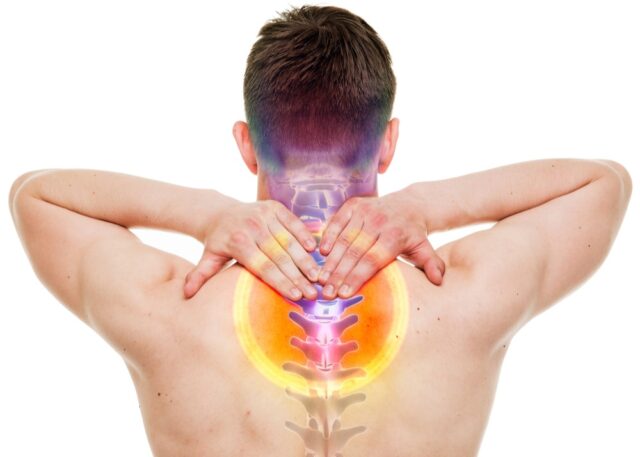
The spine supports the body, moves in every direction and protects the spinal cord. It is built in three regions — cervical, thoracic and lumbar — and each has its own common pain patterns. Because several structures often contribute at once, assessment aims to identify the dominant source, which is what determines the right treatment.
What does spine pain feel like?
Most spine pain is a localised ache with stiffness, worse with certain movements or sustained positions. Pain shooting into an arm or leg, or tingling and numbness, points to nerve involvement.
Common patterns include:
- Localised neck, mid-back or lower back ache with stiffness
- Pain worse with bending, twisting, lifting or prolonged sitting
- Sharp, catching pain with specific movements — typical of facet joint irritation
- Pain radiating into the buttock and leg (commonly called sciatica) or into the arm
- Morning stiffness that eases with movement
- Muscle spasm around the painful segment
What causes spine pain?
Most spine pain is mechanical — arising from the facet joints, discs, muscles and ligaments — driven by load spikes, sustained postures and normal age-related change rather than serious disease.
Common contributors include lifting or training load spikes, prolonged sitting, previous injury, disc bulges and degeneration, facet joint arthritis, and — less commonly — inflammatory conditions. Age-related changes on scans are near-universal from midlife and are frequently painless, which is central to interpreting imaging honestly.
Who is more likely to develop spine pain?
Almost everyone — back pain affects the great majority of adults at some point. Desk workers, manual workers, and athletes in loading or rotation sports see it most.
The encouraging flip side: because it is so common and usually mechanical, the pathway to improvement is well established and rarely involves an operating theatre.
How is spine pain diagnosed?
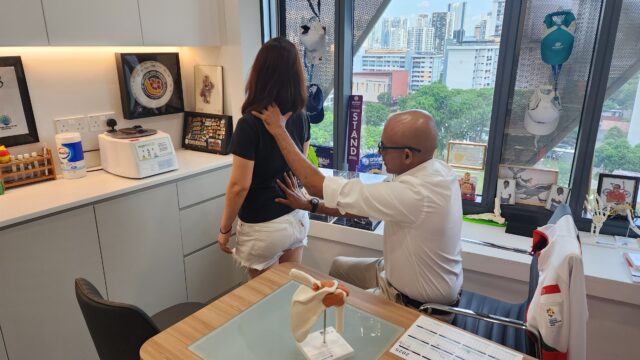
Diagnosis is clinical: the pain pattern, movement testing, palpation and a neurological examination of the limbs. The first jobs are excluding warning signs and establishing whether a nerve is involved.
From there, the examination points to the likely dominant source — facet joint, disc, sacroiliac joint or muscular — which determines both the rehabilitation emphasis and, where needed, which image-guided procedure would help.
Do I need an MRI or other scan?
Most spine pain does not need imaging. Scans are indicated for persistent nerve symptoms, red flags, or when planning a targeted procedure.
Disc bulges, degeneration and facet arthritis appear on MRI in a large proportion of people with no pain at all — findings rise steadily with age. This is why scans are interpreted alongside the examination: treating the person, not the picture, is what protects patients from unnecessary interventions and unnecessary surgery.
How is spine pain treated?
Active rehabilitation is the foundation — the evidence for exercise, movement and staying at work is stronger than for any passive treatment. Image-guided procedures support the minority whose pain persists despite it.
A complete treatment programme may include:
- Education — understanding that spine pain is common, mechanical and improvable removes fear, and fear itself worsens outcomes
- A progressive rehabilitation programme building strength, mobility and load tolerance
- Activity modification during flare-ups — adjusting, not stopping, movement
- Image-guided facet joint injections or medial branch blocks where the facet joints are the confirmed source
- Image-guided nerve root (epidural/transforaminal) injections for persistent radiating nerve pain
- Image-guided sacroiliac joint injection where that joint is the source
- Prolotherapy or PRP for selected ligament and joint problems as part of a complete treatment programme
Every procedure is delivered with continuous image guidance, targeting the structure the assessment has implicated — and always alongside rehabilitation, because the injection creates the window and the rehabilitation delivers the result.
What exercises help spine pain?
The best exercise for spine pain is the one you will do consistently — walking, strength training, Pilates and structured rehabilitation all outperform rest.
A tailored programme addresses your specific pattern: extension-biased or flexion-biased movement preferences, hip mobility, trunk strength and graded return to the loads your life and sport demand.
How long does spine pain take to improve?
Most acute episodes improve substantially within two to six weeks. Radiating nerve pain typically settles over six to twelve weeks. Persistent pain beyond that deserves targeted assessment, not resignation.
Recurrences are common — they are a feature of spines, not a sign of failure — and each responds to the same principles. Building and keeping strength is the best recurrence insurance available.
Do I need surgery for spine pain?
Very rarely. Surgery has a clear role for progressive neurological deficit, cauda equina syndrome and selected structural problems — but for pain alone, the evidence favours comprehensive non-surgical care first.
Spinal fusion for degenerative back pain has notably mixed evidence, while structured rehabilitation combined with precisely targeted image-guided procedures resolves or controls symptoms for the great majority. If spine surgery has been recommended for pain without progressive weakness, a structured second opinion is a reasonable and increasingly common step.
When should I seek medical assessment?
Seek assessment if pain persists beyond a few weeks, radiates into a limb, or keeps recurring — and urgently for saddle numbness, bladder or bowel changes, progressive leg weakness, fever or unexplained weight loss.
Those urgent symptoms are rare, but they are the reason persistent spine pain should be assessed rather than endlessly self-managed.
Assessment at Triaxis Sports & Joint Clinic
Triaxis Sports & Joint Clinic at Farrer Park Hospital provides assessment for spine pain, sports injuries and musculoskeletal conditions across the neck and back.
Assessment includes a full musculoskeletal and neurological examination, imaging decisions made on clinical grounds, and open discussion of the complete range of options — rehabilitation programmes, image-guided facet, nerve root and sacroiliac injections, and regenerative options such as prolotherapy and PRP where appropriate — so you understand every option before deciding on a plan.
Frequently asked questions
Is my disc bulge causing my back pain?
Not necessarily. Disc bulges appear on MRI in a large proportion of pain-free people and become more common with age. Whether a bulge is relevant depends on matching the scan to your examination — which is exactly what a proper assessment does.
Should I rest my back when it hurts?
Brief relative rest during a severe flare is fine, but the evidence is emphatic: staying active recovers faster than bed rest. Movement is treatment.
What is a facet joint injection?
A precisely placed, image-guided injection into or around the small joints at the back of the spine, used when examination implicates them as the pain source. It settles pain so rehabilitation can progress — part of a complete programme, not a standalone fix.
Can spine pain be treated without surgery?
Almost always. Between structured rehabilitation and image-guided procedures targeting the confirmed source — facet joints, nerve roots or the sacroiliac joint — the great majority of spine pain improves without an operation.
Is walking good for back pain?
Yes — walking is one of the best-evidenced, most accessible treatments for back pain, and a sensible foundation while a structured strengthening programme is built around it.
Back or neck pain that isn’t settling — or told you need spine surgery?
Most spine pain improves without an operation. Dr Sirisena offers thorough assessment, rehabilitation planning and precise image-guided procedures — facet joint, nerve root and sacroiliac injections — as a first port of call or a second opinion.
Triaxis Sports & Joint Clinic, Farrer Park Hospital · WhatsApp +65 8889 3594 · hello@triaxisclinic.com · Repair · Restore · Reclaim
About the author
Written and medically reviewed by Dr Dinesh Sirisena, Consultant in Sports, Exercise & Musculoskeletal Medicine, and author of Ultrasound-Guided Musculoskeletal Procedures in Sports Medicine (Elsevier, 2021). Dr Sirisena focuses on the non-surgical and image-guided treatment of musculoskeletal and sports injuries.