
Sacroiliac Joint Pain: Causes, Symptoms and Treatment Options
Written and medically reviewed by Dr Dinesh Sirisena
Consultant in Sports, Exercise & Musculoskeletal Medicine · Triaxis Sports & Joint Clinic, Farrer Park Hospital, Singapore
In short: Sacroiliac (SI) joint pain arises from the joints connecting the base of the spine to the pelvis, typically causing one-sided lower back or buttock pain that worsens with prolonged sitting, standing, stairs or running. It is frequently mistaken for other back problems. Most people improve without surgery, and an image-guided SI joint injection can both confirm the diagnosis and settle the pain — with prolotherapy and PRP as options for stubborn cases.
Key points at a glance
- The sacroiliac joints connect the sacrum to the pelvis and transfer load between the spine and legs.
- Pain is typically one-sided, over the lower back or buttock, sometimes spreading into the hip, groin or upper leg.
- Prolonged sitting, standing, stairs, running and single-leg loading are common aggravators.
- SI joint pain is a common missed diagnosis — it mimics lumbar spine and hip problems.
- Scans often cannot confirm the SI joint as the source; an image-guided diagnostic injection can.
- Most people improve without surgery through targeted rehabilitation.
- Image-guided SI joint injections, prolotherapy and PRP are options where pain persists.
What is the sacroiliac joint?
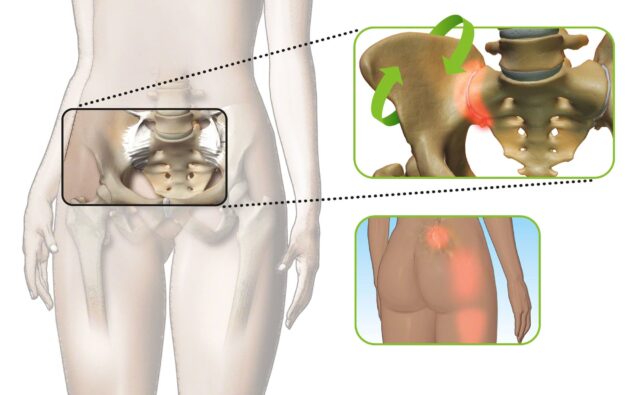
The sacroiliac joints sit either side of the base of the spine, connecting the sacrum to the pelvis. They transfer the load of the upper body into the legs with every step.
They are strong, tightly bound joints designed for stability with small amounts of movement. Pain develops when the joint is irritated, when its supporting ligaments are strained, or when the muscular control around the pelvis is insufficient for the loads being asked of it.
What does sacroiliac joint pain feel like?
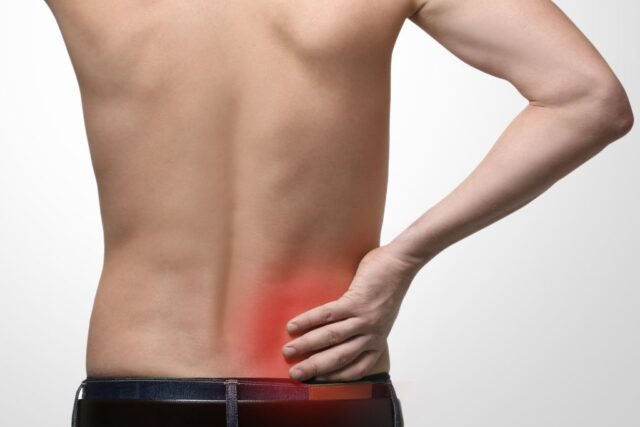
Typically a one-sided ache or sharp pain over the dimple area of the lower back or the buttock — often with difficulty finding a comfortable sitting position.
Common symptoms include:
- One-sided lower back or buttock pain, often pointed to with one finger
- Pain spreading into the hip, groin or back of the upper thigh
- Pain with prolonged sitting — especially on the affected side
- Pain rising from a chair, climbing stairs or getting out of the car
- Pain with running or single-leg loading
- Pain turning over in bed
Pain rarely travels below the knee — a useful distinction from sciatica, which often does.
Why does my lower back hurt on only one side?
One-sided pain at the base of the spine is a hallmark of sacroiliac joint problems, because each SI joint loads independently as you walk, climb and stand on one leg.
Facet joints and hip problems can also cause one-sided pain, which is why the examination systematically tests each — the treatments differ substantially.
What causes sacroiliac joint pain?
Common causes include a change in load or gait, pregnancy and the postpartum period, leg length differences, previous lumbar spine surgery, trauma, and inflammatory conditions affecting the joint.
Runners and athletes develop it through training spikes or asymmetrical loading; new mothers through the ligament laxity of pregnancy meeting the loads of infant care. In a minority, inflammatory sacroiliitis (as in axial spondyloarthritis) is the cause — a pattern specifically screened for, because its treatment is entirely different.
Who is more likely to develop it?
Runners and single-leg-loading athletes, pregnant and postpartum women, people with previous lumbar fusion, and those with leg length differences or hypermobility.
Estimates suggest the SI joint accounts for a meaningful proportion of chronic low back pain — and it is disproportionately represented among people whose “back pain” has failed standard back treatment, precisely because the true source was never identified.
How is sacroiliac joint pain diagnosed?
Diagnosis combines the pain pattern with a cluster of provocation tests that stress the joint. Where certainty matters, an image-guided anaesthetic injection into the joint is the reference-standard test.
No single examination test is reliable alone, but a positive cluster of provocation tests substantially raises confidence. If precisely injecting the joint with local anaesthetic abolishes the pain, the diagnosis is confirmed in a way no scan can match.
Do I need an X-ray, MRI or ultrasound?
Imaging often cannot confirm the SI joint as the pain source — degenerative changes are common in pain-free joints, and painful joints can look normal.
Imaging earns its place for screening inflammatory sacroiliitis (MRI shows the characteristic bone inflammation), excluding hip and lumbar alternatives, and guiding procedures. The functional diagnosis rests on examination and, where needed, the diagnostic injection.
How is sacroiliac joint pain treated?
Targeted rehabilitation — rebuilding the strength and control of the muscles that stabilise the pelvis — is the foundation. Image-guided procedures confirm the diagnosis and settle pain where it persists.
A complete treatment programme may include:
- Education and load management — adjusting the aggravating patterns while staying active
- A progressive programme strengthening the gluteal, deep abdominal and pelvic-stabilising muscles
- Correction of contributing factors — running gait, leg length, training asymmetries
- Image-guided sacroiliac joint injection — diagnostic and therapeutic in one precise procedure
- Prolotherapy to the supporting ligaments for persistent instability-pattern pain, as part of a complete treatment programme
- PRP for selected cases where regenerative support of the joint and ligaments is appropriate
- A short-term SI belt in specific situations, such as postpartum pain
The SI joint is deep and its shape complex, so accurate injection is genuinely difficult without imaging — image guidance is what makes the procedure both valid as a test and effective as a treatment.
What exercises help the sacroiliac joint?
Gluteal and deep core strengthening — bridges, side-lying and standing hip work, progressing to single-leg control — form the core of most programmes.
The goal is muscular stability of the pelvis, not bracing or avoidance. Programmes are staged from low-load control work to the single-leg strength that running and stairs demand.
How long does sacroiliac joint pain take to improve?
With targeted rehabilitation, most people improve substantially over six to twelve weeks. Longstanding or postpartum cases can take longer, and respond well to the combination of injection plus rehabilitation.
The most common reason for slow progress is that the SI joint was never actually the target of previous treatment — generic back programmes routinely miss it.
Do I need surgery for sacroiliac joint pain?
Almost never. SI joint fusion is a last-resort option for a small, carefully selected group with confirmed SI joint pain that has failed comprehensive non-surgical care.
Before any such conversation, the diagnosis should be confirmed with image-guided diagnostic injection, and the full non-surgical pathway — rehabilitation, injections, prolotherapy or PRP — genuinely completed. If SI joint surgery has been suggested, a structured second opinion on that pathway is strongly worthwhile.
When should I seek medical assessment?
Seek assessment if one-sided lower back or buttock pain persists beyond a few weeks, keeps recurring, disturbs sleep, or is accompanied by prolonged morning stiffness in a younger adult.
Morning stiffness lasting over 30–60 minutes, improving with exercise, in someone under 45 raises the question of inflammatory sacroiliitis — which deserves specific investigation, because its treatment is different and effective.
Assessment at Triaxis Sports & Joint Clinic
Triaxis Sports & Joint Clinic at Farrer Park Hospital provides assessment for sacroiliac joint pain, lower back pain and sports injuries.
Assessment includes the full provocation-test cluster, screening for inflammatory causes, honest interpretation of any imaging, and open discussion of the complete range of options — rehabilitation programmes, image-guided SI joint injections, prolotherapy and PRP — so you understand every option before deciding on a plan.
Frequently asked questions
Can sacroiliac joint pain go down the leg?
Yes — typically into the buttock and back of the upper thigh, but rarely below the knee. Pain travelling past the knee with tingling or numbness points to a nerve root problem instead.
Is sacroiliac joint pain the same as sciatica?
No. Sciatica is nerve pain from an irritated nerve root, usually travelling below the knee with tingling or numbness. SI joint pain is joint pain referred into the buttock and thigh. They are frequently confused — and treated very differently.
Is sacroiliitis the same as sacroiliac joint pain?
Sacroiliitis specifically means inflammation of the joint, as in axial spondyloarthritis, and is diagnosed on MRI and blood markers. Mechanical SI joint pain is far more common. The distinction matters because inflammatory disease has its own dedicated treatment.
Can sitting cause sacroiliac joint pain?
Prolonged sitting — especially with weight shifted to one side or a wallet in a back pocket — loads the joint asymmetrically and commonly aggravates it. Position changes and gluteal strengthening usually resolve the sitting problem.
What is prolotherapy for the SI joint?
Prolotherapy is an image-guided injection of a concentrated dextrose solution into the joint’s supporting ligaments, stimulating a strengthening response. It is an option for persistent, instability-pattern SI pain as part of a complete treatment programme.
One-sided lower back or buttock pain that isn’t settling?
The sacroiliac joint is one of the most commonly missed sources of back pain — and one of the most treatable. Dr Sirisena offers thorough assessment, image-guided diagnostic and therapeutic SI joint injections, prolotherapy, PRP and targeted rehabilitation — as a first port of call or a second opinion.
Triaxis Sports & Joint Clinic, Farrer Park Hospital · WhatsApp +65 8889 3594 · hello@triaxisclinic.com · Repair · Restore · Reclaim
About the author
Written and medically reviewed by Dr Dinesh Sirisena, Consultant in Sports, Exercise & Musculoskeletal Medicine, and author of Ultrasound-Guided Musculoskeletal Procedures in Sports Medicine (Elsevier, 2021). Dr Sirisena focuses on the non-surgical and image-guided treatment of musculoskeletal and sports injuries.