
Golfer’s Elbow: Symptoms, Causes and Treatment Options
Written and medically reviewed by Dr Dinesh Sirisena
Consultant in Sports, Exercise & Musculoskeletal Medicine · Triaxis Sports & Joint Clinic, Farrer Park Hospital, Singapore
In short: Golfer’s elbow (medial epicondylopathy) is a tendon condition on the inner side of the elbow caused by repetitive gripping, lifting or wrist movement — not just golf. Most people improve without surgery through a progressive loading programme. Where the tendon is slow to settle, ultrasound-guided options including PRP, shockwave therapy and Tenex can support recovery.
Key points at a glance
- Golfer’s elbow affects the tendons on the inner side of the elbow.
- It develops from repetitive gripping, lifting, throwing or wrist flexion — golf is only one of many causes.
- Pain is felt on the inner elbow and may spread into the forearm; grip often feels weak.
- Longstanding cases involve tendon change rather than ongoing inflammation, which shapes the treatment.
- Most people improve without surgery with a progressive loading programme.
- Ultrasound-guided PRP, shockwave and Tenex are options for stubborn tendons.
- Ultrasound guidance matters at the inner elbow because the ulnar nerve lies close by.
What is golfer’s elbow?
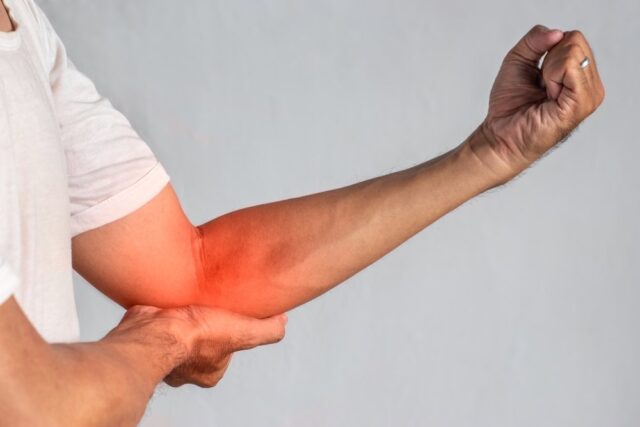
Golfer’s elbow — medically, medial epicondylopathy — is a condition of the tendons that anchor the wrist and finger flexor muscles to the inner side of the elbow. Repeated loading beyond the tendon’s capacity causes pain and reduced grip function.
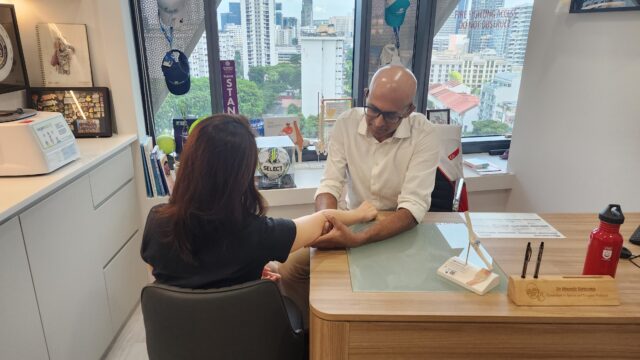
Although inflammation may feature early on, most longstanding cases involve structural change within the tendon rather than ongoing inflammation. This matters, because it explains why rest alone rarely fixes it and why progressive loading is the core of treatment.
It is the inner-elbow counterpart of tennis elbow, and like tennis elbow, its name is misleading — most people who develop it have never swung a golf club.
What does golfer’s elbow feel like?
The hallmark is pain and tenderness on the bony prominence of the inner elbow, worse with gripping, lifting or twisting.
Common symptoms include:
- Pain and tenderness over the inner side of the elbow
- Pain when gripping, shaking hands or opening jars
- Pain lifting objects, especially palm-up
- An ache spreading down the inner forearm
- Reduced grip strength
- Morning stiffness in the elbow or forearm
Occasional tingling into the ring and little fingers can occur if the nearby ulnar nerve is irritated — a detail that changes the assessment and is specifically checked.
What causes golfer’s elbow?
Repetitive loading of the wrist flexor tendons beyond their capacity — through sport, work or a sudden spike in activity — is the usual cause.
Common contributors include:
- Repetitive gripping and lifting at work or in the gym
- Throwing sports, golf, racquet sports and climbing
- A recent increase in training load or a change in technique or equipment
- Manual occupations — carpentry, plumbing, assembly work
- Age-related tendon changes, most commonly between 40 and 60
Who is more likely to develop golfer’s elbow?
Adults between 40 and 60, manual workers, and athletes in throwing, racquet and grip-heavy sports are most commonly affected.
It is less common than tennis elbow but follows the same tendon biology — and responds to the same modern treatment approach.
How is golfer’s elbow diagnosed?
Diagnosis is clinical: tenderness over the inner elbow and pain on resisted wrist flexion are the key findings. Ultrasound confirms the diagnosis and grades the tendon where needed.
Assessment also checks the ulnar nerve, the elbow ligaments and the neck, because these can produce similar inner-elbow and forearm symptoms and occasionally coexist.
Do I need an MRI or ultrasound scan?
Most people do not need a scan to make the diagnosis. When imaging helps, ultrasound is the first choice — it shows the tendon in real time, grades the changes and guides treatment precisely.
MRI is reserved for atypical cases or when ligament injury is suspected, for example in throwing athletes.
How is golfer’s elbow treated?
A progressive loading programme for the forearm flexors is the foundation of treatment and works for most people. Stubborn tendons respond to targeted, ultrasound-guided procedures.
A complete treatment programme may include:
- Education and load management — adjusting grip-heavy tasks rather than complete rest
- A progressive strengthening programme for the wrist flexors and grip
- Shockwave therapy for chronic tendinopathy that is slow to respond to loading
- Platelet-rich plasma (PRP), delivered under ultrasound guidance, to support tendon healing — with good evidence at the elbow
- Percutaneous ultrasonic tenotomy (Tenex) to remove degenerative tendon tissue through a tiny incision in refractory cases
- A counterforce brace for short-term symptom relief during unavoidable gripping tasks
Cortisone injections deserve a special note at the elbow: research shows they relieve pain in the short term but lead to worse outcomes at one year compared with a wait-and-strengthen approach. They are therefore used sparingly and strategically, if at all.
Ultrasound guidance is particularly important on the inner elbow because the ulnar nerve runs immediately behind the injection field — precision protects the nerve and puts the treatment exactly where it is needed.
What exercises help golfer’s elbow?
The most effective exercises load the wrist flexors progressively — starting with isometric holds, then slow, heavy wrist and grip strengthening.
Loading is the stimulus tendons need to rebuild; the skill is dosing it below the flare-up threshold and progressing steadily. A tailored programme after assessment achieves this much faster than a generic sheet.
How long does golfer’s elbow take to heal?
Most people improve substantially within three months of structured loading. Longstanding cases can take six to twelve months to resolve fully.
Tendon recovery is slow but reliable — the common mistake is abandoning the programme when pain first improves, which invites recurrence.
Does golfer’s elbow go away on its own?
Mild, recent cases sometimes settle with sensible load management. Symptoms persisting beyond six to eight weeks usually need a structured programme — waiting tends to prolong the problem.
The tendon does not strengthen while it is being rested, so “wait and see” often turns a three-month problem into a twelve-month one.
Do I need surgery for golfer’s elbow?
Very rarely. The overwhelming majority of people recover with loading programmes and, where needed, ultrasound-guided procedures such as PRP, shockwave or Tenex.
Open surgery is a last resort for the small minority with symptoms persisting beyond a year despite properly completed treatment. If surgery has been recommended to you, it is reasonable to seek a second opinion on the minimally invasive options first — Tenex in particular treats the same degenerative tissue through a needle-sized incision.
When should I seek medical assessment?
Seek assessment if inner-elbow pain has lasted more than a few weeks, grip weakness is developing, or tingling is spreading into the ring and little fingers.
Tingling in the fingers suggests the ulnar nerve is involved, which changes the treatment plan and is worth identifying early.
Assessment at Triaxis Sports & Joint Clinic
Triaxis Sports & Joint Clinic at Farrer Park Hospital provides assessment for elbow pain, tendon problems and sports injuries.
Assessment includes a musculoskeletal examination and, where appropriate, diagnostic ultrasound during the consultation to grade the tendon and check the ulnar nerve. The full range of options — loading programmes, shockwave, ultrasound-guided PRP and Tenex — is discussed openly so you understand every option before deciding on a plan.
Frequently asked questions
What is the difference between golfer’s elbow and tennis elbow?
Golfer’s elbow affects the tendons on the inner side of the elbow (the wrist flexors); tennis elbow affects the outer side (the wrist extensors). The biology and treatment principles are the same — progressive loading first, with ultrasound-guided procedures for stubborn cases.
Should I get a cortisone injection for golfer’s elbow?
Usually not as a first step. Trials at the elbow show cortisone helps short-term pain but produces worse results at one year than structured rehabilitation. Options such as shockwave, PRP and Tenex target tendon healing rather than just masking pain.
Is PRP better than cortisone for golfer’s elbow?
For elbow tendinopathy, studies suggest PRP provides more durable improvement than cortisone beyond the first few months. PRP uses concentrated platelets from your own blood, delivered precisely into the tendon under ultrasound guidance, as part of a complete treatment programme.
Can I keep playing golf or training with golfer’s elbow?
Usually yes, with load adjustments — reducing volume, modifying grip and continuing strengthening. Complete rest weakens the tendon. A guided return-to-sport plan protects both your game and the tendon.
Why do my fingers tingle with golfer’s elbow?
The ulnar nerve runs directly behind the inner elbow and can become irritated alongside the tendon. Tingling in the ring and little fingers should be assessed, as it changes the treatment approach.
Inner-elbow pain that isn’t settling — or told you need surgery?
Golfer’s elbow almost always improves without an operation. Dr Sirisena offers assessment with diagnostic ultrasound during the consultation, structured loading programmes and ultrasound-guided procedures including PRP, shockwave and Tenex — as a first port of call or a second opinion.
Triaxis Sports & Joint Clinic, Farrer Park Hospital · WhatsApp +65 8889 3594 · hello@triaxisclinic.com · Repair · Restore · Reclaim
About the author
Written and medically reviewed by Dr Dinesh Sirisena, Consultant in Sports, Exercise & Musculoskeletal Medicine, and author of Ultrasound-Guided Musculoskeletal Procedures in Sports Medicine (Elsevier, 2021). Dr Sirisena focuses on the non-surgical and image-guided treatment of musculoskeletal and sports injuries.