
Shoulder Impingement: Symptoms, Causes and Treatment Options
Written and medically reviewed by Dr Dinesh Sirisena
Consultant in Sports, Exercise & Musculoskeletal Medicine · Triaxis Sports & Joint Clinic, Farrer Park Hospital, Singapore
In short: Shoulder impingement is one of the most common causes of shoulder pain, typically felt when lifting the arm or reaching overhead. It happens when the rotator cuff tendons or the bursa beneath the top of the shoulder become irritated during movement. Most people improve without surgery through a structured rehabilitation programme, sometimes supported by an ultrasound-guided injection to settle pain. Recovery usually takes several weeks to a few months.
Key points at a glance
- Shoulder impingement is one of the most common causes of shoulder pain in adults.
- Pain typically occurs when lifting the arm, reaching overhead or sleeping on the affected side.
- It is common in overhead sports (tennis, badminton, swimming) and manual or repetitive work.
- Several shoulder conditions cause similar symptoms, so an accurate diagnosis matters.
- Ultrasound can assess the tendons and bursa in real time, during the movements that hurt.
- Most people improve without surgery — exercise-based rehabilitation is the foundation of treatment.
- An ultrasound-guided injection can settle pain so rehabilitation can progress.
- Large clinical trials show surgery offers little advantage over structured non-surgical care for most people.
What is shoulder impingement?
Shoulder impingement is irritation of the rotator cuff tendons or the subacromial bursa beneath the bony roof of the shoulder (the acromion). It causes pain when lifting the arm, reaching overhead or performing repetitive shoulder movements.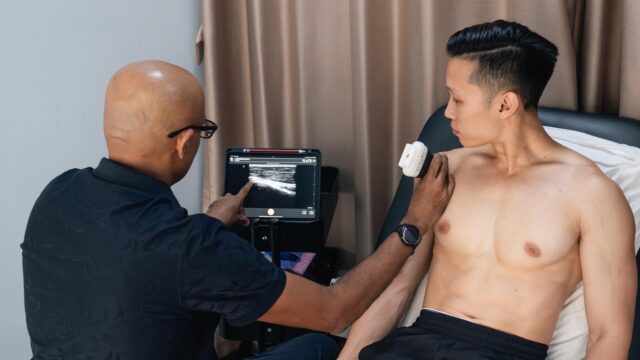
The shoulder is the most mobile joint in the body, relying on the coordinated action of muscles, tendons, ligaments and bones. During arm movement, the rotator cuff tendons and the subacromial bursa glide beneath the acromion. When these soft tissues become irritated, or the space they move through narrows during movement, pain develops.
Doctors increasingly use the term subacromial pain syndrome for this presentation, because the pain usually reflects tendon and bursa irritation rather than a structure being physically “pinched”. Whatever the label, the pattern is recognisable and very treatable.
What does shoulder impingement feel like?
The classic symptom is a sharp or aching pain over the outer shoulder when lifting the arm, particularly through the middle of the arc of movement. Night pain when lying on the affected side is also very common.
Common symptoms include:
- Pain when lifting the arm or reaching overhead
- A painful arc — pain that peaks midway as the arm is raised, then eases at the top
- Pain reaching behind the back (tucking in a shirt, fastening a bra)
- Night pain, especially lying on the affected shoulder
- Pain during swimming, throwing or racquet sports
- Discomfort with gym exercises, particularly pressing overhead
- A sense of weakness when lifting or carrying
Symptoms may build gradually or start after a period of increased activity — a new training block, a house move, or a spike in overhead work.
Where is the pain usually felt?
Most people feel the pain over the outer part of the shoulder, often spreading a short distance down the upper arm. It rarely travels below the elbow.
Pain may also be felt at the front or top of the shoulder depending on which structures are irritated. Importantly, shoulder impingement does not cause numbness or tingling in the hand — those symptoms point towards the neck or a nerve problem and should be assessed separately.
What causes shoulder impingement?
In most people, symptoms develop from a combination of repeated loading, changes in shoulder movement and normal age-related tendon changes — rather than one single injury.
Common contributing factors include:
- Repetitive overhead activity in sport or work
- Rotator cuff tendinopathy (irritation or wear within the tendons)
- Inflammation of the subacromial bursa (bursitis)
- Reduced shoulder or upper-back mobility
- Altered shoulder blade (scapular) movement
- A recent spike in training or workload
- Previous shoulder injury, falls or direct trauma
- Natural age-related tendon changes from the 40s onwards
Identifying which of these factors apply to you is one of the most useful parts of a clinical assessment, because it shapes the treatment plan.
Who is more likely to develop shoulder impingement?
Shoulder impingement most often affects adults between 40 and 60, and anyone whose sport or job involves frequent overhead movement.
Higher-risk groups include tennis, badminton and volleyball players, swimmers, cricketers and weightlifters, as well as electricians, painters, construction and warehouse workers. That said, having a risk factor does not mean impingement is inevitable — and building shoulder strength and control substantially reduces the risk.
How is shoulder impingement diagnosed?
Diagnosis is clinical: a detailed history, examination of shoulder movement and strength, and specific tests that reproduce the pain. Imaging is used selectively to confirm the diagnosis or rule out other causes.
A musculoskeletal assessment typically includes your medical history, shoulder range of motion, muscle strength testing, functional movement assessment, shoulder stability testing, and a review of your sporting and occupational demands. Because rotator cuff tears, frozen shoulder, calcific tendinopathy and shoulder arthritis can all mimic impingement, the assessment is designed to distinguish between them — the treatment for each is different.
Do I need an MRI or ultrasound scan?
Not everyone needs a scan. When imaging is helpful, musculoskeletal ultrasound is usually the first choice: it shows the tendons and bursa in real time, during the exact movements that cause your pain.
Ultrasound also allows the shoulder to be compared with the other side and, where an injection is indicated, allows it to be delivered with precision in the same visit. MRI is reserved for situations where deeper structures need assessment — for example, a suspected significant rotator cuff tear or labral injury. An X-ray may be added where bone changes or calcific deposits are suspected.
How is shoulder impingement treated?
Exercise-based rehabilitation is the foundation of treatment and works for most people. Where pain is blocking progress, an ultrasound-guided injection into the subacromial bursa can settle symptoms so rehabilitation can continue.
A typical treatment plan includes:
- Education — understanding the condition removes fear and guides sensible activity choices
- Activity modification — adjusting, not stopping, the movements that aggravate symptoms
- A progressive rehabilitation programme targeting the rotator cuff and shoulder blade muscles
- Ultrasound-guided subacromial injection where pain is limiting sleep, function or rehabilitation
- Shockwave therapy where a coexisting rotator cuff tendinopathy is slow to settle
- Platelet-rich plasma (PRP), delivered under ultrasound guidance, to support healing of an associated rotator cuff tendinopathy as part of a complete treatment programme
- Percutaneous ultrasonic tenotomy (Tenex) or barbotage for coexisting calcific or degenerative rotator cuff changes that have not responded to other measures
- Review and progression — treatment is adjusted as strength and movement improve
Ultrasound guidance matters for injections around the shoulder: it ensures the medication is delivered precisely into the bursa rather than into the tendon, improving accuracy and safety. An injection is not a standalone fix — it is most effective as part of a complete treatment programme that rebuilds strength and movement.
What exercises help shoulder impingement?
The most effective exercises strengthen the rotator cuff and the muscles that control the shoulder blade, progressing gradually from comfortable ranges to overhead positions.
Early-stage exercises often include isometric rotator cuff holds, banded external rotation and shoulder blade control drills. As pain settles, the programme progresses to loaded strengthening and, for athletes, sport-specific overhead work. The right starting point depends on your symptoms and strength — a programme tailored after assessment is far more effective than a generic sheet of exercises, and avoids the common mistake of pushing into pain too early.
How long does shoulder impingement take to heal?
Most people improve substantially within six to twelve weeks of starting a structured rehabilitation programme. Longstanding symptoms or significant tendon changes can take three to six months.
Recovery is rarely a straight line — flare-ups after busy weeks are normal and do not mean the shoulder is being damaged. Regular review helps confirm progress is on track and allows the plan to be adjusted if it is not.
Does shoulder impingement go away on its own?
Mild symptoms sometimes settle with rest and sensible activity changes. However, symptoms that have persisted beyond a few weeks usually respond much better to a structured programme than to waiting.
The risk of simply resting is twofold: the shoulder weakens further, and other conditions that mimic impingement — such as a rotator cuff tear or early frozen shoulder — go unrecognised. If pain has lasted more than a few weeks, an assessment is worthwhile.
Can I keep training or playing sport with shoulder impingement?
Usually yes — with modifications. Complete rest is rarely necessary and often unhelpful. The aim is to keep training around the shoulder while the painful movements are temporarily adjusted.
Lower-body work, running and most gym training can typically continue. Overhead pressing, wide-grip movements and high-volume throwing or swimming loads are the usual culprits and can be modified or scaled back temporarily. For athletes, a guided return-to-sport progression protects both performance and the shoulder.
How should I sleep with shoulder impingement?
Avoid lying directly on the painful shoulder. Sleeping on your back, or on the opposite side hugging a pillow to support the affected arm, usually reduces night pain.
Persistent night pain that regularly wakes you is also one of the clearest signs that treatment — sometimes including an ultrasound-guided injection — is worth considering, because poor sleep slows recovery.
Do I need surgery for shoulder impingement?
For the large majority of people, no. High-quality clinical trials have shown that subacromial decompression surgery offers little or no meaningful benefit over structured non-surgical care for shoulder impingement.
This is one of the best-researched questions in musculoskeletal medicine. Landmark randomised trials comparing keyhole decompression surgery with placebo surgery and with exercise-based treatment found no clinically important difference in outcomes. As a result, international guidelines now recommend exhausting a proper rehabilitation programme before surgery is even discussed.
Surgery still has a role in selected situations — for example, a significant rotator cuff tear in the right patient. If you have been advised to have shoulder surgery, a second opinion covering the full range of non-surgical options is a reasonable and increasingly common step.
When should I seek medical assessment?
Seek an assessment if shoulder pain has lasted more than a few weeks, wakes you at night, limits your work or sport, or follows a fall or injury.
Consider assessment if:
- Shoulder pain has persisted for several weeks despite sensible self-management
- You cannot comfortably lift your arm
- Night pain regularly interrupts your sleep
- You notice shoulder weakness
- Pain followed a fall or injury
- Symptoms are interfering with work, sport or daily activities
Sudden weakness after an injury deserves prompt assessment, as it may indicate a rotator cuff tear that benefits from early diagnosis.
Assessment at Triaxis Sports & Joint Clinic
Triaxis Sports & Joint Clinic at Farrer Park Hospital provides assessment for shoulder pain, sports injuries and a wide range of musculoskeletal conditions.
Assessment focuses on understanding your symptoms, shoulder movement, functional limitations, activity level and medical history. Depending on the clinical findings, it may include a musculoskeletal examination, diagnostic ultrasound performed during the consultation, and a discussion of suitable treatment options — from rehabilitation programmes to ultrasound-guided procedures. Patient education and shared decision-making are central to every consultation, so you understand your condition and all the options available before deciding on a plan.
Frequently asked questions
Is shoulder impingement the same as a rotator cuff tear?
No. Impingement is irritation of the tendons or bursa; a tear is a structural defect in the tendon itself. They can co-exist and cause similar pain, which is why examination — and often ultrasound — is used to distinguish them. The treatments differ, so the distinction matters.
Are cortisone injections safe for the shoulder?
Used judiciously and delivered accurately under ultrasound guidance into the bursa, a corticosteroid injection is a safe and effective way to settle pain. Repeated injections into or around tendons are avoided, and an injection works best as a window of pain relief in which rehabilitation can progress.
Will shoulder impingement come back?
It can if the underlying contributors — shoulder strength, movement control and workload spikes — are not addressed. Completing a full rehabilitation programme, rather than stopping when pain settles, is the best protection against recurrence.
Can physiotherapy alone fix shoulder impingement?
For many people, yes — exercise-based rehabilitation is the single most effective treatment. Where pain is too severe to engage with exercises, an ultrasound-guided injection can unlock progress. The two approaches work together rather than in competition.
Does shoulder impingement cause numbness in the hand?
No. Numbness or tingling in the arm or hand points towards the neck or a nerve problem rather than impingement, and should be assessed in its own right.
Shoulder pain that isn’t settling — or told you need surgery?
Most shoulder impingement improves without an operation. Dr Sirisena offers assessment with diagnostic ultrasound during the consultation, structured rehabilitation planning and ultrasound-guided procedures where appropriate — as a first port of call or a second opinion.
Triaxis Sports & Joint Clinic, Farrer Park Hospital · WhatsApp +65 8889 3594 · hello@triaxisclinic.com · Repair · Restore · Reclaim
About the author
Written and medically reviewed by Dr Dinesh Sirisena, Consultant in Sports, Exercise & Musculoskeletal Medicine, and author of Ultrasound-Guided Musculoskeletal Procedures in Sports Medicine (Elsevier, 2021). Dr Sirisena focuses on the non-surgical and image-guided treatment of musculoskeletal and sports injuries.