Rotator Cuff Injury: Causes, Symptoms and Treatment Options
Rotator Cuff, Written and medically reviewed by Dr Dinesh Sirisena · Consultant in Sports, Exercise & Musculoskeletal Medicine · Triaxis Sports & Joint Clinic
In short: A rotator cuff injury affects the tendons that move and stabilise the shoulder, ranging from tendon irritation to a partial or full tear. Reassuringly, many rotator cuff problems — including a good number of tears, especially age-related ones — are treated successfully without surgery, using a guided strengthening programme and, where helpful, image-guided treatment. Surgery has a clearer role for certain acute or traumatic tears.
Key points at a glance
- The rotator cuff is four tendons that stabilise and move the shoulder.
- Injuries range from tendon irritation to partial or full-thickness tears.
- Many rotator cuff problems, including some tears, are managed successfully without surgery.
- A progressive strengthening programme is the foundation of treatment.
- Surgery is considered mainly for certain acute, traumatic or high-demand tears.
What is a rotator cuff injury?
A rotator cuff injury affects one or more of the four tendons that move and stabilise the shoulder. It can range from tendon irritation (tendinopathy) to a partial tear or a full-thickness tear.
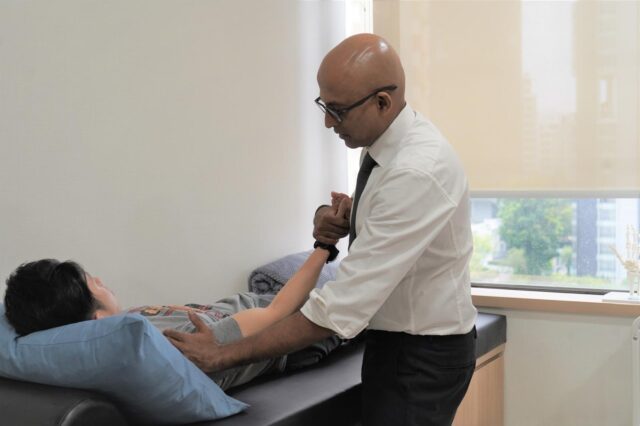
The rotator cuff is made up of four muscles — supraspinatus, infraspinatus, teres minor and subscapularis — whose tendons keep the shoulder stable while allowing smooth movement. The severity, and the right treatment, depend on which of these patterns is present.
Why does the rotator cuff become injured, and what causes it?
Rotator cuff problems develop from repeated tendon loading, age-related tendon changes, or a sudden injury such as a fall. In many people several factors combine rather than one single event.
- Repetitive overhead work or sport
- Swimming, throwing and racquet sports
- Weightlifting
- Falls or trauma
- Age-related tendon changes
- Altered shoulder movement patterns
What does a rotator cuff injury feel like?
It commonly causes shoulder pain on movement, weakness when lifting the arm, and discomfort with overhead activity. Pain at night when lying on the shoulder is common.
- Pain lifting the arm or reaching overhead
- Shoulder weakness
- Difficulty putting on clothing
- Night pain
- Clicking during movement
- Reduced shoulder strength
Are all rotator cuff tears the same?
No — and the type matters. Tendon irritation, a partial tear and a full-thickness tear behave differently and are managed differently. Many degenerative tears in older adults are managed well without surgery.
| Type | What it means | Usual first approach |
| Tendinopathy | Tendon irritation without a tear | Guided strengthening programme |
| Partial tear | Part of the tendon thickness is torn | Usually non-surgical first |
| Full-thickness tear | The tendon is torn all the way through | Depends on age, cause and demands |
Do I need surgery for a rotator cuff injury?
Not always. Many rotator cuff injuries — including a good proportion of tears, particularly age-related ones — improve with a guided non-surgical programme. Surgery has a clearer role for acute traumatic tears, larger tears in younger or high-demand shoulders, or when a good rehabilitation programme hasn’t restored function.
What are the best non-surgical treatments for a rotator cuff injury?
The foundation is a progressive shoulder strengthening and rehabilitation programme, supported where helpful by minimally invasive, ultrasound-guided procedures. Most people start here.
- Activity modification
- A progressive strengthening and rehabilitation programme
- Mobility work
- Education about shoulder mechanics
- Image-guided corticosteroid or PRP injection where appropriate
- Barbotage (ultrasound-guided needling) and shockwave therapy for calcific rotator cuff tendinopathy
- Percutaneous ultrasonic tenotomy (Tenex) for selected calcific or degenerative tendon changes
- Sports ultrasound assessment to confirm the diagnosis and guide treatment
Do I need a scan for a rotator cuff injury?
Not always. Diagnosis starts with your symptoms and examination. Sports ultrasound can assess the tendons during movement and guide treatment; MRI gives additional detail on tears when it is needed.
How long does a rotator cuff injury take to recover?
Tendon-related problems often improve over a few months with the right programme; recovery varies with the type of injury and your activity demands.
When should I see a doctor for a rotator cuff injury?
Seek assessment if shoulder pain persists, weakness develops, night pain disturbs sleep, or symptoms follow a fall. Sudden weakness after an injury warrants prompt review.
- Shoulder pain lasting several weeks
- Difficulty lifting the arm comfortably
- Night pain disturbing sleep
- Developing weakness
- Pain following a fall
- Frequent recurrences
- Increasingly limited movement
Worth assessing promptly
After a significant fall or injury, sudden and marked shoulder weakness — or being unable to lift the arm at all — should be assessed promptly, as some acute tears do better when treated earlier.
Frequently asked questions
Can a rotator cuff tear heal without surgery?
Many rotator cuff problems, including a good proportion of tears, improve with a guided programme; not every tear needs an operation.
Can I exercise with a rotator cuff injury?
Usually yes, with a guided programme. Strengthening is part of recovery rather than something to avoid.
Does a rotator cuff tear always need an MRI?
No. Ultrasound often provides the information needed, with MRI reserved for selected cases.
Is a rotator cuff tear the same as impingement?
They are related but not identical; assessment clarifies which is driving your symptoms.
Assessment at Triaxis Sports & Joint Clinic
Triaxis Sports & Joint Clinic provides assessment for a wide range of musculoskeletal and sports conditions affecting the shoulder, elbow, spine, hip, knee, ankle and other joints. Assessment focuses on understanding your symptoms, functional limitations, activity needs, medical history and goals.
Depending on the clinical findings, assessment may include movement analysis, a musculoskeletal examination, sports ultrasound where appropriate, and a discussion of suitable treatment options. Patient education and shared decision-making are central to the consultation, so you can understand your condition and the care options available to you.
Told you have a rotator cuff tear?
Not every tear needs surgery. Dr Sirisena offers assessment, sports ultrasound and minimally invasive, non-surgical treatment — and an honest view on when an operation is genuinely worth considering.
Triaxis Sports & Joint Clinic, Farrer Park Hospital · WhatsApp +65 8889 3594 · hello@triaxisclinic.sg · Repair · Restore · Reclaim
About the author
Written and medically reviewed by Dr Dinesh Sirisena, Consultant in Sports, Exercise & Musculoskeletal Medicine, and author of Ultrasound-Guided Musculoskeletal Procedures in Sports Medicine (Elsevier, 2021). Dr Sirisena focuses on the non-surgical and image-guided treatment of musculoskeletal and sports injuries.