Back Pain: Causes, Symptoms and Treatment Options
Written and medically reviewed by Dr Dinesh Sirisena · Consultant in Sports, Exercise & Musculoskeletal Medicine · Triaxis Sports & Joint Clinic
In short: Back pain is extremely common and, in the large majority of cases, improves without surgery. It can come from muscles, joints, discs or nerves, but often no single structure is to blame — and scan findings frequently don’t match the pain. Most people recover best by staying gently active, following a guided programme, and addressing the factors driving their symptoms. A small number of warning signs need urgent attention.
Key points at a glance
- Back pain is one of the most common conditions in adults and usually improves without surgery.
- It can arise from several structures, and imaging findings often don’t explain the pain.
- Staying gently active generally helps more than bed rest.
- A few warning signs (below) need urgent medical attention.
- Most people benefit from a guided programme rather than a scan or an operation.
When to seek urgent medical care
Seek urgent medical care if back pain occurs together with any of the following: loss of bladder or bowel control; numbness around the groin, buttocks or inner thighs; progressive weakness or numbness in the legs; fever or unexplained weight loss; or pain following a significant injury. These situations are uncommon, but they need to be checked straight away.
What is back pain?
Back pain is discomfort affecting the spine and the muscles, joints, discs, ligaments or nerves around it. It can occur anywhere from the upper to the lower back and ranges from short-lived stiffness to more persistent pain. It is a symptom, not a single diagnosis.
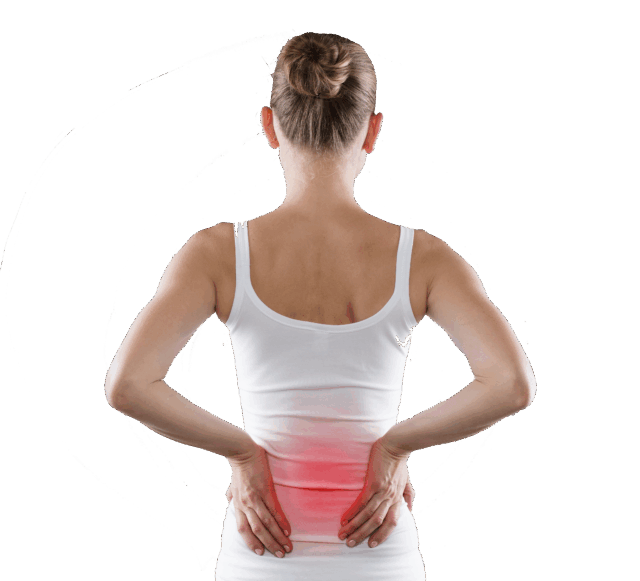
Because several structures can produce similar symptoms, understanding the pattern of your pain often matters more than any single label.
What causes back pain, and why does it happen?
Back pain usually develops when the spine’s muscles, joints or discs are loaded more than they can comfortably handle, or with age-related changes. In many people several factors combine, and often no single cause can be pinpointed.
- Muscle or ligament strain
- Disc-related changes
- Facet joint irritation
- Age-related changes
- Sport — running, golf, rowing, weightlifting and others
- Occupational factors — prolonged sitting, repetitive lifting, manual handling
- A sudden increase in activity
Reassuringly, the fact that a cause can’t always be named does not mean the pain can’t be treated.
Is my back-pain caused by a disc?
Often, no. Disc bulges and age-related disc changes appear on the scans of large numbers of people with no pain at all, so a disc finding may be a bystander rather than the cause. Most back pain is treatable without targeting a disc.
This is why effective care looks at you and your symptoms, not just the scan. You can read more on our pages explaining what a disc finding really means.
What does back pain feel like, and where is it felt?
Back-pain may feel like stiffness, aching, muscle tightness or sharp pain on movement, and it can affect the upper, middle or lower back — most commonly the lower back. The pattern often guides assessment.
- Localised aching or stiffness
- Pain on bending or standing
- Stiffness after sitting, or in the morning
- Muscle spasm
- Pain spreading into the buttock
- Pain, tingling or numbness into a leg when a nerve is irritated
Should I get a scan for my back-pain?
Not usually, at least early on. For most back-pain an early scan does not change treatment, and it can even be unhelpful — because it often shows normal age-related changes that aren’t the source of the pain. Imaging is reserved for when there are warning signs or when it would change management.
When imaging is needed, it is interpreted alongside your examination rather than in isolation.
What are the best treatments for backache?
Most back pain is best managed by staying gently active and following a guided programme, supported by good pain control while symptoms settle. The aim is to keep you moving and rebuild capacity and confidence.
- Staying active and avoiding prolonged bed rest
- A guided exercise and rehabilitation programme
- Pain relief where needed
- Education and reassurance
- Addressing contributing factors — load, work setup, conditioning
- Image-guided facet joint injections or medial branch blocks where the facet joints are the confirmed source
- Image-guided nerve root (epidural or transforaminal) injections for persistent nerve-related leg pain
- Image-guided sacroiliac joint injections where that joint is the source
- Prolotherapy or PRP for selected ligament and joint problems, as part of a complete treatment programme
- Sports ultrasound for selected soft-tissue causes
Can an injection help my back or leg pain?
For persistent leg pain from an irritated nerve, an image-guided nerve root injection can reduce pain and support rehabilitation. Where the facet joints or the sacroiliac joint are the source, precisely targeted image-guided injections can help, and prolotherapy or PRP is an option for selected ligament-related pain. These are options within a broader plan, not a first step for most simple back pain.
Do I need surgery for back pain?
Surgery is not needed for most back pain. The large majority of people improve without an operation, and surgery is considered for specific problems — such as certain nerve-related conditions or the warning-sign situations above — rather than for back pain in general.
How long does back pain last, and can it improve?
Many episodes of back pain settle within weeks. Some people have recurring symptoms, which is common and usually manageable with the right approach.
Staying active, following rehabilitation where recommended, and addressing contributing factors all support long-term spinal health.
When should I seek assessment for back pain?
Seek assessment if back pain persists for several weeks, keeps recurring, limits your activities, disturbs sleep, or is associated with leg symptoms. Seek urgent care for any of the warning signs listed above.
- Symptoms lasting several weeks
- Pain interfering with work or sport
- Pain travelling into the leg
- Tingling or numbness
- Disturbed sleep
- Pain after an injury
- No improvement with self-management

Frequently asked questions
Can I have a disc bulge with no pain?
Yes. Disc bulges are common in people with no back pain at all, which is why a scan finding doesn’t always explain symptoms.
Should I rest or stay active with back pain?
Staying gently active is usually better than bed rest, which can slow recovery.
Will my back pain come back?
Recurrences are common and usually manageable; staying active and conditioned reduces the likelihood.
Do I need an MRI for back pain?
Often not, especially early on, unless there are warning signs or it would change your treatment.
Assessment at Triaxis Sports & Joint Clinic
Triaxis Sports & Joint Clinic provides assessment for a wide range of musculoskeletal and sports conditions affecting the shoulder, elbow, spine, hip, knee, ankle and other joints. Assessment focuses on understanding your symptoms, functional limitations, activity needs, medical history and goals.
Depending on the clinical findings, assessment may include movement analysis, a musculoskeletal examination, sports ultrasound where appropriate, and a discussion of suitable treatment options. Patient education and shared decision-making are central to the consultation, so you can understand your condition and the care options available to you.
Back pain that isn’t settling — or being pushed toward surgery?
Most back pain improves without an operation. Dr Sirisena offers non-surgical assessment that maps out the full range of options before any major decision.
Triaxis Sports & Joint Clinic, Farrer Park Hospital · WhatsApp +65 8889 3594 · hello@triaxisclinic.sg · Repair · Restore · Reclaim
About the author
Written and medically reviewed by Dr Dinesh Sirisena, Consultant in Sports, Exercise & Musculoskeletal Medicine, and author of Ultrasound-Guided Musculoskeletal Procedures in Sports Medicine (Elsevier, 2021). Dr Sirisena focuses on the non-surgical and image-guided treatment of musculoskeletal and sports injuries.